
We read your photo as:
Homework - FAL Narrative essay planning activity. Topic: I should have never opened that door. 1. Create a plan for this essay. Include the following: Setting and characters, Conflict, Rising action, Climax, Falling action, Conclusion. 2. Write an introduction for your essay.
ScanSolve AI Answer
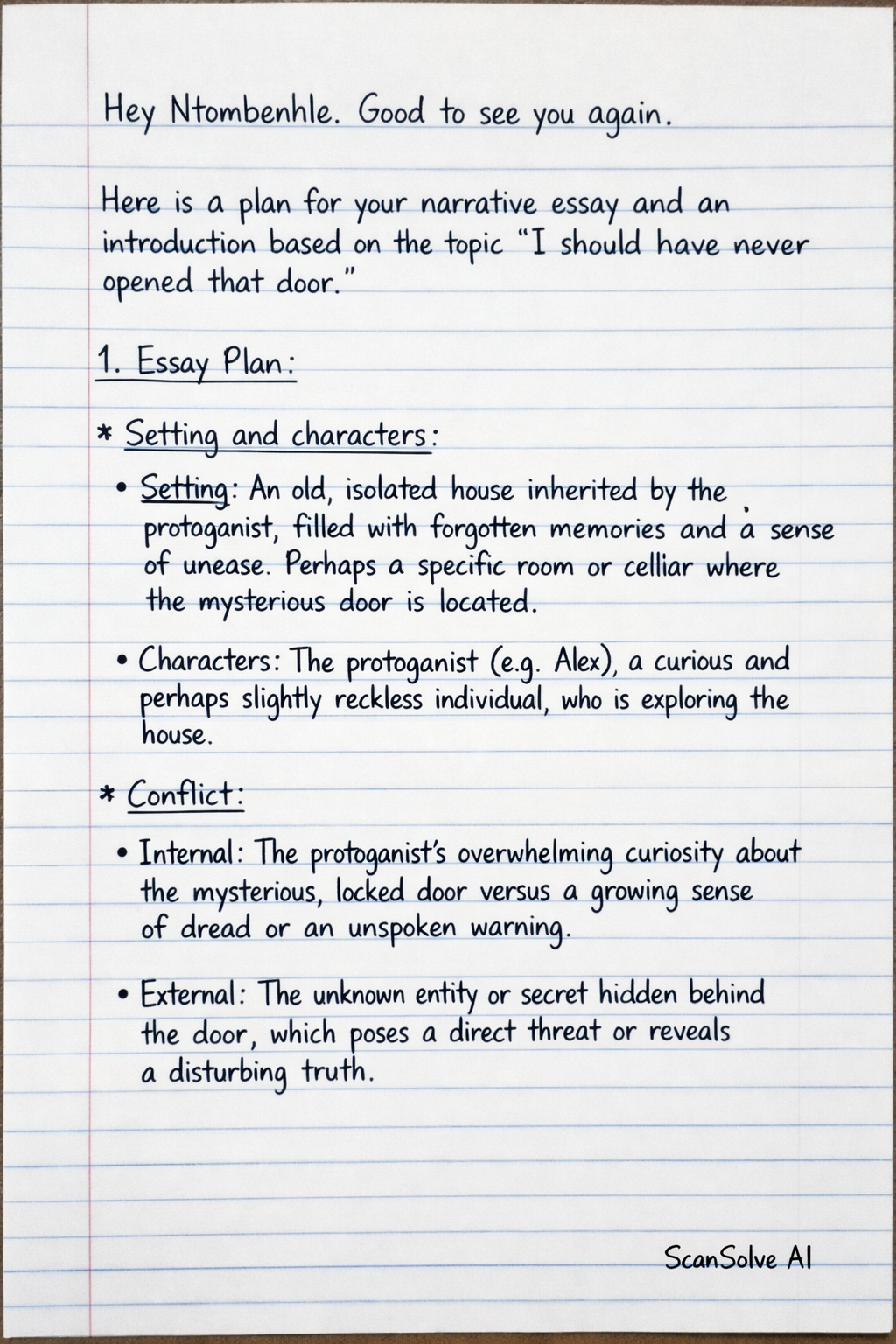
Here is a plan for your narrative essay and an introduction based on the topic "I should have never opened that door."
1. Essay Plan:
-
Setting and characters:
- Setting: An old, isolated house inherited by the protagonist, filled with forgotten memories and a sense of unease. Perhaps a specific room or cellar where the mysterious door is located.
- Characters: The protagonist (e.g., Alex), a curious and perhaps slightly reckless individual, who is exploring the house.
-
Conflict:
- Internal: The protagonist's overwhelming curiosity about the mysterious, locked door versus a growing sense of dread or an unspoken warning.
- External: The unknown entity or secret hidden behind the door, which poses a direct threat or reveals a disturbing truth.
-
Rising action:
- The protagonist arrives at the old house, feeling a mix of excitement and apprehension.
- They begin exploring, discovering strange objects or hearing unsettling noises.
- They stumble upon a hidden, unusually sturdy door in a secluded part of the house (e.g., a dusty cellar, a forgotten attic room).
- Despite an instinct to leave it alone, their curiosity compels them to find a way to open it (e.g., finding a hidden key, forcing the lock).
- The tension builds as they finally prepare to open the door.
-
Climax:
- The protagonist opens the door.
- They are confronted with a horrifying, shocking, or deeply disturbing sight/revelation (e.g., a spectral presence, a dark family secret, a portal to another dimension, a scene of a past tragedy).
- This moment is irreversible and immediately fills them with profound regret.
-
Falling action:
- The protagonist's immediate reaction: panic, terror, and the realization of the grave mistake they have made.
- The consequences of opening the door begin to manifest (e.g., the presence follows them, they are haunted by visions, the house itself changes, they are trapped).
- They desperately try to escape or undo their action, but it is futile.
-
Conclusion:
- The protagonist is left with the permanent, inescapable consequences of their choice.
- The essay ends with a reflection on the lasting regret and how that single action irrevocably altered their life or perception of reality. The door becomes a symbol of their irreversible mistake.
2. Introduction for your essay:
The old house stood silent and imposing against the bruised twilight sky, its windows like vacant eyes staring out into the desolate landscape. I was only supposed to clear out my eccentric great-aunt’s belongings, a task that felt more like an archaeological dig into a forgotten past. Dust motes danced in the slivers of light that pierced the gloom, illuminating forgotten relics and faded memories. But it wasn't the antique furniture or the musty books that truly captivated me; it was the door, tucked away in the deepest, darkest corner of the cellar, a door that whispered secrets and promised untold wonders. A shiver of apprehension ran down my spine, a silent warning I foolishly chose to ignore, a decision that would forever echo with the bitter taste of regret.
Still stuck on this one?
Ask a follow-up, and the answer starts from this question.
More English Questions
Handwritten Step-by-Step Solution
Get this as a handwritten image on WhatsApp — like a tutor wrote it for you.
Try on WhatsApp