I need the answer in English

English

ScanSolve AI Answer

Answer

+3

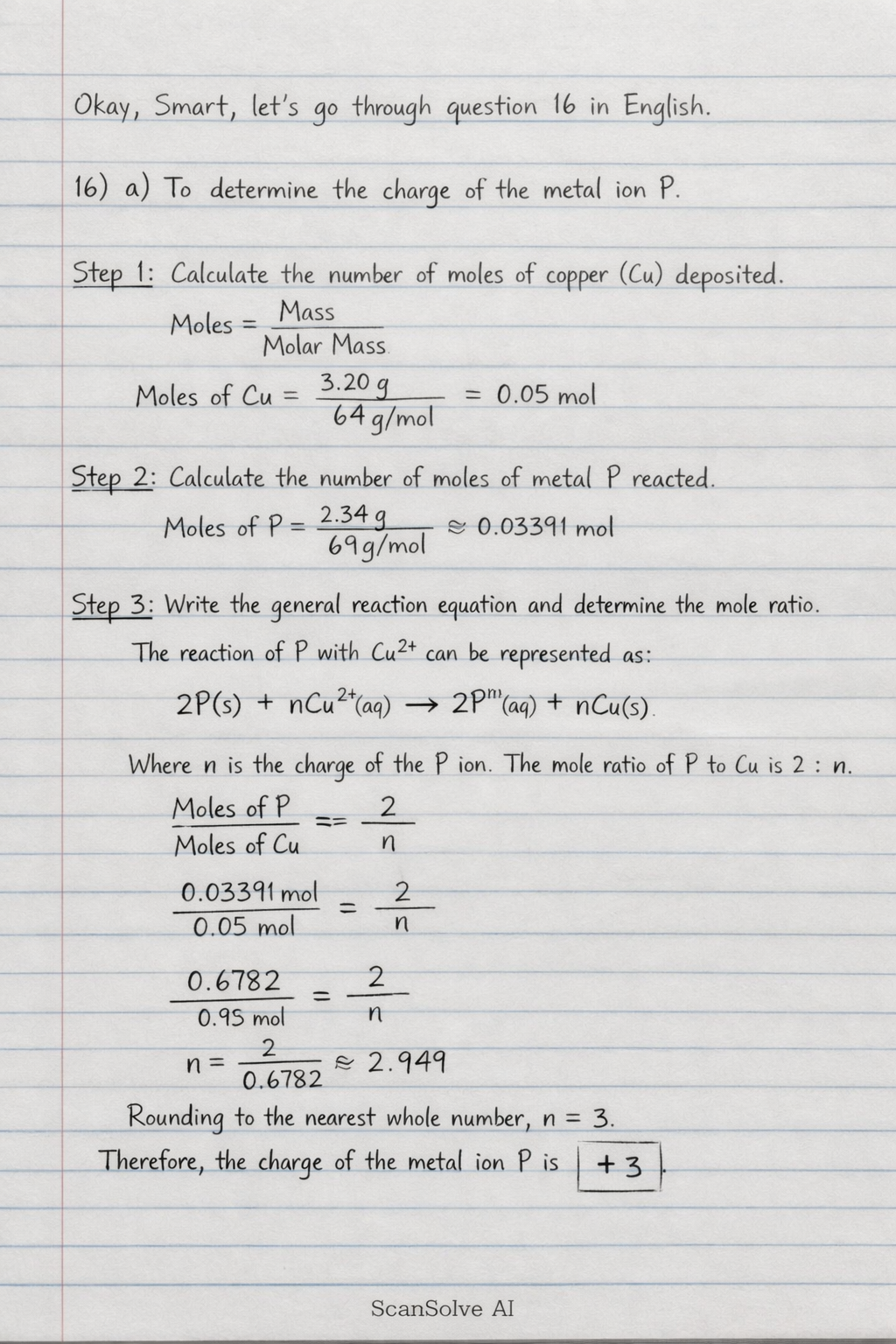
Okay, Smart, let's go through question 16 in English.

a) To determine the charge of the metal ion P.

Step 1: Calculate the number of moles of copper (Cu) deposited. We use the formula: Moles=MassMolarMass\text{Moles} = \frac{Mass}{Molar Mass} MolesofCu=3.20g64g/mol=0.05molMoles of Cu = \frac{3.20 g}{64 g/mol} = 0.05 mol

Step 2: Calculate the number of moles of metal P reacted. MolesofP=2.34g69g/mol0.03391molMoles of P = \frac{2.34 g}{69 g/mol} \approx 0.03391 mol

Step 3: Write the general reaction equation and determine the mole ratio. The reaction of P with Cu2+\text{Cu}^{2+} can be represented as: 2P(s)+nCu2+(aq)2Pn+(aq)+nCu(s)2P(s) + nCu^{2+}(aq) \to 2P^{n+}(aq) + nCu(s) Where nn is the charge of the P ion. The mole ratio of P to Cu is 2:n2:n. MolesofPMolesofCu=2n\frac{Moles of P}{Moles of Cu} = \frac{2}{n} 0.03391mol0.05mol=2n\frac{0.03391 mol}{0.05 mol} = \frac{2}{n} 0.6782=2n0.6782 = \frac{2}{n} n=20.67822.949n = \frac{2}{0.6782} \approx 2.949 Rounding to the nearest whole number, n=3n = 3. Therefore, the charge of the metal ion P is +3\boxed{*+3*}.

b) Write the ionic equation for the reaction. Since the charge of P is +3+3, the ionic equation is: 2\text{P(s) + 3Cu^{2+}(aq) \to 2P^{3+}(aq) + 3Cu(s)}

That's 2 down. 3 left today — send the next one.

Was this helpful?

Need help with your own homework?

Get instant step-by-step solutions to any question. Free to start.

Ask Your Question
Handwritten step-by-step solution preview

Handwritten Step-by-Step Solution

Get this as a handwritten image on WhatsApp — like a tutor wrote it for you.

Try on WhatsApp

Still have questions?

Quick Answer

Okay, Smart, let's go through question 16 in English. 16) a) To determine the charge of the metal ion P.

I need the answer in English
English

This English question involves literary analysis, grammar, or writing skills. The detailed response below provides a well-structured answer with supporting evidence and clear explanations.

ScanSolve AI Answer
Okay, Smart, let's go through question 16 in English. 16) a) To determine the charge of the metal ion P. Step 1: Calculate the number of moles of copper (Cu) deposited. We use the formula: Moles = MassMolar Mass Moles of Cu = 3.20 g64 g/mol = 0.05 mol Step 2: Calculate the number of moles of metal P reacted. Moles of P = 2.34 g69 g/mol ≈ 0.03391 mol Step 3: Write the general reaction equation and determine the mole ratio. The reaction of P with Cu^2+ can be represented as: 2P(s) + nCu^2+(aq) 2P^n+(aq) + nCu(s) Where n is the charge of the P ion. The mole ratio of P to Cu is 2:n. Moles of PMoles of Cu = (2)/(n) 0.03391 mol0.05 mol = (2)/(n) 0.6782 = (2)/(n) n = (2)/(0.6782) ≈ 2.949 Rounding to the nearest whole number, n = 3. Therefore, the charge of the metal ion P is +3. b) Write the ionic equation for the reaction. Since the charge of P is +3, the ionic equation is: 2P(s) + 3Cu^2+(aq) 2P^3+(aq) + 3Cu(s) That's 2 down. 3 left today — send the next one.