
We read your photo as:
How to i plot a graph and calculate slope?
English
ScanSolve AI Answer
Answer
Step-by-step solution
3 stepsPlotting the Graph
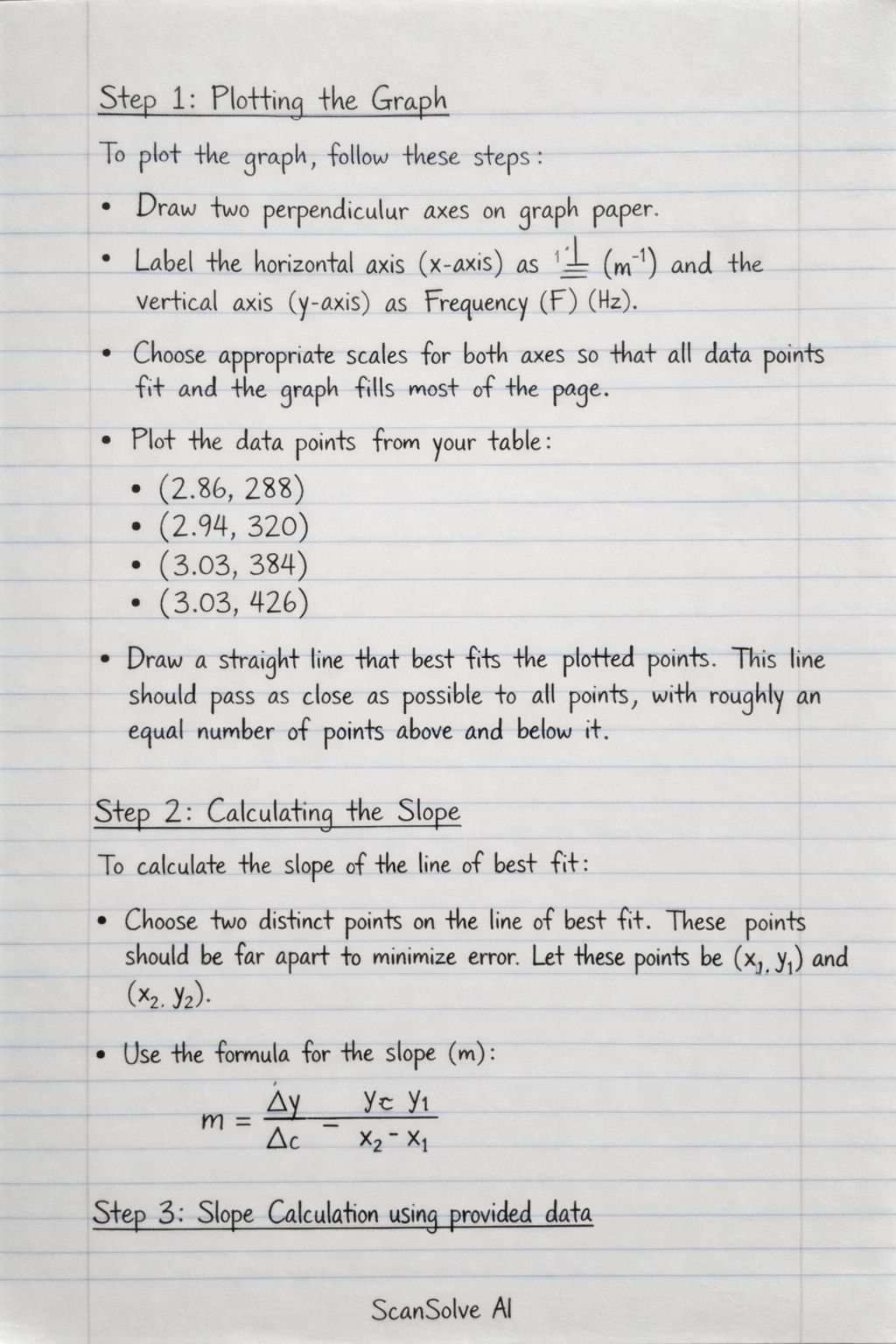
To plot the graph, follow these steps:
- Draw two perpendicular axes on graph paper.
- Label the horizontal axis (x-axis) as " (m)" and the vertical axis (y-axis) as "Frequency () (Hz)".
- Choose appropriate scales for both axes so that all data points fit and the graph fills most of the page.
- Plot the data points from your table:
- Draw a straight line that best fits the plotted points. This line should pass as close as possible to all points, with roughly an equal number of points above and below it.
Calculating the Slope
To calculate the slope of the line of best fit:
- Choose two distinct points on the line of best fit. These points should be far apart to minimize error. Let these points be and .
- Use the formula for the slope ():
Slope Calculation using provided data
Since a line of best fit cannot be drawn here, we will calculate the slope using the first data point and an average of the last two data points (due to the repeated x-value) to represent the trend.
The points used for calculation are:
Point 1:
Point 2:Now, substitute these values into the slope formula:
The calculated slope is approximately .
Was this helpful?
Try one yourself
A new problem that tests the same skill.
Still stuck on this one?
Ask a follow-up, and the answer starts from this question.
Got a different question?Ask your own question
More English Questions
Handwritten Step-by-Step Solution
Get this as a handwritten image on WhatsApp — like a tutor wrote it for you.
Try on WhatsApp