
I want in english
ScanSolve AI Answer
Step-by-step solution
12 stepsHere are the answers to your questions:
1. Represent on a number line.
is a negative rational number that lies between 0 and .
Divide the segment between 0 and on the number line into 4 equal parts.
The third point to the left of 0 will represent .
2. Write in the form .
Any integer can be expressed in the form where and .
Write the given integers in the form
3. Guess my number: Your friend picks an integer between 0 and 100. You have to find that number, but your friend can only answer 'yes' or 'no'. What strategy would you use?
The most effective strategy for solving this type of problem is binary search or the halving strategy.
First, ask if the number is greater than 50.
Based on the answer, halve the possible range of the number.
For example, if the answer is 'yes', the number is between 51 and 100; if 'no', the number is between 0 and 50.
Continue this process, always asking about the middle of the current range, until the number is found.
With each question, the number of possible values is halved, making it quick to pinpoint the exact number.
4. Are the following statements true? Give reasons with examples for your answers.
i. Every rational number is an integer.This statement is false.
A rational number is any number that can be expressed in the form , where and are integers and .
An integer is a whole number (e.g., ).
For example, is a rational number, but it is not an integer.
Similarly, and are also rational numbers that are not integers.
Still stuck on this one?
Ask a follow-up, and the answer starts from this question.
More English Questions
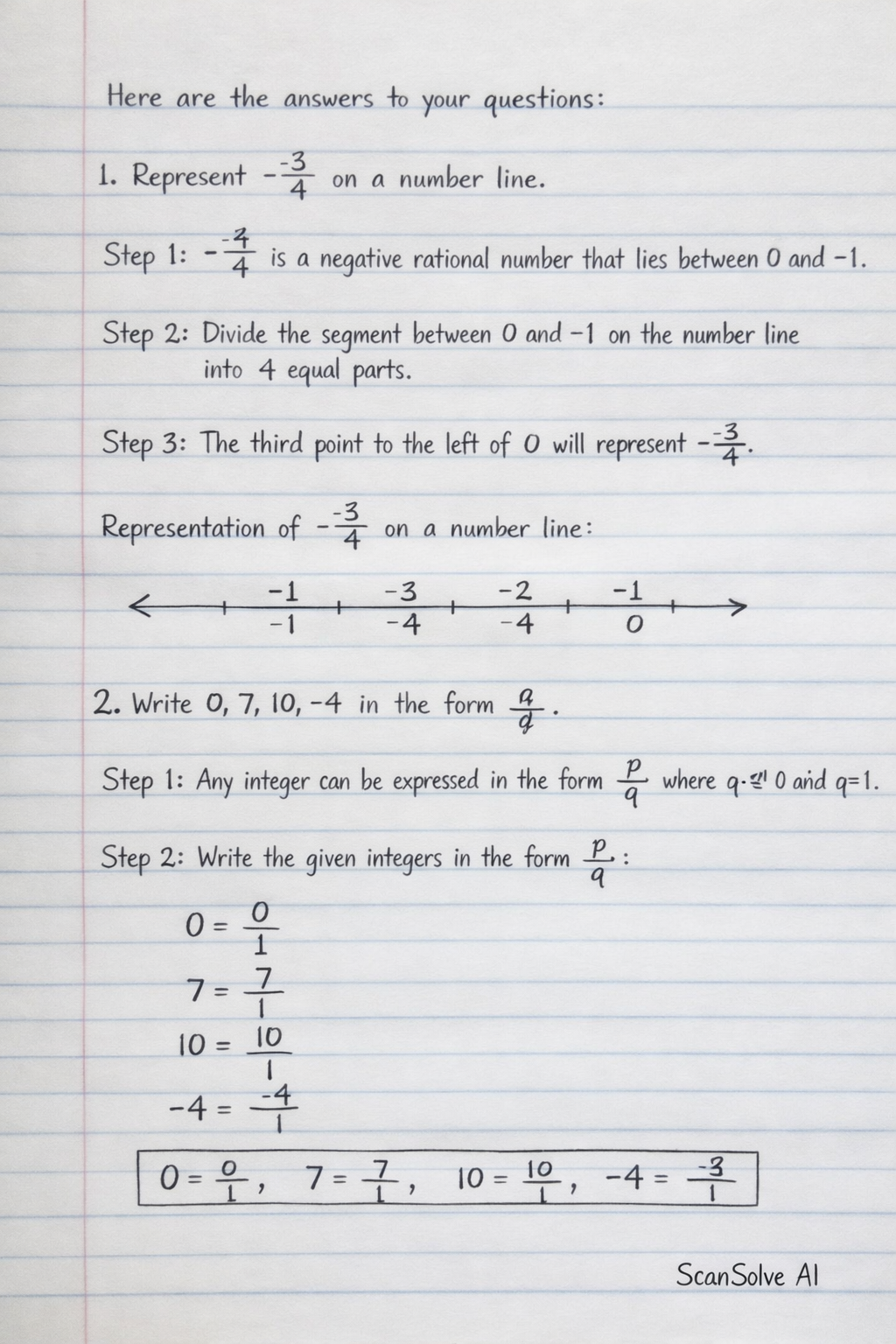
Handwritten Step-by-Step Solution
Get this as a handwritten image on WhatsApp — like a tutor wrote it for you.
Try on WhatsApp