
We read your photo as:
I want the work in English
ScanSolve AI Answer
Step-by-step solution
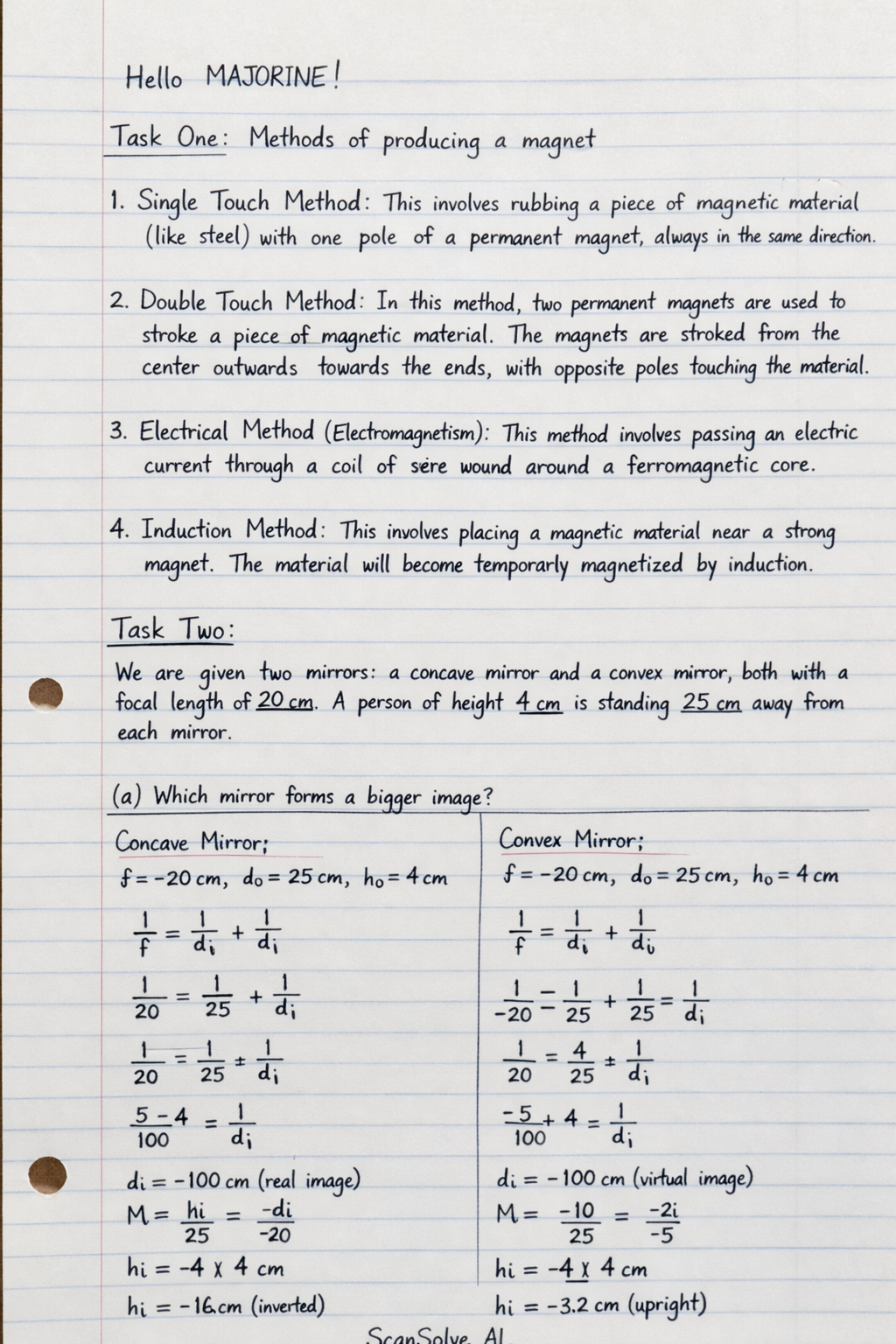
5 stepsTask One: Methods of producing a magnet
Here are different methods to produce a magnet:
- Single Touch Method: This involves rubbing a piece of magnetic material (like steel) with one pole of a permanent magnet, always in the same direction.
- Double Touch Method: In this method, two permanent magnets are used to stroke a piece of magnetic material. The magnets are stroked from the center outwards towards the ends, with opposite poles touching the material.
- Electrical Method (Electromagnetism): This method involves passing an electric current through a coil of wire wound around a ferromagnetic core.
- Induction Method: This involves placing a magnetic material near a strong magnet. The material will become temporarily magnetized by induction.
Task Two:
We are given two mirrors: a concave mirror and a convex mirror, both with a focal length of . A person of height is standing away from each mirror.
Part a· 2 steps
**Which mirror forms a bigger image?
Given Data:
Object height,
Object distance,
Focal length of concave mirror,
Focal length of convex mirror, (for a convex mirror, is negative)
Calculate the image distance () and image height () for the concave mirror.
We use the mirror formula:
Magnification,
Image height,
h_{ic} = M_c \times h_o = -4 \times 4 \text{ cm} = -16 \text{ cm} $$
The magnitude of the image size is
16 \text{ cm}$. The negative sign indicates an inverted image.Step 2: Calculate the image distance () and image height () for the convex mirror.
We use the mirror formula:Magnification,
Image height,
h_{ix} = M_x \times h_o = \frac{4}{9} \times 4 \text{ cm} = \frac{16}{9} \text{ cm} \approx 1.78 \text{ cm} $$
The magnitude of the image size is approximately
1.78 \text{ cm}$. The positive sign indicates an upright image.Compare the image heights.
The image height from the concave mirror is .
The image height from the convex mirror is .Conclusion:
The mirror that forms a bigger image is the concave mirror.
Part b· 3 steps
**Write a brief report about the nature of the image formed by each mirror and advise which mirror is suitable for use as a driving mirror.
Characteristics of the image formed by a concave mirror.
For an object placed from a concave mirror with (i.e., the object is between F and C):
- The image is real.
- The image is inverted.
- The image is magnified.
- The image is formed in front of the mirror, beyond the center of curvature (C).
Characteristics of the image formed by a convex mirror.
For any real object placed in front of a convex mirror:
- The image is virtual.
- The image is erect (upright).
- The image is diminished (smaller).
- The image is formed behind the mirror, between the pole and the focus.
Advice on which mirror is suitable for use as a driving mirror.
A driving mirror needs to provide a wide field of view and form erect images so that objects appear in their correct orientation.
- Concave mirrors form inverted images when the object is far from the focus, which is unsuitable for driving. They also have a narrow field of view.
- Convex mirrors always form erect, diminished, and virtual images, and they provide a much wider field of view. This allows the driver to see a larger area behind the vehicle.
Therefore, a convex mirror is more suitable for use as a driving mirror.
Still stuck on this one?
Ask a follow-up, and the answer starts from this question.
More English Questions
Handwritten Step-by-Step Solution
Get this as a handwritten image on WhatsApp — like a tutor wrote it for you.
Try on WhatsApp