
We read your photo as:
Identify and describe the form of oral literature you have collected.
ScanSolve AI Answer
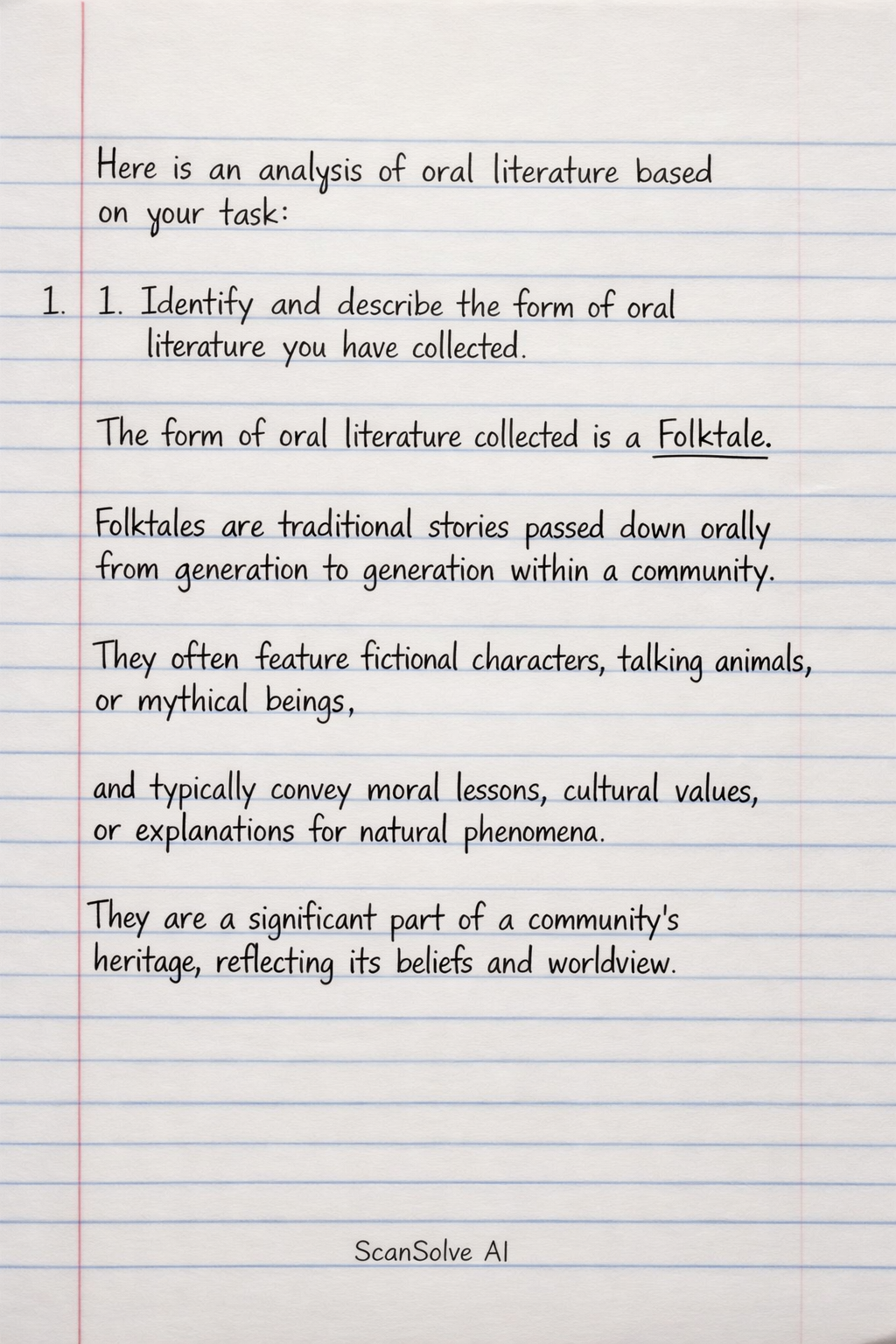
Here is an analysis of oral literature based on your task:
-
Identify and describe the form of oral literature you have collected. The form of oral literature collected is a Folktale. Folktales are traditional stories passed down orally from generation to generation within a community. They often feature fictional characters, talking animals, or mythical beings, and typically convey moral lessons, cultural values, or explanations for natural phenomena. They are a significant part of a community's heritage, reflecting its beliefs and worldview.
-
Present the item exactly as it is performed (when, where and by whom). Let's consider the folktale "The Tortoise and the Eagle's Feast."
- When: This story is typically performed in the evenings, after the day's work is done, often during moonlit nights or special community gatherings.
- Where: The performance usually takes place in a communal space, such as the village square, under a large shade tree, or within a family compound, with children and adults gathered in a circle.
- By whom: The story is told by an elder, often a grandmother or a respected community storyteller, who possesses a deep knowledge of the community's traditions and a captivating storytelling style. The storyteller uses gestures, facial expressions, and varying vocal tones to bring the characters to life, often engaging the audience with call-and-response phrases.
-
Analyse at least two features of oral literature evidenced in your example.
- Performance and Audience Participation: Oral literature, especially folktales, is not merely recited but performed. The storyteller uses dramatic pauses, changes in voice for different characters, and expressive body language to captivate the audience. The audience actively participates through call-and-response (e.g., "Story, story!" "Story come!"), repeating refrains, or interjecting comments, making the experience interactive and communal.
- Didacticism (Moral Lesson): Most folktales serve a didactic purpose, meaning they aim to teach a moral lesson or reinforce societal values. In "The Tortoise and the Eagle's Feast," the story often illustrates the dangers of greed, deceit, and selfishness, teaching listeners about the importance of honesty, humility, and community spirit.
-
Explain the importance of this item to the community. Folktales like "The Tortoise and the Eagle's Feast" are crucial for the community because they serve as a primary means of cultural transmission, passing down history, traditions, and social norms from elders to younger generations. They provide moral education, guiding children on acceptable behavior and the consequences of actions. Furthermore, storytelling sessions foster social cohesion by bringing community members together, strengthening bonds, and providing shared entertainment and a sense of collective identity.
-
Explain the challenges facing oral literature today and suggest possible solutions.
- Challenges: Oral literature faces significant threats from modernization and globalization, as younger generations are increasingly exposed to digital media and Western cultural influences, leading to a decline in interest in traditional storytelling. The loss of indigenous languages, which are often the medium for these stories, also poses a major challenge. Additionally, the passing of elders without adequate transmission of their knowledge to younger generations results in irreplaceable loss.
- Possible Solutions: To preserve oral literature, communities can implement documentation and archiving projects, recording and transcribing stories in both original languages and translations. Integrating oral literature into school curricula can ensure that younger generations learn and appreciate their heritage. Organizing regular community storytelling festivals and workshops can encourage active participation and transmission. Finally, leveraging modern technology like podcasts, videos, and digital platforms can help share these stories with a wider, younger audience, making them relevant in contemporary contexts.
Still stuck on this one?
Ask a follow-up, and the answer starts from this question.
More English Questions
Handwritten Step-by-Step Solution
Get this as a handwritten image on WhatsApp — like a tutor wrote it for you.
Try on WhatsApp