
We read your photo as:
Identify the adjective in the sentence, choose the correct auxiliary verb, and select the correct sentence structure.
ScanSolve AI Answer
Answer
Step-by-step solution
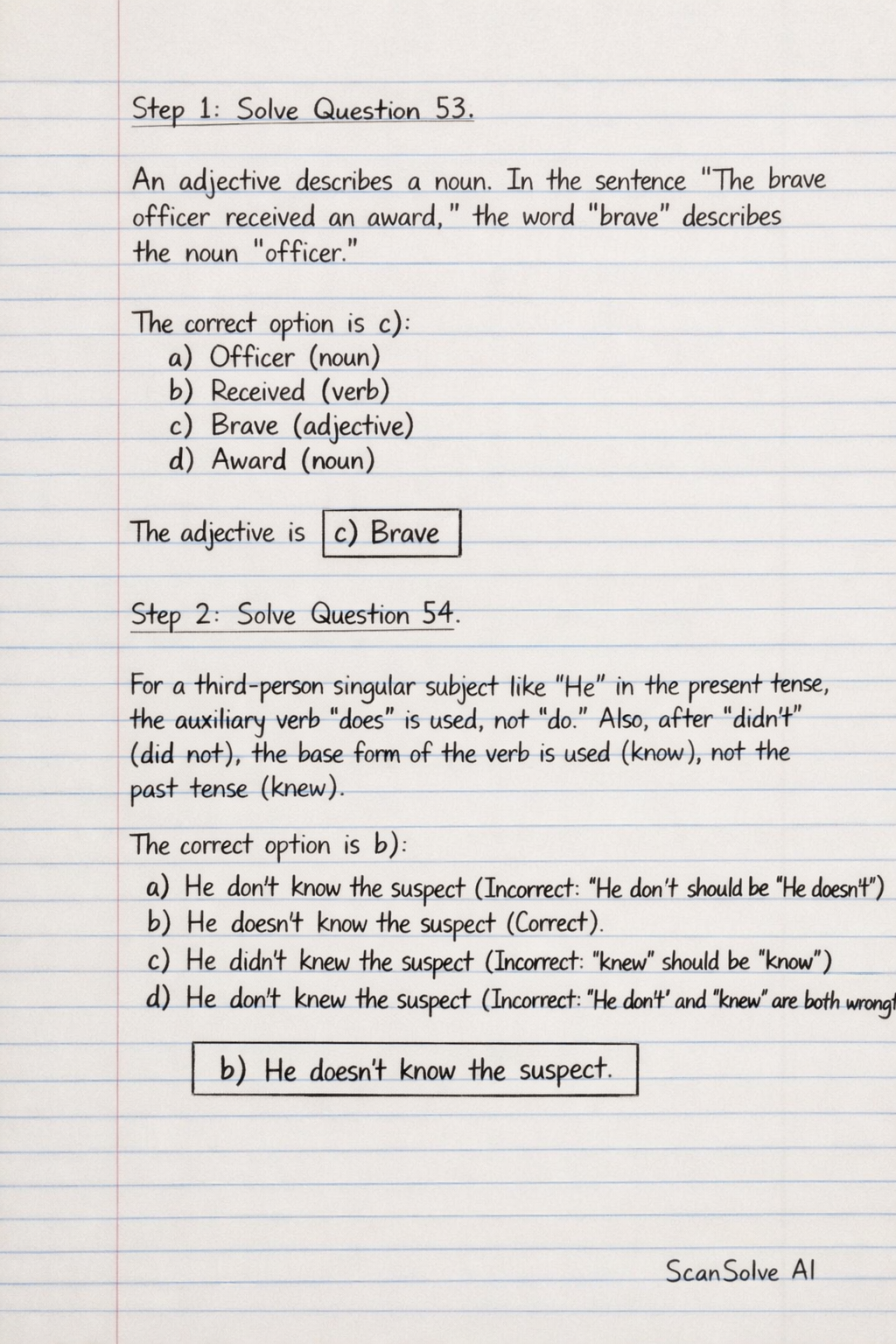
6 stepsSolve Question 53.
An adjective describes a noun. In the sentence "The brave officer received an award," the word "brave" describes the noun "officer."
The correct option is c).
- a) Officer (noun)
- b) Received (verb)
- c) Brave (adjective)
- d) Award (noun)
The adjective is .
Solve Question 54.
For a third-person singular subject like "He" in the present tense, the auxiliary verb "does" is used, not "do." Also, after "didn't" (did not), the base form of the verb is used (know), not the past tense (knew).
The correct option is b).
- a) He don't know the suspect (Incorrect: "He don't" should be "He doesn't")
- b) He doesn't know the suspect (Correct)
- c) He didn't knew the suspect (Incorrect: "knew" should be "know")
- d) He don't knew the suspect (Incorrect: "He don't" and "knew" are both wrong)
The correct sentence is .
Solve Question 55.
This question asks for the correct sentence structure. Among the given options, "The suspect was running" follows the standard subject-verb structure for a past continuous tense.
The correct option is c).
- a) Running the suspect was (Incorrect structure)
- b) The suspect running was (Incorrect structure)
- c) The suspect was running (Correct structure: Subject + auxiliary verb + present participle)
The correct sentence structure is .
Solve Question 56.
When reporting direct speech, a comma typically precedes the opening quotation mark, and the punctuation mark (like a period) goes inside the closing quotation mark. The first word of the direct speech is capitalized.
The correct option is c).
- a) The officer said stop. (Missing comma and quotation marks)
- b) The officer said, stop. (Missing quotation marks)
- c) The officer said, "Stop". (Correct punctuation)
- d) The officer said "Stop" (Missing comma before quote, period should be inside)
The correctly punctuated sentence is .
Solve Question 57.
For compound nouns like "commander-in-chief," the main noun is pluralized. In this case, "commander" is the main noun.
The correct option is b).
- a) Commander-in-chiefs (Incorrect: "chiefs" is pluralized instead of "commander")
- b) Commanders-in-chief (Correct: "commander" is pluralized)
- c) Commander-ins-chief (Incorrect)
- d) Commander-in-chiefes (Incorrect)
The plural of "commander-in-chief" is .
Solve Question 58.
This question asks for the odd word out. "Arrest," "detain," and "jail" all refer to holding someone in custody or restricting their freedom. "Release" means to set someone free.
The correct option is d).
- a) Arrest (To take into custody)
- b) Detain (To hold in custody)
- c) Jail (To imprison)
- d) Release (To set free)
The odd word out is .
Try one yourself
A new problem that tests the same skill.
Still stuck on this one?
Ask a follow-up, and the answer starts from this question.
More English Questions
Handwritten Step-by-Step Solution
Get this as a handwritten image on WhatsApp — like a tutor wrote it for you.
Try on WhatsApp