
We read your photo as:
Identify the function of the suffix or word in each sentence.
ScanSolve AI Answer
Answer
Step-by-step solution
19 stepsSolve question 21.
The suffix "-ly" is typically added to adjectives to form adverbs, which describe how an action is performed.
The correct option is C.Solve question 22.
The suffix "-er" is used to form the comparative degree of adjectives, comparing two things.
The correct option is D.Solve question 23.
The suffixes "-ness," "-ion," and "-tion/-sion" are all used to form nouns. The suffix "-es" is primarily used to form plural nouns or as a third-person singular verb ending, not to derive a noun from another word class.
The correct option is C.Solve question 24.
"Should" is used to give advice or make a recommendation.
The correct option is D.Solve question 25.
"Mustn't" expresses a strong prohibition or a rule that something is not allowed.
The correct option is B.Solve question 26.
"Don't have to" indicates that something is not necessary. Since the deadline is extended, rushing is not required.
The correct option is B.Solve question 27.
"Must" expresses a strong obligation or necessity.
The correct option is A.Solve question 28.
"Will" is used to express a future intention or a necessary action to achieve a goal.
The correct option is D.Solve question 29.
"Ought to" expresses a moral obligation or strong recommendation, similar to "should."
The correct option is B.Solve question 30.
"Which" is the correct relative pronoun to refer to a thing (the book).
The correct option is B.Solve question 31.
"Whose" is a possessive relative pronoun, indicating that the students belong to the teacher.
The correct option is C.Solve question 32.
"Where" is the correct relative adverb to refer to a place (the village).
The correct option is C.Solve question 33.
"Whom" is the object form of "who" and is used when the pronoun is the object of a verb or preposition (I consulted whom).
The correct option is D.Solve question 34.
"Who" is the subject form of the relative pronoun, referring to the teacher who performs the action of teaching.
The correct option is A.Solve question 35.
"Where" is the correct relative adverb to refer to a place (the vehicle) where an action occurred.
The correct option is B.Solve question 36.
"Whom" is the object of the preposition "to."
The correct option is B.Solve question 37.
The present perfect tense ("has lost") is used to describe an action that happened in the past but has a present result (she can't find them now).
The correct option is B.Solve question 38.
"Yet" is commonly used with the present perfect tense to indicate that something has not happened up to the present moment. "We" takes "have."
The correct option is A.Solve question 39.
"For" is used to specify a duration of time.
The correct option is C.
Try one yourself
A new problem that tests the same skill.
Still stuck on this one?
Ask a follow-up, and the answer starts from this question.
More English Questions
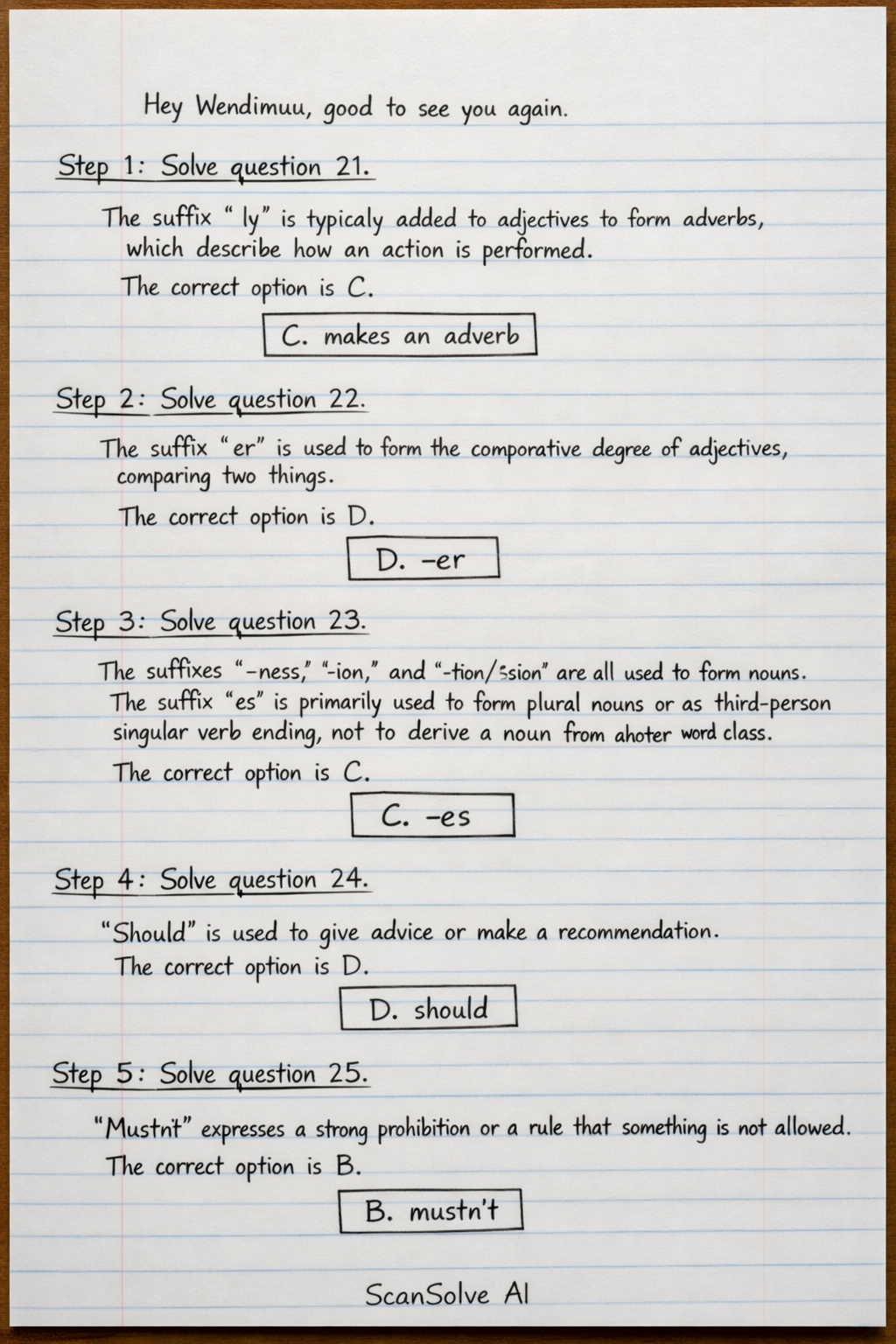
Handwritten Step-by-Step Solution
Get this as a handwritten image on WhatsApp — like a tutor wrote it for you.
Try on WhatsApp