
We read your photo as:
Identify the function of the suffix and choose the correct word/phrase for each sentence.
ScanSolve AI Answer
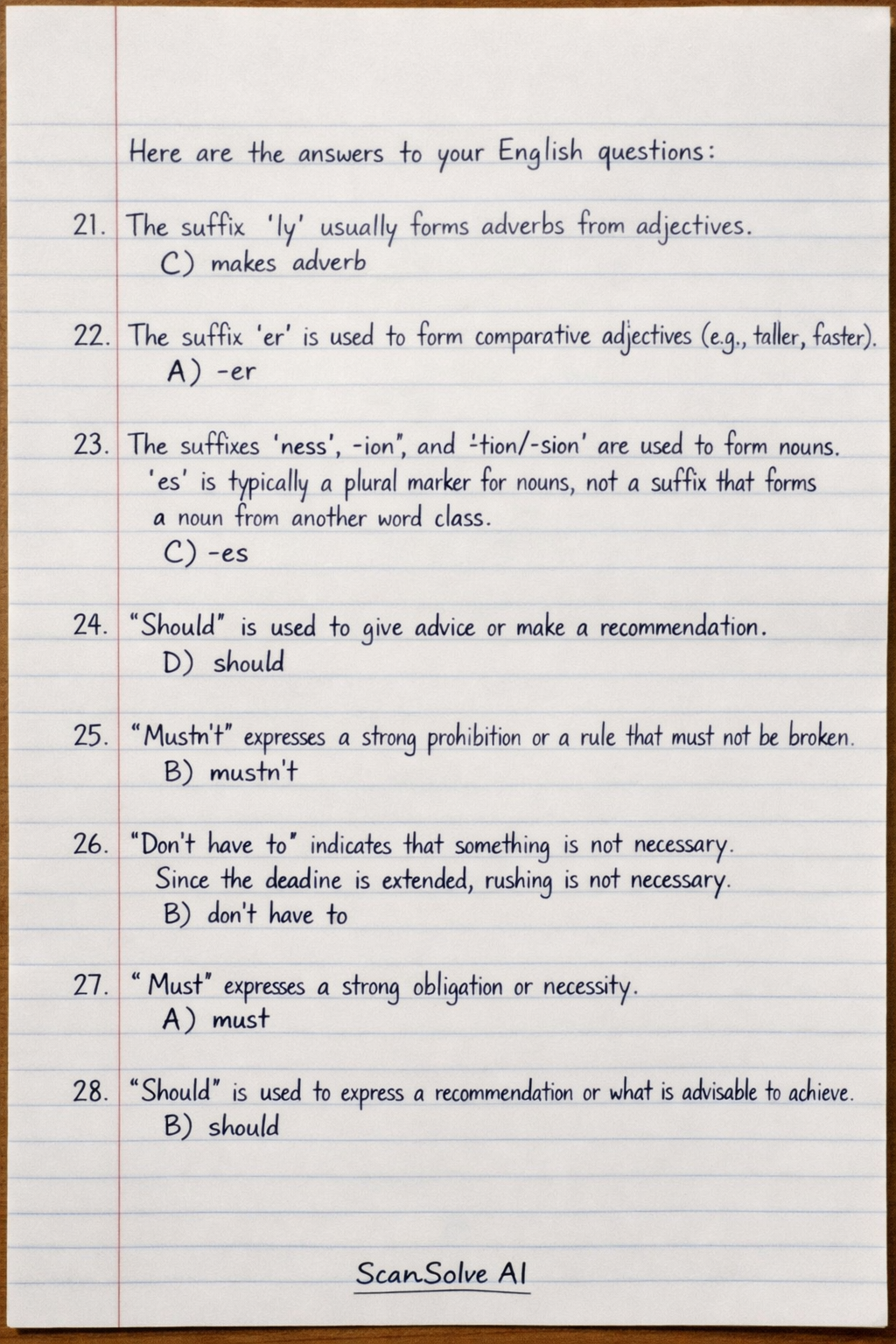
Here are the answers to your English questions:
-
The suffix '-ly' usually forms adverbs from adjectives.
- C) makes adverb
-
The suffix '-er' is used to form comparative adjectives (e.g., taller, faster).
- A) -er
-
The suffixes '-ness', '-ion', and '-tion/-sion' are used to form nouns. '-es' is typically a plural marker for nouns, not a suffix that forms a noun from another word class.
- C) -es
-
"Should" is used to give advice or make a recommendation.
- D) should
-
"Mustn't" expresses a strong prohibition or a rule that must not be broken.
- B) mustn't
-
"Don't have to" indicates that something is not necessary. Since the deadline is extended, rushing is not necessary.
- B) don't have to
-
"Must" expresses a strong obligation or necessity.
- A) must
-
"Should" is used to express a recommendation or what is advisable to achieve a goal.
- B) should
-
"Ought to" expresses a moral obligation or a strong recommendation, similar to "should" but often with a stronger sense of duty.
- B) ought to
-
Options A and B are identical and grammatically correct. "Which" is used to refer to things.
- A) The book which I borrowed from the library is very interesting.
-
"Whose" is used to show possession (the students belong to the teacher).
- C) whose
-
"Where" is used to refer to a place.
- C) where
-
"Whom" is the object of the verb "consulted" (I consulted him).
- D) whom
-
"Who" is the subject of the verb "teaches".
- A) who
-
"Where" refers to the place (the vehicle) where the gun was found.
- B) where the gun was found
-
"To whom" is correct because "whom" is the object of the preposition "to".
- B) to whom
-
The present perfect tense ("has lost") is used for an action that happened in the past but has a result relevant to the present (she can't find them now).
- B) has lost
-
"Yet" is commonly used with the present perfect tense in negative sentences to indicate that something has not happened up to the present moment.
- A) haven't eaten
-
"For" is used to specify a duration of time.
- C) for
Still stuck on this one?
Ask a follow-up, and the answer starts from this question.
More English Questions
Handwritten Step-by-Step Solution
Get this as a handwritten image on WhatsApp — like a tutor wrote it for you.
Try on WhatsApp