
We read your photo as:
III. Answer the following in one word or one sentence:
ScanSolve AI Answer
Step-by-step solution
2 stepsHere are the solutions to the questions:
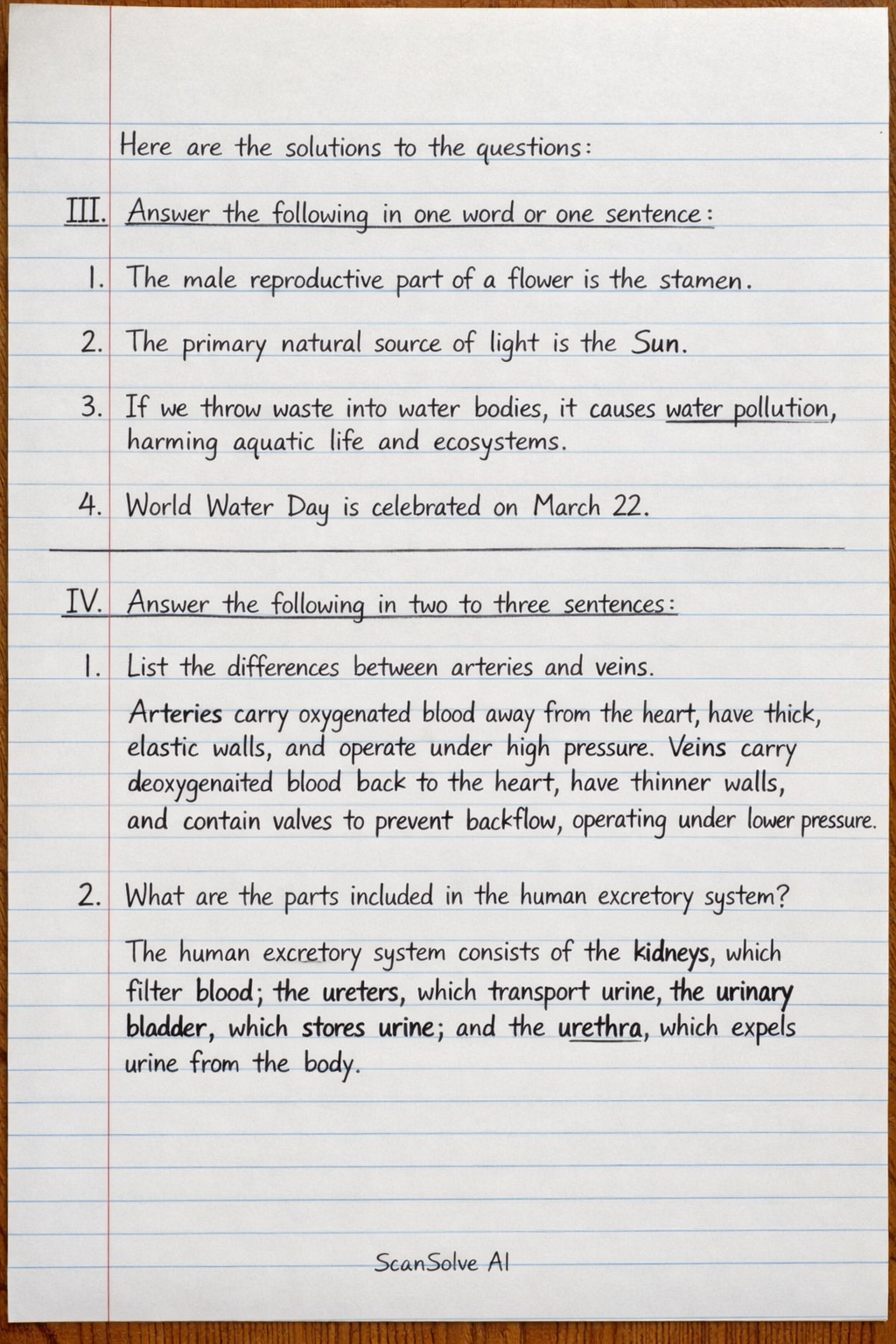
III. Answer the following in one word or one sentence:
- The male reproductive part of a flower is the stamen.
- The primary natural source of light is the Sun.
- If we throw waste into water bodies, it causes water pollution, harming aquatic life and ecosystems.
- World Water Day is celebrated on March 22.
IV. Answer the following in two to three sentences:
-
List the differences between arteries and veins.
- Arteries carry oxygenated blood away from the heart, have thick, elastic walls, and operate under high pressure. Veins carry deoxygenated blood back to the heart, have thinner walls, and contain valves to prevent backflow, operating under lower pressure.
-
What are the parts included in the human excretory system?
- The human excretory system consists of the kidneys, which filter blood; the ureters, which transport urine; the urinary bladder, which stores urine; and the urethra, which expels urine from the body.
-
Uniform motion is called effortless motion. Why?
- Uniform motion means an object moves at a constant velocity, covering equal distances in equal time intervals. According to Newton's first law, an object in uniform motion requires no net external force to maintain its state, making it seem "effortless" once initiated, as no additional push or pull is needed.
-
A bicycle travels 5 km in 20 minutes. What is its average speed?
Convert time to hours.
$$ 20 \text{ minutes} = \frac{20}{60} \text{ hours} = \frac{1}{3} \text{ hours} $$Calculate average speed using the formula .
$$ \text{Average speed} = \frac{5 \text{ km}}{1/3 \text{ h}} = 5 \times 3 \text{ km/h} = \boxed{\text{15 km/h}} $$5. Why is nichrome wire used in electric stoves? * Nichrome wire is used in electric stoves because it has high electrical resistance, which causes it to heat up significantly when current passes through it. It also has a high melting point and resists oxidation at high temperatures, ensuring durability and efficient heating.
-
List two devices that work based on the heating effect of electric current.
- Two devices that work based on the heating effect of electric current are electric heaters (e.g., room heaters, water heaters) and electric irons.
-
What is the use of a plane mirror?
- A plane mirror is used to produce virtual, erect, and laterally inverted images that are the same size as the object. They are commonly used for personal reflection, in periscopes, and in various optical instruments.
-
The image seen in a stainless steel plate is erect and of the same size as the object.
- This statement is true if the stainless steel plate is flat and highly polished, acting as a plane mirror. A plane mirror forms a virtual, erect image that is the same size as the object and appears to be as far behind the mirror as the object is in front.
-
As a responsible person, how can we reduce sewage waste?
- We can reduce sewage waste by minimizing water usage at home, avoiding flushing non-biodegradable items, and properly disposing of chemicals and oils. Supporting and implementing wastewater treatment and water recycling initiatives also significantly helps.
-
How can the impurities in sewage water be classified?
- Impurities in sewage water can be classified as organic impurities (e.g., human and animal waste, food waste, detergents) and inorganic impurities (e.g., nitrates, phosphates, metals, suspended solids like sand). They also include pathogens (bacteria, viruses).
V. Answer the following in four to five sentences:
-
Explain the role of forests in maintaining ecological balance.
- Forests are vital for maintaining ecological balance as they act as carbon sinks, absorbing carbon dioxide and releasing oxygen, which regulates global climate. They prevent soil erosion by anchoring soil with their root systems and contribute to the water cycle through transpiration, influencing rainfall. Furthermore, forests provide habitat for diverse species, supporting biodiversity and complex food webs, thus ensuring stable ecosystems and essential resources for life.
-
Draw a labeled diagram showing fertilization in plants.
- As an AI, I am unable to draw diagrams. However, I can describe the process of fertilization in plants:
- Fertilization in plants begins when a pollen grain lands on the stigma of a flower.
- The pollen grain then germinates, forming a pollen tube that grows down through the style towards the ovule in the ovary.
- Male gametes (sperm nuclei) travel down the pollen tube to reach the ovule.
- One male gamete fuses with the egg cell to form a zygote, which develops into an embryo.
- Another male gamete fuses with the central cell to form the endosperm, which provides nourishment to the developing embryo. This process is known as double fertilization in flowering plants.
- As an AI, I am unable to draw diagrams. However, I can describe the process of fertilization in plants:
-
Still stuck on this one?
Ask a follow-up, and the answer starts from this question.
More English Questions
Handwritten Step-by-Step Solution
Get this as a handwritten image on WhatsApp — like a tutor wrote it for you.
Try on WhatsApp