

This English question involves literary analysis, grammar, or writing skills. The detailed response below provides a well-structured answer with supporting evidence and clear explanations.
ScanSolve AI Answer
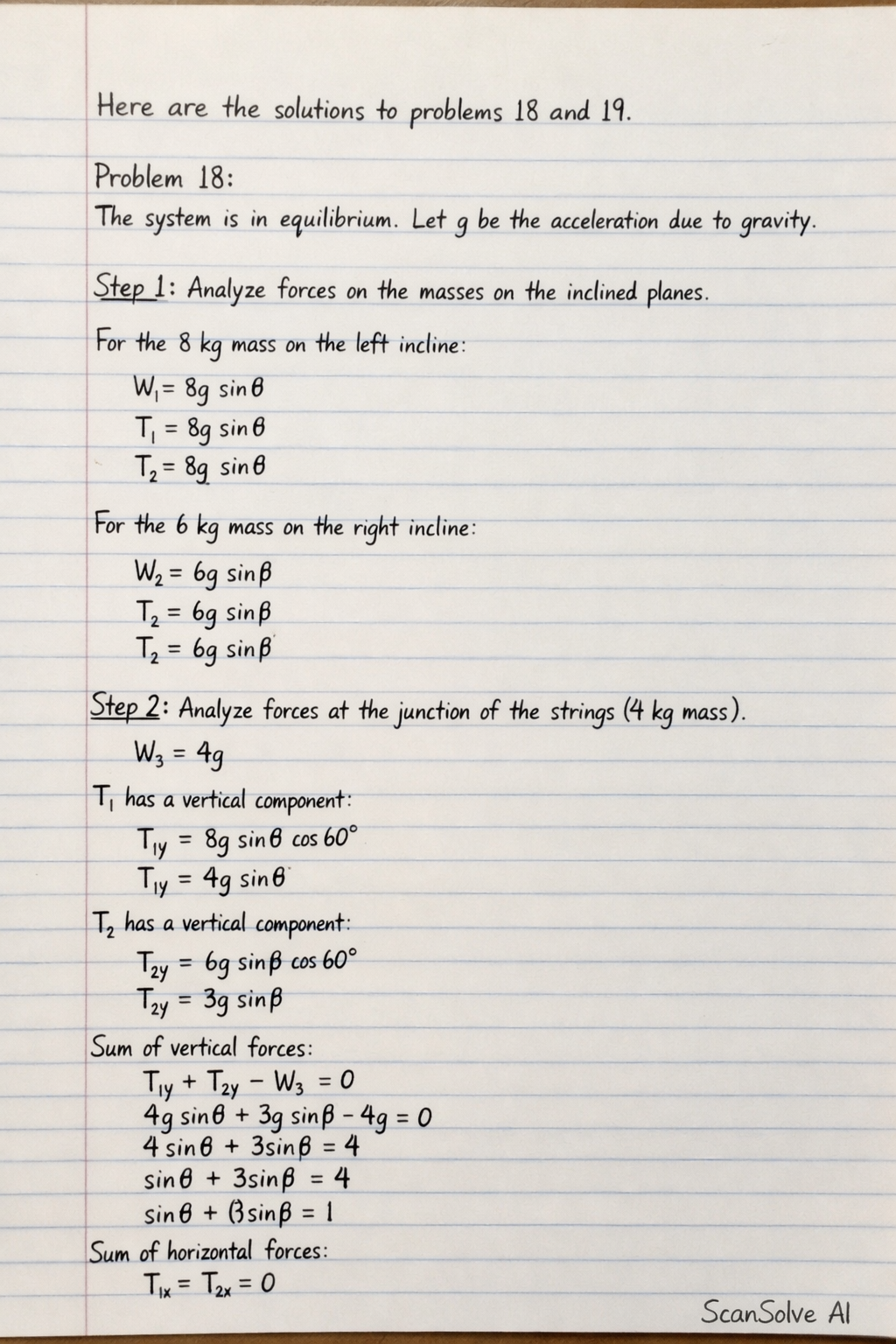
Here are the solutions to problems 18 and 19. Problem 18: The system is in equilibrium. Let g be the acceleration due to gravity. Step 1: Analyze forces on the masses on the inclined planes. For the 8 kg mass on the left incline: The component of weight acting down the incline is W_1 = 8g . The tension in the left string, T_1, acts up the incline. Since the mass is in equilibrium, T_1 = 8g . For the 6 kg mass on the right incline: The component of weight acting down the incline is W_2 = 6g . The tension in the right string, T_2, acts up the incline. Since the mass is in equilibrium, T_2 = 6g . Step 2: Analyze forces at the junction of the strings (4 kg mass). The 4 kg mass hangs freely, so its weight acts downwards: W_3 = 4g. The left string makes an angle of 60^ with the upward vertical. The right string makes an angle of 60^ with the upward vertical. For equilibrium, the sum of vertical forces is zero and the sum of horizontal forces is zero. Vertical equilibrium: T_1 (60^) + T_2 (60^) = 4g Since (60^) = (1)/(2): (1)/(2)T_1 + (1)/(2)T_2 = 4g T_1 + T_2 = 8g (Equation 1) Horizontal equilibrium: T_1 (60^) = T_2 (60^) Since (60^) ≠ 0, we can divide by it: T_1 = T_2 (Equation 2) Step 3: Solve for tensions T_1 and T_2. Substitute Equation 2 into Equation 1: T_1 + T_1 = 8g 2T_1 = 8g T_1 = 4g From Equation 2, T_2 = 4g. Step 4: Find and . Using the equilibrium condition for the 8 kg mass: T_1 = 8g 4g = 8g = (4g)/(8g) = (1)/(2) = ((1)/(2)) = 30^ Using the equilibrium condition for the 6 kg mass: T_2 = 6g 4g = 6g = (4g)/(6g) = (2)/(3) = ((2)/(3)) ≈ 41.8^ Problem 19: The system is in equilibrium. Let g be the acceleration due to gravity. Step 1: Analyze forces on masses A and B on the inclined planes. Both planes have an inclination of 30^. For mass A (m_A = 2m): The component of weight acting down the incline is W_A = m_A g (30^) = (2m)g((1)/(2)) = mg. The tension in the left string, T_A, acts up the incline. Since mass A is in equilibrium, T_A = mg. For mass B (m_B = m): The component of weight acting down the incline is W_B = m_B g (30^) = (m)g((1)/(2)) = (1)/(2)mg. The tension in the right string, T_B, acts up the incline. Since mass B is in equilibrium, T_B = (1)/(2)mg. Step 2: Analyze forces at the junction of the strings (mass C). Mass C (m_C = m) hangs freely, so its weight acts downwards: W_C = mg. The left string makes an angle with the upward vertical. The right string makes an angle with the upward vertical. For equilibrium, the sum of vertical forces is zero and the sum of horizontal forces is zero. Vertical equilibrium: T_A + T_B = W_C Substitute T_A = mg, T_B = (1)/(2)mg, and W_C = mg: mg + (1)/(2)mg = mg Divide by mg: + (1)/(2) = 1 Multiply by 2: 2 + = 2 This can be written as + 2 = 2, which matches the second relation to show. Horizontal equilibrium: T_A = T_B Substitute T_A = mg and T_B = (1)/(2)mg: mg = (1)/(2)mg Divide by mg: = (1)/(2) This can be written as 2 = . Note: The problem statement asks to show = 2. There is a discrepancy here. Based on the diagram and given masses, the correct relation is 2 = . We will use this derived relation to find and . Step 3: Solve for and using the derived relations. We have two equations: 1) 2 = 2) 2 + = 2 From (1), = 2. From (2), = 2 - 2. Using the trigonometric identity ^2 + ^2 = 1: (2)^2 + (2 - 2)^2 = 1 4^2 + (4 - 8 + 4^2) = 1 4(^2 + ^2) - 8 + 4 = 1 Since ^2 + ^2 = 1: 4(1) - 8 + 4 = 1 8 - 8 = 1 8 = 7 = (7)/(8) = ((7)/(8)) ≈ 29.0^ Now find using = 2 - 2: = 2 - 2((7)/(8)) = 2 - (14)/(8) = 2 - (7)/(4) = (8)/(4) - (7)/(4) = (1)/(4) = ((1)/(4)) ≈ 75.5^ 3 done, 2 left today. You're making progress.