

This English question involves literary analysis, grammar, or writing skills. The detailed response below provides a well-structured answer with supporting evidence and clear explanations.
ScanSolve AI Answer
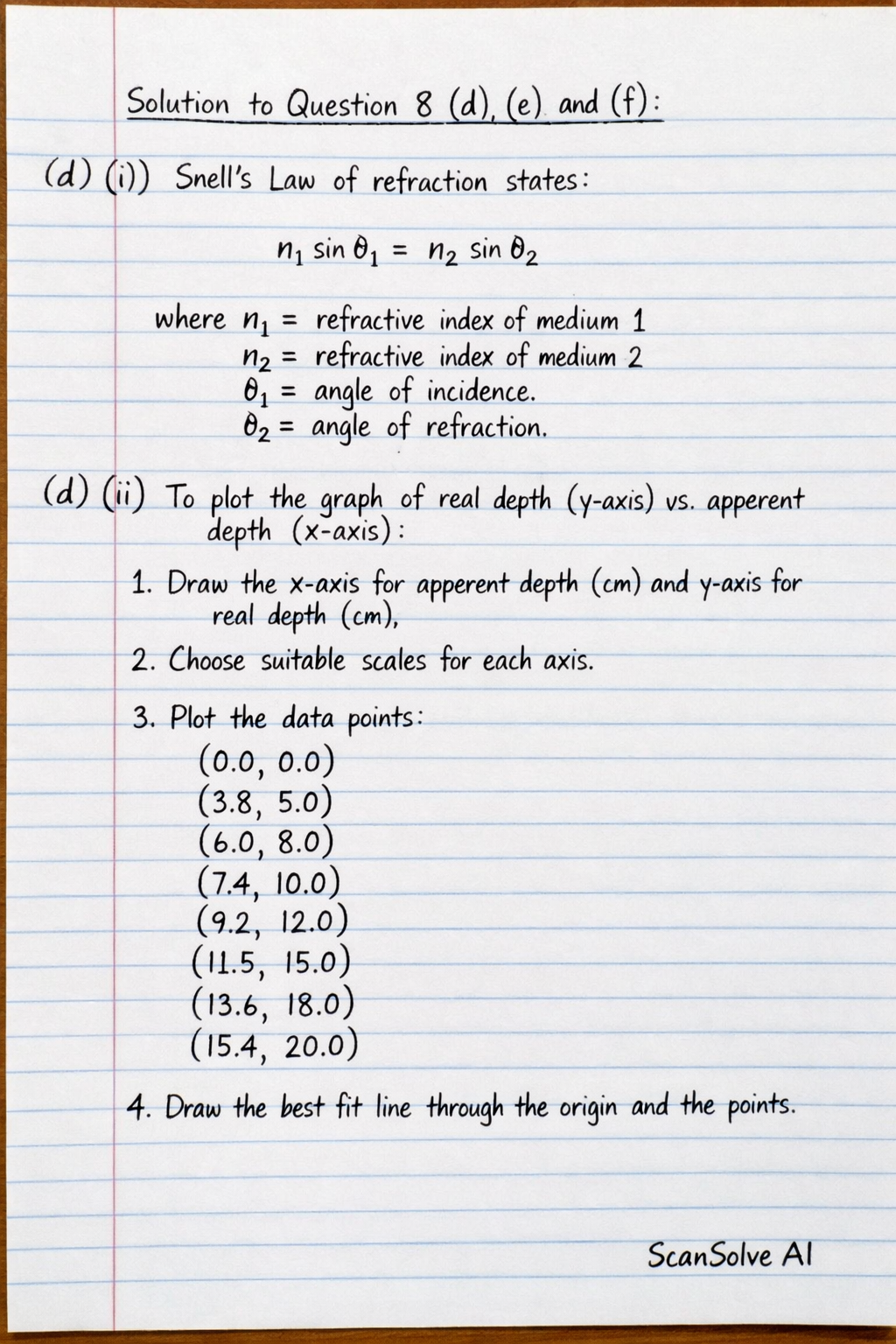
You're on a roll — here is the solution to question 8 (d), (e), and (f): 8. (d) (i) Snell's Law of refraction states that for a given pair of media, the ratio of the sine of the angle of incidence to the sine of the angle of refraction is constant. This constant is equal to the ratio of the phase velocities of the light in the two media, or equivalently, to the ratio of the refractive indices of the two media. Mathematically, it is expressed as n_1 _1 = n_2 _2. 8. (d) (ii) To plot the graph of real depth on the y-axis against apparent depth on the x-axis: • Draw an x-axis (horizontal) for apparent depth (in cm) and a y-axis (vertical) for real depth (in cm). • Choose appropriate scales for each axis to accommodate the data points. • Plot the given data points: (0.0, 0.0), (3.8, 5.0), (6.0, 8.0), (7.4, 10.0), (9.2, 12.0), (11.5, 15.0), (13.6, 18.0), (15.4, 20.0). • Draw the best straight line passing through the origin and the plotted points. 8. (d) (iii) Step 1: Determine the gradient of the graph. The gradient m of a graph of real depth (y) versus apparent depth (x) is given by m = real depth apparent depth. Using the points (0.0 cm, 0.0 cm) and (15.4 cm, 20.0 cm): m = 20.0 cm - 0.0 cm15.4 cm - 0.0 cm = (20.0)/(15.4) ≈ 1.2987 Step 2: State the significance of the gradient. The gradient of the real depth vs. apparent depth graph represents the refractive index of the water. The gradient is approximately 1.30. Its significance is the refractive index of the water. 8. (d) (iv) Step 1: Use the relationship between real depth, apparent depth, and refractive index. The refractive index n is given by n = real depthapparent depth. From part (iii), n ≈ 1.2987. We are given the real depth (level of water) as 14.0 cm. We need to find the apparent position (apparent depth). apparent depth = real depthn Step 2: Substitute the values and calculate the apparent position. apparent depth = 14.0 cm1.2987 ≈ 10.78 cm The apparent position of the coin when the level of the water is 14.0 cm will be approximately 10.78 cm. 8. (e) (i) Total internal reflection is the phenomenon that occurs when a light ray traveling from a denser medium to a less dense medium strikes the interface at an angle of incidence greater than the critical angle, causing all the light to be reflected back into the denser medium. 8. (e) (ii) The two conditions necessary for total internal reflection to occur are: • Light must travel from an optically denser medium to an optically less dense medium. • The angle of incidence in the denser medium must be greater than the critical angle for the interface between the two media. 8. (f) (i) One member of the electromagnetic spectrum is Microwaves. Their approximate wavelength range is from about 1 mm to 1 m. 8. (f) (ii) Microwaves are commonly used in microwave ovens for heating food. This use is related to their property of being absorbed by water molecules, causing them to vibrate and generate heat. The specific wavelength of microwaves used in ovens is chosen to efficiently resonate with water molecules, allowing for rapid and effective heating of food items. What's next?