
We read your photo as:
In English language with more explanation
ScanSolve AI Answer
Here is a detailed explanation for each question in English:
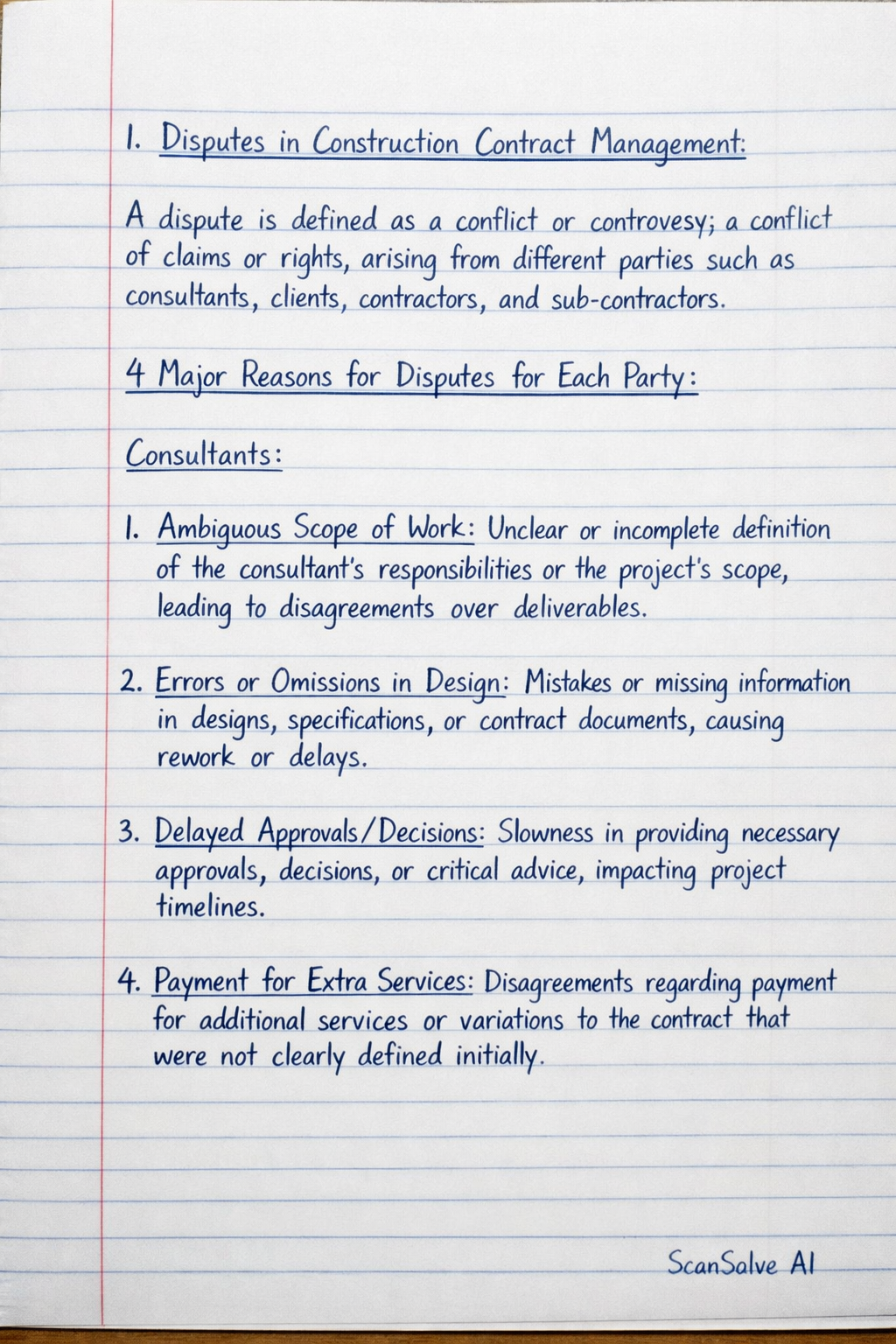
1. Disputes in Construction Contract Management
A dispute is defined as a conflict or controversy; a conflict of claims or rights, arising from different parties such as consultants, clients, contractors, and sub-contractors.
-
4 Major Reasons for Disputes for Each Party:
-
Consultants:
- Ambiguous Scope of Work: Unclear or incomplete definition of the consultant's responsibilities or the project's scope, leading to disagreements over deliverables.
- Errors or Omissions in Design: Mistakes or missing information in designs, specifications, or contract documents, causing rework or delays.
- Delayed Approvals/Decisions: Slowness in providing necessary approvals, decisions, or critical advice, impacting project timelines.
- Payment for Extra Services: Disagreements regarding payment for additional services or variations to the contract that were not clearly defined initially.
-
Clients:
- Frequent Changes in Requirements: Constant changes to project scope, design, or specifications after the contract has been awarded, leading to cost and time overruns.
- Delayed Payments: Failure to make timely payments to contractors or consultants, causing cash flow problems for the performing parties.
- Inaccurate or Incomplete Information: Providing incorrect, insufficient, or delayed critical information required for the project's execution.
- Interference in Contractor's Work: Direct intervention in the contractor's methods or project management, which can disrupt workflow and responsibilities.
-
Contractors:
- Delays in Project Completion: Failure to complete the work according to the agreed-upon schedule, leading to liquidated damages or project extensions.
- Poor Workmanship or Materials: Substandard quality of work or the use of materials that do not meet specified standards, resulting in defects and rework.
- Unjustified Claims for Extras: Submitting claims for additional work or variations that are not properly substantiated or agreed upon.
- Non-compliance with Contract Terms: Failure to adhere to contract clauses, safety regulations, or construction standards.
-
Sub-contractors:
- Delayed Payments from Main Contractor: Not receiving timely payments from the main contractor, affecting their cash flow and ability to pay their own suppliers and workers.
- Scope of Work Discrepancies: Disagreements with the main contractor regarding the exact scope of work or responsibilities assigned.
- Lack of Resources/Instructions: Insufficient provision of materials, resources, or clear instructions from the main contractor.
- Sudden Changes in Schedule: Abrupt changes to the work schedule or terms by the main contractor, disrupting the sub-contractor's planning.
-
2. Importance of Procurement in District Councils
-
a) Explain why you think procurements is of paramount importance in district councils in Tanzania: Procurement is of paramount importance in district councils in Tanzania because it ensures the efficient, transparent, and accountable use of public funds. It is the process through which district councils acquire goods, services, and works (like building schools, health centers, roads, and water systems) essential for local development and service delivery. A robust procurement system helps to obtain the best value for money, ensuring that projects are completed to the required quality standards. Furthermore, it minimizes the risks of corruption, embezzlement, and misuse of resources, thereby fostering public trust and confidence in local government.
-
b) By giving an example, explain what will happen if the principles of procurements are not upheld in the procurement process in construction sector in your district? Example: Imagine a district council needs to construct a new modern market. If the principles of procurement, such as transparency, fairness, competition, and value for money, are not upheld—for instance, by awarding the tender to a contractor lacking the necessary qualifications or experience due to favoritism or corruption. Consequences:
- Poor Project Quality: The market might be constructed using substandard materials or poor workmanship, leading to an unsafe structure that requires frequent repairs or even collapses prematurely.
- Project Delays: The project could face significant delays in completion, depriving traders and the community of the market's benefits for an extended period.
- Cost Overruns: The project's cost could escalate due to rework, additional repairs, or even the need to restart parts of the construction, leading to financial losses for the district.
- Loss of Public Trust: Citizens will lose faith in the district council and the procurement process, believing that their public funds are not being used effectively, transparently, or for their benefit.
3. Functions of Three Members of the Tender Board
Here are four functions for each of the three members of the Tender Board:
-
Chairperson of the Tender Board:
- To preside over all meetings of the Tender Board, ensuring orderly proceedings.
- To ensure that all procurement rules, regulations, and procedures are strictly adhered to.
- To approve meeting agendas and ensure discussions are conducted efficiently and effectively.
- To sign official documents and decisions made by the Tender Board.
-
Secretary of the Tender Board:
- To prepare agendas, documents, and all necessary reports for Tender Board meetings.
- To record and maintain accurate minutes of meetings and decisions made by the Board.
- To provide professional advice to the Board on procurement matters and relevant laws.
- To ensure that decisions made by the Board are communicated and implemented appropriately.
-
Member of the Tender Board:
- To actively participate in discussions, evaluations, and decision-making processes of the Board.
- To thoroughly review and evaluate submitted tender documents and proposals.
- To offer expert opinions and advice based on their experience and specialization.
- To ensure transparency, integrity, and fairness throughout the entire tendering process.
Still stuck on this one?
Ask a follow-up, and the answer starts from this question.
More English Questions
Handwritten Step-by-Step Solution
Get this as a handwritten image on WhatsApp — like a tutor wrote it for you.
Try on WhatsApp