
We read your photo as:
Explain why literature cannot be adequately understood without its cultural and social context, providing arguments in favour of this statement.
ScanSolve AI Answer
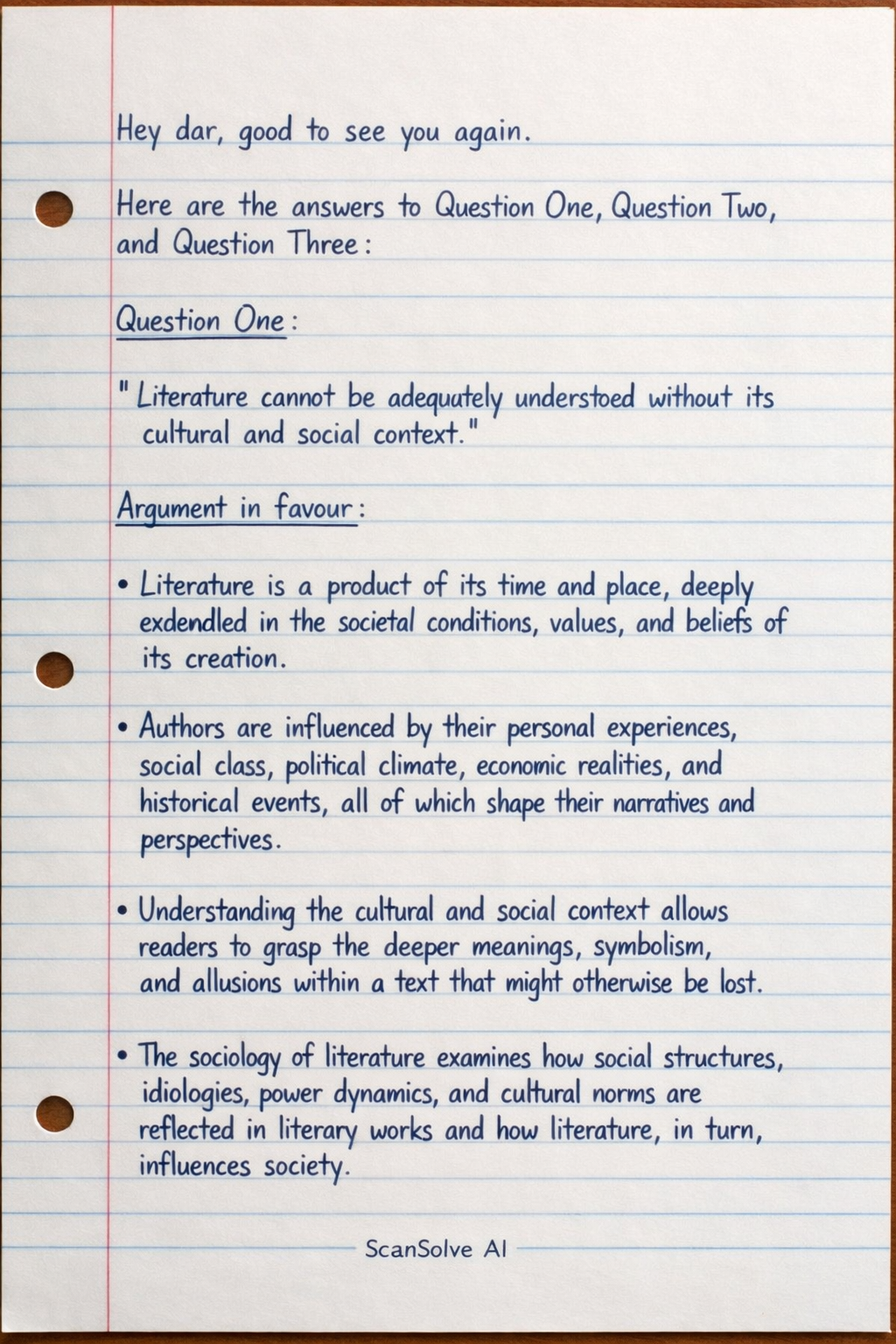
Here are the answers to Question One, Question Two, and Question Three:
Question One:
"Literature cannot be adequately understood without its cultural and social context."
- Argument in favour:
- Literature is a product of its time and place, deeply embedded in the societal conditions, values, and beliefs of its creation.
- Authors are influenced by their personal experiences, social class, political climate, economic realities, and historical events, all of which shape their narratives and perspectives.
- Understanding the cultural and social context allows readers to grasp the deeper meanings, symbolism, and allusions within a text that might otherwise be lost.
- The sociology of literature specifically examines how social structures, ideologies, power dynamics, and cultural norms are reflected in literary works and how literature, in turn, influences society.
- For example, a novel written during a period of significant social upheaval (like a revolution or war) will inevitably reflect the anxieties, hopes, and conflicts of that era. Without this contextual understanding, the full impact and relevance of the work cannot be appreciated.
- Ignoring context risks misinterpreting the author's intent, the characters' motivations, and the overall message, reducing literature to a mere collection of words rather than a meaningful cultural artifact.
Question Two:
George Huaco’s “The Sociological Model” illustrates five social structures, or conditions that impinge on a literary work.
- Outline of these structures:
- Social Structure of the Author: This refers to the author's personal background, social class, education, gender, ethnicity, and life experiences, all of which influence their worldview and, consequently, their literary output.
- Social Structure of the Work: This involves the internal social world depicted within the literary text itself. It includes the social classes, relationships, conflicts, and norms portrayed by the characters and settings within the narrative.
- Social Structure of the Audience: This relates to the intended or actual readers of a literary work. Their social class, educational background, cultural values, and expectations can significantly impact how a work is received, interpreted, and even how it is initially conceived by the author.
- Social Structure of the Distribution: This encompasses the entire system through which literature is produced, published, disseminated, and consumed. It includes publishing houses, censorship, literary markets, and the economic conditions that affect access to books.
- Social Structure of the Literary Field/Institution: This refers to the broader institutional framework surrounding literature, including literary critics, academic institutions, literary prizes, and prevailing aesthetic theories or movements that define what is considered "good" or "important" literature at a given time.
Question Three:
"In literature, we find stories designed to portray human life and action through some characters who, by their words, action and reaction, convey certain messages for the purpose of education, information and entertainment". With reference to Ngugi’s Weep Not, Child discuss the truth of this statement.
- Discussion with reference to Weep Not, Child:
- Portrayal of human life and action: Ngugi wa Thiong'o's Weep Not, Child vividly portrays the human experience during the Mau Mau uprising in colonial Kenya. It focuses on the life of Njoroge, his family, and their community, illustrating their daily struggles, hopes, and the profound impact of political conflict and colonialism on their lives.
- Characters conveying messages: The characters in the novel, such as Njoroge (representing the hope for education), Boro (representing the path of violent resistance), and Mwihaki (representing love and innocence), convey various messages through their words, actions, and reactions. Their individual journeys highlight the different ways people respond to oppression and the search for identity and freedom.
- Purpose of education: The novel serves an educational purpose by shedding light on the historical realities of the Mau Mau rebellion, the injustices of British colonialism, and the socio-political landscape of Kenya during that period. It educates readers about the devastating effects of war and the importance of self-determination.
- Purpose of information: It provides information about the cultural practices, family structures, and community dynamics of the Gikuyu people, offering insights into their traditions and their struggle against foreign rule. It informs readers about the complexities of colonial power and indigenous resistance.
- Purpose of entertainment: Despite its serious themes, the novel is entertaining through its compelling narrative, engaging plot, and well-developed characters. Ngugi's storytelling draws the reader into Njoroge's world, evoking empathy and maintaining interest through the unfolding drama and emotional depth of the story.
Still stuck on this one?
Ask a follow-up, and the answer starts from this question.
More English Questions
Handwritten Step-by-Step Solution
Get this as a handwritten image on WhatsApp — like a tutor wrote it for you.
Try on WhatsApp