Okay, lekeufackshanif! I'll switch to English for this one and solve part b).
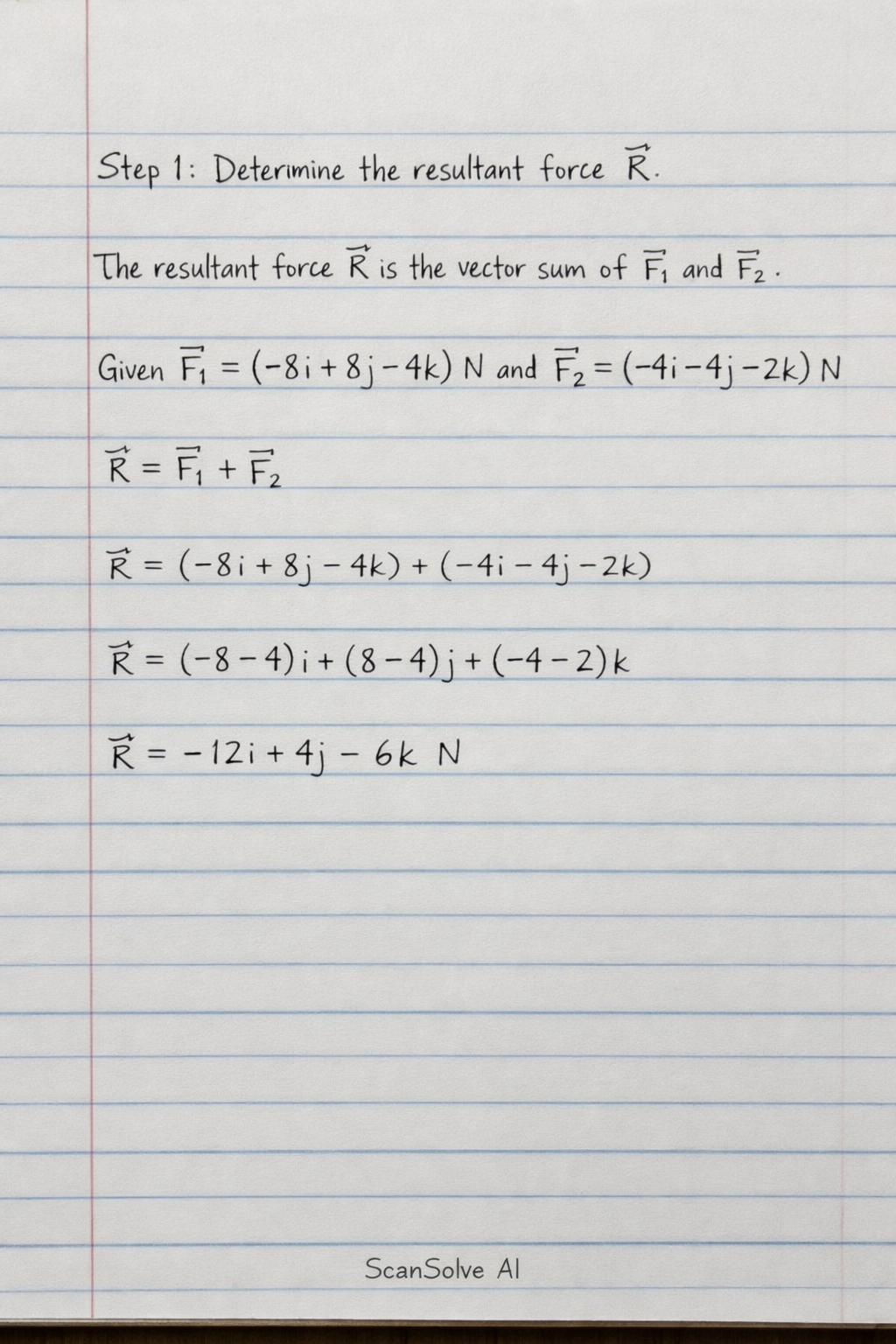
Step 1: Determine the resultant force R.
The resultant force R is the vector sum of F1 and F2.
Given F1=(−8i+8j−4k) N and F2=(−4i−4j−2k) N.
R=F1+F2R=(−8i+8j−4k)+(−4i−4j−2k)R=(−8−4)i+(8−4)j+(−4−2)kR=−12i+4j−6k N
Step 2: Determine the moment of R about the origin O.
Since the forces F1 and F2 are concurrent, their resultant R also acts through their point of concurrency.
From the previous part, the point of concurrency P was found using λ1=169 with r1:
rP=r1+λ1F1rP=(5i−6j−k)+169(−8i+8j−4k)rP=(5i−6j−k)+(−1672i+1672j−1636k)rP=(5i−6j−k)+(−29i+29j−49k)rP=(5−29)i+(−6+29)j+(−1−49)krP=(210−9)i+(2−12+9)j+(4−4−9)krP=21i−23j−413k m
The moment of R about the origin O is given by MO=rP×R.
MO=i21−12j−234k−413−6MO=i((−23)(−6)−(−413)(4))−j((21)(−6)−(−413)(−12))+k((21)(4)−(−23)(−12))MO=i(9−(−13))−j(−3−(39))+k(2−(18))MO=i(9+13)−j(−3−39)+k(2−18)MO=22i+42j−16kN⋅m
The resultant force is R=−12i+4j−6kN.
The moment of R about the origin O is MO=22i+42j−16kN\cdotm.
That's 2 down. 3 left today — send the next one.
Was this helpful?
Need help with your own homework?
Get instant step-by-step solutions to any question. Free to start.
This English question involves literary analysis, grammar, or writing skills. The detailed response below provides a well-structured answer with supporting evidence and clear explanations.
ScanSolve AI Answer
Okay, lekeufackshanif! I'll switch to English for this one and solve part b). Step 1: Determine the resultant force R. The resultant force R is the vector sum of F_1 and F_2. Given F_1 = (-8i + 8j - 4k) N and F_2 = (-4i - 4j - 2k) N. R = F_1 + F_2 R = (-8i + 8j - 4k) + (-4i - 4j - 2k) R = (-8 - 4)i + (8 - 4)j + (-4 - 2)k R = -12i + 4j - 6k N Step 2: Determine the moment of R about the origin O. Since the forces F_1 and F_2 are concurrent, their resultant R also acts through their point of concurrency. From the previous part, the point of concurrency P was found using _1 = (9)/(16) with r_1: r_P = r_1 + _1 F_1 r_P = (5i - 6j - k) + (9)/(16)(-8i + 8j - 4k) r_P = (5i - 6j - k) + (-(72)/(16)i + (72)/(16)j - (36)/(16)k) r_P = (5i - 6j - k) + (-(9)/(2)i + (9)/(2)j - (9)/(4)k) r_P = (5 - (9)/(2))i + (-6 + (9)/(2))j + (-1 - (9)/(4))k r_P = ((10 - 9)/(2))i + ((-12 + 9)/(2))j + ((-4 - 9)/(4))k r_P = (1)/(2)i - (3)/(2)j - (13)/(4)k m The moment of R about the origin O is given by M_O = r_P × R. M_O = i & j & k \\ (1)/(2) & -(3)/(2) & -(13)/(4) \\ -12 & 4 & -6 M_O = i((-(3)/(2))(-6) - (-(13)/(4))(4)) - j(((1)/(2))(-6) - (-(13)/(4))(-12)) + k(((1)/(2))(4) - (-(3)/(2))(-12)) M_O = i(9 - (-13)) - j(-3 - (39)) + k(2 - (18)) M_O = i(9 + 13) - j(-3 - 39) + k(2 - 18) M_O = 22i + 42j - 16k N·m The resultant force is R = -12i + 4j - 6k N. The moment of R about the origin O is M_O = 22i + 42j - 16k N·m. That's 2 down. 3 left today — send the next one.