
This English question involves literary analysis, grammar, or writing skills. The detailed response below provides a well-structured answer with supporting evidence and clear explanations.
ScanSolve AI Answer
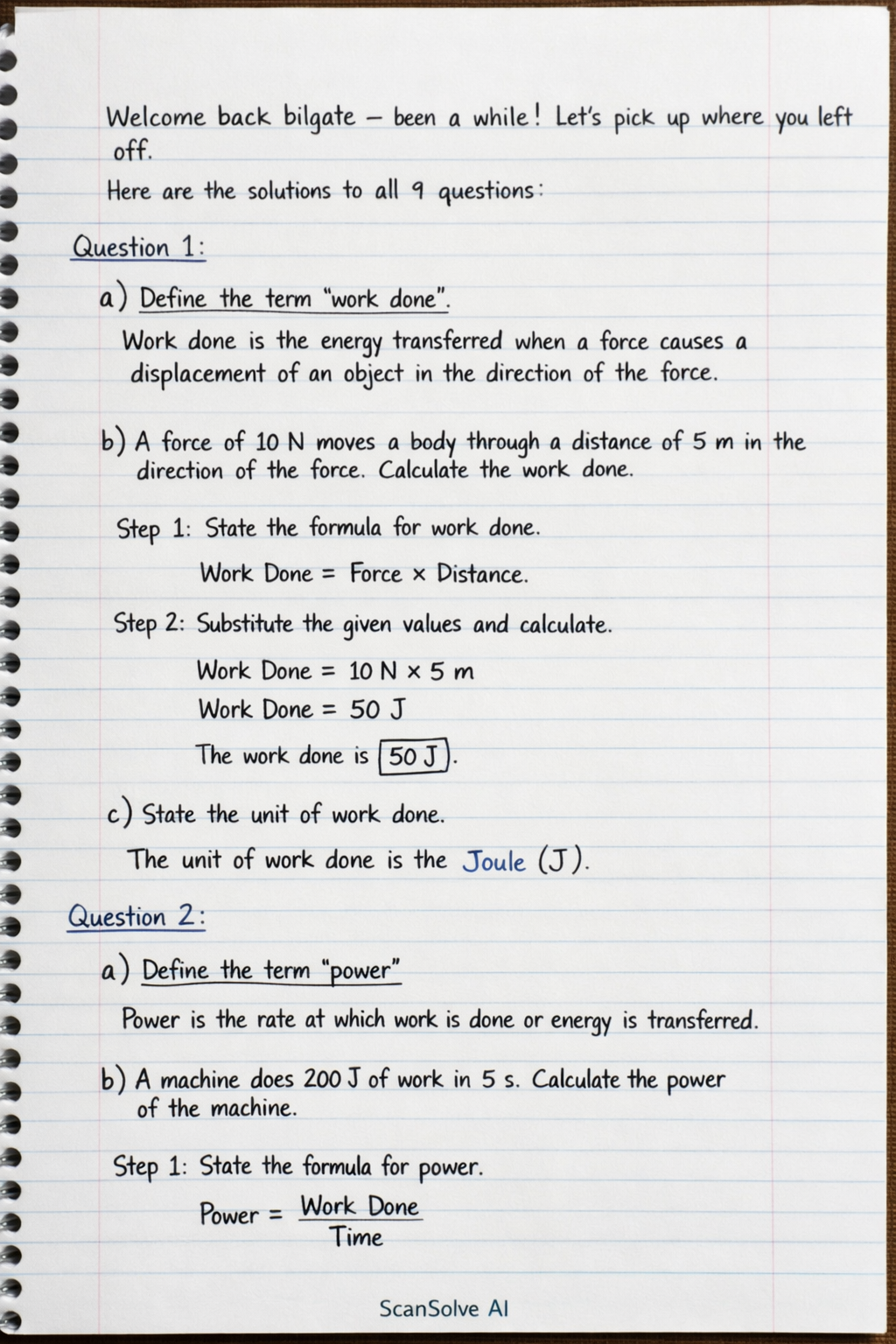
Here are the solutions to all 9 questions: Question 1: a) Define the term 'work done'. Work done is the energy transferred when a force causes a displacement of an object in the direction of the force. b) A force of 10 N moves a body through a distance of 5 m in the direction of the force. Calculate the work done. Step 1: State the formula for work done. Work Done = Force × Distance Step 2: Substitute the given values and calculate. Work Done = 10 \, N × 5 \, m Work Done = 50 \, J The work done is 50 J. c) State the unit of work done. The unit of work done is the Joule (J). Question 2: a) Define the term 'power'. Power is the rate at which work is done or energy is transferred. b) A machine does 200 J of work in 5 s. Calculate the power of the machine. Step 1: State the formula for power. Power = Work DoneTime Step 2: Substitute the given values and calculate. Power = 200 \, J5 \, s Power = 40 \, W The power of the machine is 40 W. c) State the unit of power. The unit of power is the Watt (W). Question 3: a) Define the term 'energy'. Energy is the capacity of a system to do work. b) State two forms of energy. Two forms of energy are: 1. Kinetic energy 2. Potential energy (or chemical energy, thermal energy, electrical energy, etc.) c) State the law of conservation of energy. The law of conservation of energy states that energy cannot be created or destroyed, but it can be transformed from one form to another. The total amount of energy in an isolated system remains constant. Question 4: a) Define the term 'kinetic energy'. Kinetic energy is the energy possessed by an object due to its motion. b) A car of mass 1000 kg moves with a velocity of 20 m/s. Calculate its kinetic energy. Step 1: State the formula for kinetic energy. Kinetic Energy (KE) = (1)/(2) m v^2 Step 2: Substitute the given values and calculate. KE = (1)/(2) × 1000 \, kg × (20 \, m/s)^2 KE = (1)/(2) × 1000 \, kg × 400 \, (m/s)^2 KE = 500 \, kg × 400 \, (m/s)^2 KE = 200000 \, J The kinetic energy of the car is 200000 J. Question 5: a) Define the term 'potential energy'. Potential energy is the energy stored in an object due to its position or state. b) A stone of mass 2 kg is lifted to a height of 10 m. Calculate its potential energy. (Take g = 10 N/kg) Step 1: State the formula for gravitational potential energy. Potential Energy (PE) = mgh Step 2: Substitute the given values and calculate. PE = 2 \, kg × 10 \, N/kg × 10 \, m PE = 200 \, J The potential energy of the stone is 200 J. Question 6: a) Define the term 'pressure'. Pressure is the force applied perpendicular to the surface of an object per unit area over which the force is distributed. b) A force of 50 N acts on an area of 2 m². Calculate the pressure. Step 1: State the formula for pressure. Pressure (P) = Force (F)Area (A) Step 2: Substitute the given values and calculate. P = 50 \, N2 \, m^2 P = 25 \, Pa The pressure is 25 Pa. c) State the unit of pressure. The unit of pressure is the Pascal (Pa) or N/m^2. Question 7: a) Define the term 'density'. Density is a measure of mass per unit volume of a substance. b) A block of wood has a mass of 200 g and a volume of 250 cm³. Calculate its density. Step 1: State the formula for density. Density = MassVolume Step 2: Substitute the given values and calculate. Density = 200 \, g250 \, cm^3 Density = 0.8 \, g/cm^3 The density of the block of wood is 0.8 g/cm^3. c) State the unit of density. The unit of density is kg/m^3 or g/cm^3. Question 8: a) Define the term 'specific heat capacity'. Specific heat capacity is the amount of heat energy required to raise the temperature of 1 kg of a substance by 1 °C (or 1 K). b) 500 J of heat energy is supplied to 2 kg of a substance, and its temperature rises by 5 °C. Calculate the specific heat capacity of the substance. Step 1: State the formula relating heat energy, mass, specific heat capacity, and temperature change. Q = mc T Where Q is heat energy, m is mass, c is specific heat capacity, and T is the change in temperature. Step 2: Rearrange the formula to solve for specific heat capacity (c). c = (Q)/(m T) Step 3: Substitute the given values and calculate. c = 500 \, J2 \, kg × 5 \, °C c = 500 \, J10 \, kg°C c = 50 \, J kg^-1 °C^-1 The specific heat capacity of the substance is 50 J kg^-1 °C^-1. c) State the unit of specific heat capacity. The unit of specific heat capacity is J kg^-1 °C^-1 or J kg^-1 K^-1. Question 9: a) Define the term 'latent heat of fusion'. Latent heat of fusion is the amount of heat energy required to change 1 kg of a substance from a solid state to a liquid state at its melting point without a change in temperature. b) 100 g of ice at 0 °C melts completely when 33400 J of heat energy is supplied. Calculate the specific latent heat of fusion of ice. Step 1: Convert the mass from grams to kilograms. m = 100 \, g = 0.1 \, kg Step 2: State the formula relating heat energy, mass, and specific latent heat of fusion. Q = mL_f Where Q is heat energy, m is mass, and L_f is the specific latent heat of fusion. Step 3: Rearrange the formula to solve for specific latent heat of fusion (L_f). L_f = (Q)/(m) Step 4: Substitute the given values and calculate. L_f = 33400 \, J0.1 \, kg L_f = 334000 \, J/kg The specific latent heat of fusion of ice is 334000 J/kg. c) State the unit of specific latent heat of fusion. The unit of specific latent heat of fusion is J/kg. Drop the next question.