
We read your photo as:
Solve all the questions in English
ScanSolve AI Answer
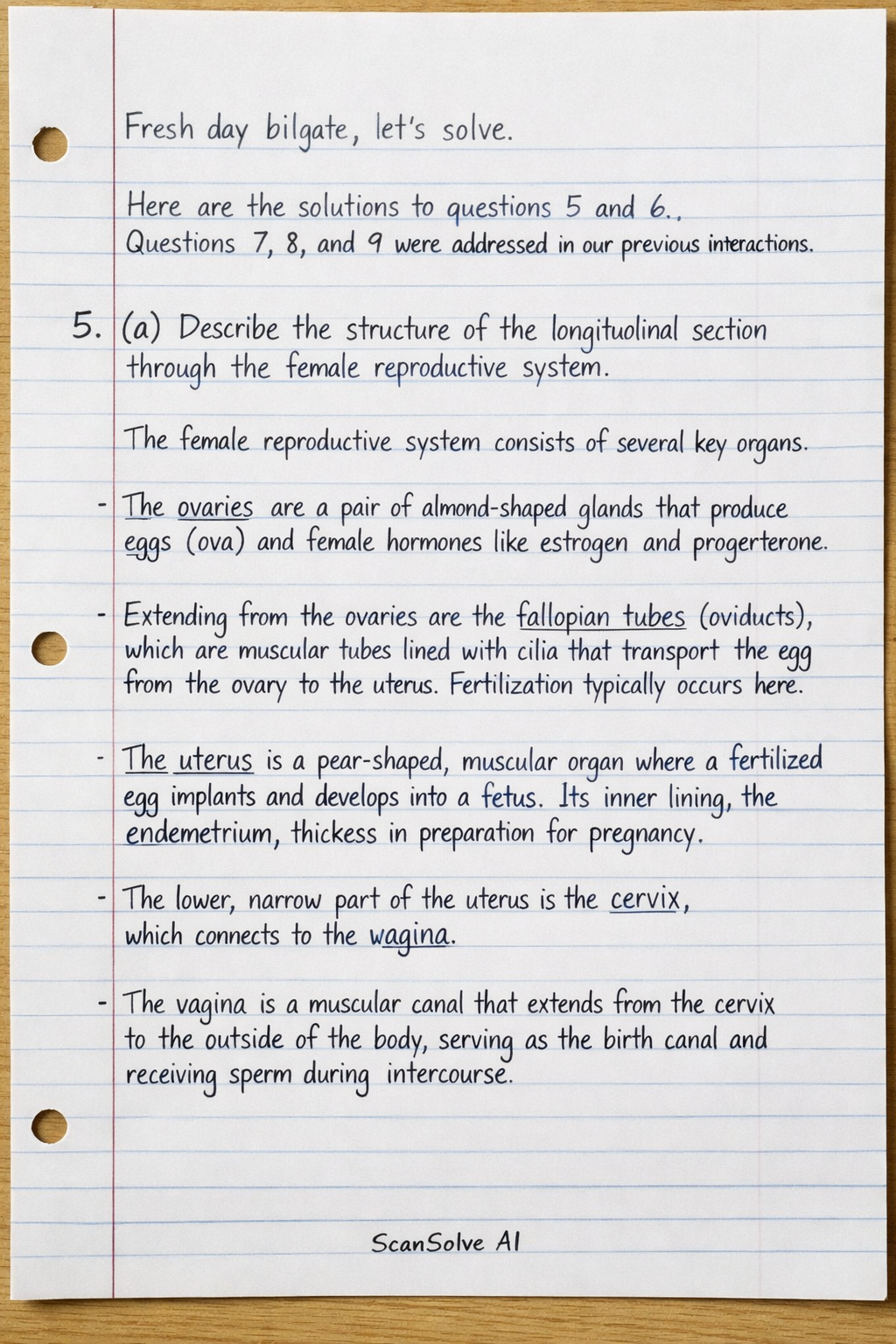
Here are the solutions to questions 5 and 6. Questions 7, 8, and 9 were addressed in our previous interactions.
5. (a) Describe the structure of the longitudinal section through the female reproductive system.
The female reproductive system consists of several key organs. The ovaries are a pair of almond-shaped glands that produce eggs (ova) and female hormones like estrogen and progesterone. Extending from the ovaries are the fallopian tubes (oviducts), which are muscular tubes lined with cilia that transport the egg from the ovary to the uterus. Fertilization typically occurs here. The uterus is a pear-shaped, muscular organ where a fertilized egg implants and develops into a fetus. Its inner lining, the endometrium, thickens in preparation for pregnancy. The lower, narrow part of the uterus is the cervix, which connects to the vagina. The vagina is a muscular canal that extends from the cervix to the outside of the body, serving as the birth canal and receiving sperm during intercourse.
5. (b) Explain how:
5. (b) (i) Sex is determined in humans
Sex in humans is determined genetically by the sex chromosomes. Females typically have two X chromosomes (XX), while males typically have one X and one Y chromosome (XY). During meiosis, females produce eggs that all carry an X chromosome. Males produce two types of sperm: half carry an X chromosome and half carry a Y chromosome. If an egg is fertilized by an X-carrying sperm, the resulting zygote will be XX and develop into a female. If an egg is fertilized by a Y-carrying sperm, the resulting zygote will be XY and develop into a male. Therefore, the sperm determines the sex of the offspring.
5. (b) (ii) The birth process occurs.
The birth process, or parturition, typically begins around 40 weeks of gestation. It is initiated by hormonal changes, primarily an increase in oxytocin, which causes the muscular walls of the uterus to contract. This is the first stage of labor, characterized by uterine contractions that gradually dilate and efface (thin out) the cervix. As the cervix fully dilates to about 10 cm, the second stage of labor begins. During this stage, the mother actively pushes with contractions, and the baby moves down the birth canal. The baby is usually born headfirst. Once the baby is delivered, the third stage of labor occurs, involving the expulsion of the placenta (afterbirth) from the uterus.
6. (a) Explain the meaning of the following terms:
6. (a) (i) Infectious disease
An infectious disease is a disease caused by pathogenic microorganisms (such as bacteria, viruses, fungi, or parasites) that can be spread, directly or indirectly, from one person or animal to another.
6. (a) (ii) Epidemic disease
An epidemic disease is a widespread occurrence of an infectious disease in a community or region at a particular time, affecting a large number of people significantly more than what is normally expected.
6. (a) (iii) Incubation period
The incubation period is the time interval between the exposure to an infectious agent and the first appearance of symptoms of the disease. During this time, the pathogen multiplies within the host.
6. (b) How are contagious diseases spread?
Contagious diseases are spread through various modes of transmission. Direct contact involves physical contact between an infected person and a susceptible person, such as touching, kissing, or sexual contact. Indirect contact occurs when an infected person touches an object (fomite) and then a susceptible person touches that object. Droplet transmission happens when respiratory droplets containing pathogens are expelled through coughing or sneezing and land on the mucous membranes of a nearby person. Airborne transmission involves smaller particles that remain suspended in the air for longer periods and can travel further. Vector-borne transmission involves an intermediate organism, like an insect (e.g., mosquitoes for malaria), carrying the pathogen. Finally, vehicle-borne transmission occurs through contaminated inanimate objects like food, water, or blood.
6. (c) Using the following headings describe the disease cholera:
6. (c) (i) Causative agent
The causative agent of cholera is the bacterium Vibrio cholerae.
6. (c) (ii) A mode of transmission
Cholera is primarily transmitted through the fecal-oral route, typically by consuming water or food contaminated with the feces of an infected person.
6. (c) (iii) Two symptoms
Two common symptoms of cholera are:
- Severe watery diarrhea (often described as "rice-water stools").
- Vomiting.
6. (c) (iv) Two control measures.
Two control measures for cholera are:
- Ensuring access to safe, clean drinking water and proper sanitation facilities.
- Practicing good personal hygiene, especially handwashing with soap and water after using the toilet and before handling food.
Still stuck on this one?
Ask a follow-up, and the answer starts from this question.
More English Questions
Handwritten Step-by-Step Solution
Get this as a handwritten image on WhatsApp — like a tutor wrote it for you.
Try on WhatsApp