
This English question involves literary analysis, grammar, or writing skills. The detailed response below provides a well-structured answer with supporting evidence and clear explanations.
ScanSolve AI Answer
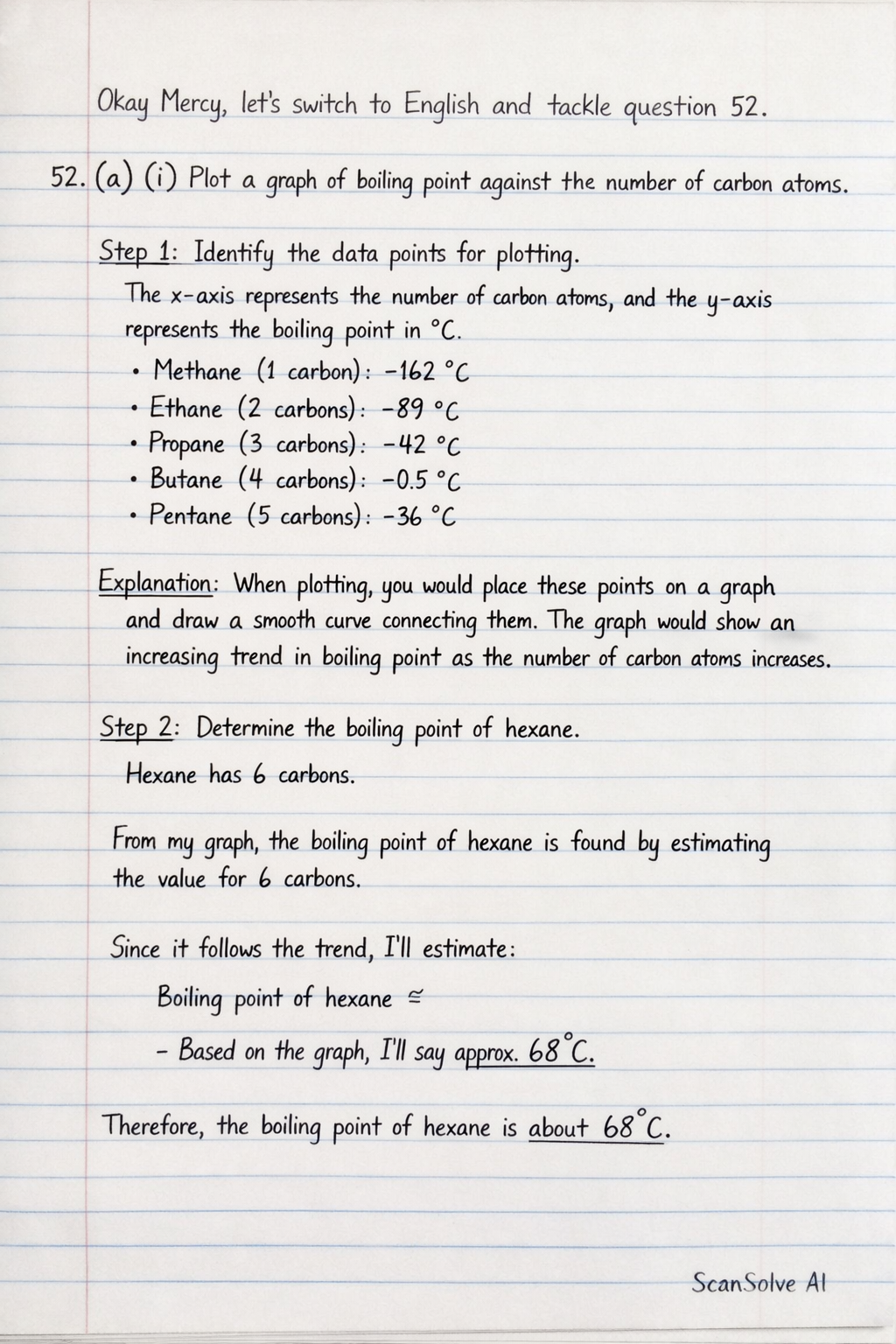
Okay Mercy, let's switch to English and tackle question 52. 52. (a) The table below shows the boiling points of some alkanes. | Alkane | Boiling point (°C) | |---|---| | Methane | -162 | | Ethane | -89 | | Propane | -42 | | Butane | -0.5 | | Pentane | 36 | a) (i) Plot a graph of boiling point against the number of carbon atoms. Step 1: Identify the data points for plotting. The x-axis represents the number of carbon atoms, and the y-axis represents the boiling point in °C. • Methane (1 carbon): -162 °C • Ethane (2 carbons): -89 °C • Propane (3 carbons): -42 °C • Butane (4 carbons): -0.5 °C • Pentane (5 carbons): 36 °C Explanation: When plotting, you would place these points on a graph and draw a smooth curve connecting them. The graph would show an increasing trend in boiling point as the number of carbon atoms increases. a) (ii) From your graph, determine the boiling point of hexane. Step 1: Extrapolate the trend from the given data. As the number of carbon atoms increases, the boiling point increases. Observing the differences: Ethane - Methane: -89 - (-162) = 73 \,^C Propane - Ethane: -42 - (-89) = 47 \,^C Butane - Propane: -0.5 - (-42) = 41.5 \,^C Pentane - Butane: 36 - (-0.5) = 36.5 \,^C The increase in boiling point is decreasing with each additional carbon atom. Following this trend, the increase for hexane (6 carbons) would be slightly less than 36.5 \,^C. A reasonable estimate would be around 32-34 \,^C. 36 \,^C + 33 \,^C = 69 \,^C Final Answer: a) (ii) The boiling point of hexane is approximately 69 \,^. a) (iii) Explain the trend of boiling points of alkanes as the number of carbon atoms increases. Step 1: Relate molecular size to intermolecular forces. As the number of carbon atoms in an alkane increases, the size and molecular mass of the molecule also increase. Step 2: Explain the effect on boiling point. Larger molecules have stronger London dispersion forces (a type of Van der Waals force) between them. More energy is required to overcome these stronger intermolecular forces, leading to a higher boiling point. Final Answer: a) (iii) As the number of carbon atoms increases, the molecular mass of the alkanes increases. This leads to stronger London dispersion forces (Van der Waals forces) between the molecules. More energy is required to overcome these stronger intermolecular forces, resulting in a higher boiling point. 52. (b) State two uses of alkanes. Step 1: Identify common applications of alkanes. Alkanes are widely used as fuels and as raw materials in the chemical industry. Final Answer: b) Two uses of alkanes are: • Fuels (e.g., methane in natural gas, propane/butane in LPG, gasoline). • Raw materials for the production of other chemicals and polymers. 52. (c) Write the structural formula of 2,2-dimethylpropane. Step 1: Identify the parent alkane and substituents. The parent alkane is propane, which has a 3-carbon chain. "2,2-dimethyl" means there are two methyl (CH_3) groups attached to the second carbon atom of the propane chain. Step 2: Draw the structural formula. c CH_3 \\ | \\ CH_3-C-CH_3 \\ | \\ CH_3 Final Answer: c) c CH_3 \\ | \\ CH_3-C-CH_3 \\ | \\ CH_3 52. (d) Write the IUPAC name of the following compound: CH3-CH-CH2-CH3 | CH3 Step 1: Identify the longest continuous carbon chain. The longest chain has 4 carbon atoms. This indicates a butane derivative. Step 2: Number the carbon atoms in the main chain to give the substituent the lowest possible number. Numbering from the left: C_1H_3-C_2H(CH_3)-C_3H_2-C_4H_3. The methyl group is on carbon 2. Numbering from the right: C_4H_3-C_3H(CH_3)-C_2H_2-C_1H_3. The methyl group is on carbon 3. The correct numbering gives the methyl group the position 2. Step 3: Identify the substituent. There is one methyl group (CH_3) at position 2. Step 4: Combine the parts to form the IUPAC name. Final Answer: d) The IUPAC name is 2-methylbutane. 52. (e) Explain why alkanes are generally unreactive. Step 1: Describe the bonding in alkanes. Alkanes consist only of carbon-carbon single bonds (C-C) and carbon-hydrogen single bonds (C-H). These bonds are strong and require a significant amount of energy to break. Step 2: Explain the polarity of the bonds. The electronegativity difference between carbon and hydrogen is very small, making the C-H bonds essentially non-polar. The C-C bonds are also non-polar. This lack of polarity means there are no regions of positive or negative charge to attract common reactive species like nucleophiles or electrophiles. Step 3: Conclude on reactivity. Due to the strength and non-polar nature of their bonds, and the absence of functional groups like double or triple bonds, alkanes are generally unreactive under normal conditions. They primarily undergo combustion and free radical substitution reactions (e.g., with halogens in the presence of UV light). Final Answer: e) Alkanes are generally unreactive because they contain only strong, non-polar carbon-carbon single bonds (C-C) and carbon-hydrogen single bonds (C-H). These bonds are difficult to break, and the lack of polarity means there are no sites for attack by common reactive species (like electrophiles or nucleophiles). They also lack reactive functional groups. 3 done, 2 left today. You're making progress.