
We read your photo as:
Write an essay describing a rainstorm disaster and asking for assistance from your elder brother.
ScanSolve AI Answer
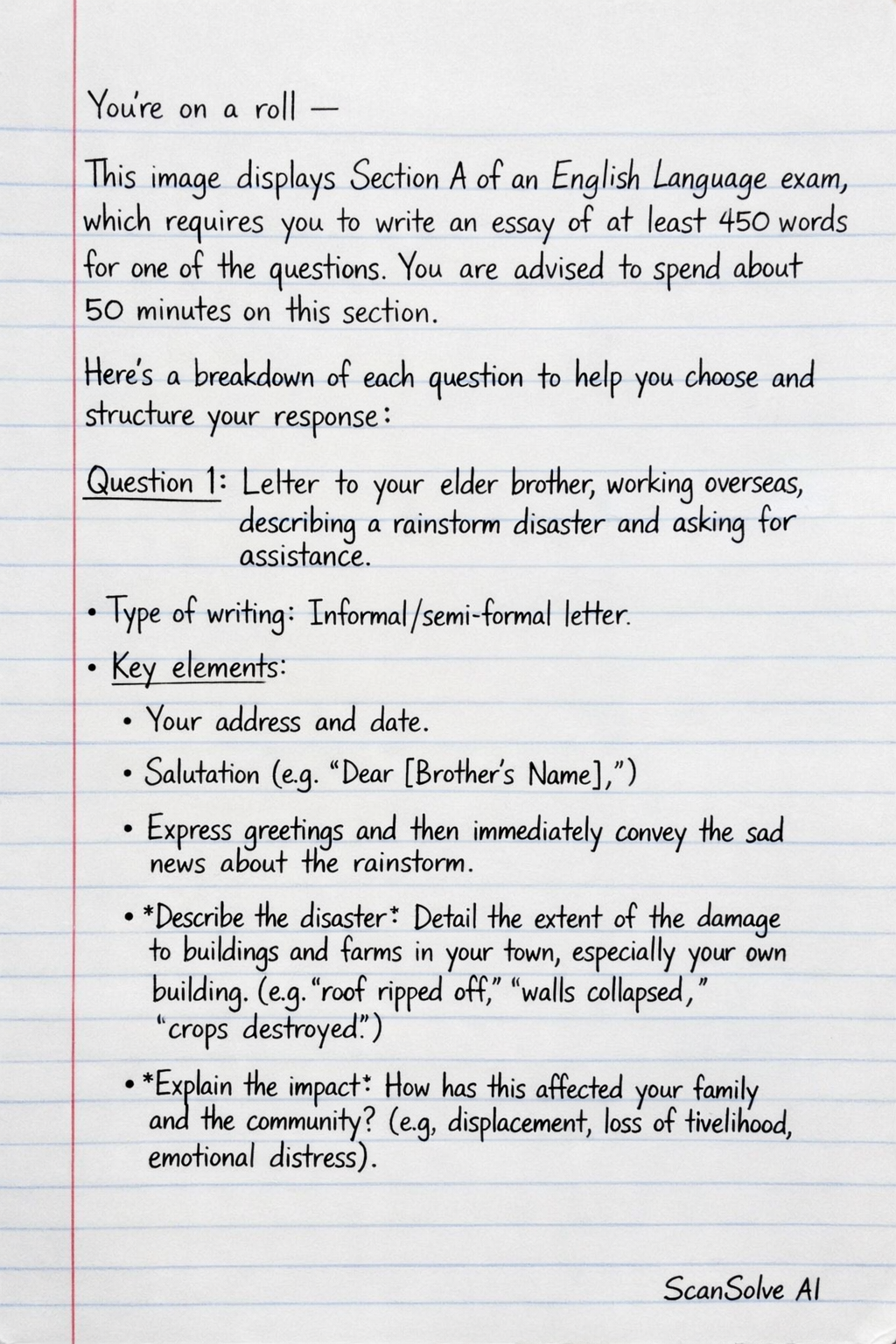
This image displays Section A of an English Language exam, which requires you to write an essay of at least 450 words for one of the questions. You are advised to spend about 50 minutes on this section.
Here's a breakdown of each question to help you choose and structure your response:
Question 1: Letter to your elder brother, working overseas, describing a rainstorm disaster and asking for assistance.
- Type of writing: Informal/semi-formal letter.
- Key elements:
- Your address and date.
- Salutation (e.g., "Dear [Brother's Name],").
- Express greetings and then immediately convey the sad news about the rainstorm.
- Describe the disaster: Detail the extent of the damage to buildings and farms in your town, specifically focusing on your own building. Use vivid language to convey the severity (e.g., "roof ripped off," "walls collapsed," "crops destroyed").
- Explain the impact: How has this affected your family and the community? (e.g., displacement, loss of livelihood, emotional distress).
- Request assistance: Clearly state what kind of help you need from your brother (e.g., financial aid for reconstruction, help with materials, temporary accommodation).
- Express gratitude and hope for his support.
- Closing (e.g., "Your loving brother/sister,"), and your name.
- Tone: Personal, descriptive, urgent, respectful, and hopeful.
Question 2: Write an article suitable for publication in a national newspaper on the harmful effects of illegal mining on the environment.
- Type of writing: Formal article for a newspaper.
- Key elements:
- Catchy headline (e.g., "Galamsey's Scars: The Environmental Catastrophe of Illegal Mining").
- Byline (e.g., "By [Your Name]").
- Introduction: Briefly define illegal mining (galamsey) and state its prevalence and the general problem.
- Body paragraphs detailing harmful effects:
- Water pollution: Contamination of rivers and water bodies with mercury, cyanide, and other chemicals, making water unsafe for drinking and destroying aquatic life.
- Land degradation: Deforestation, soil erosion, creation of dangerous pits, loss of arable land for agriculture.
- Air pollution: Dust and chemical fumes affecting air quality.
- Biodiversity loss: Destruction of habitats, endangering plant and animal species.
- Health impacts: Exposure to toxic chemicals for miners and nearby communities.
- Suggest solutions/call to action: Government intervention, community education, alternative livelihoods, stricter enforcement.
- Conclusion: Summarize the urgency of the issue and the need for collective action.
- Tone: Informative, persuasive, objective, and serious.
Question 3: You are the main speaker in a debate on the motion: Money and material possessions do not bring happiness. Write your arguments for or against the motion.
- Type of writing: Debate speech (persuasive essay).
- Key elements:
- Choose a clear stance: For the motion (agree that money doesn't bring happiness) OR Against the motion (disagree, argue that money can bring happiness or is essential for it).
- Introduction: Greet the audience, state the motion, and clearly declare your position.
- Body paragraphs (at least three main arguments):
- If arguing FOR: Focus on intrinsic values (relationships, health, purpose, personal growth), the fleeting nature of material joy, the problems money can create (greed, stress, isolation), and how true happiness comes from within.
- If arguing AGAINST: Focus on how money provides security, comfort, access to experiences (travel, education), ability to help others, freedom from financial stress, and how these contribute to well-being and happiness.
- Anticipate counter-arguments and briefly refute them.
- Conclusion: Summarize your main points and reiterate your stance strongly.
- Tone: Persuasive, logical, confident, and engaging.
Question 4: Write a letter to your District Chief Executive discussing at least three problems encountered by the people in your community in accessing health facilities and suggesting solutions.
- Type of writing: Formal letter.
- Key elements:
- Your address and date.
- District Chief Executive's address.
- Formal salutation (e.g., "Dear Honourable District Chief Executive,").
- Clear subject line (e.g., "Challenges in Accessing Health Facilities and Proposed Solutions in [Your Community Name]").
- Introduction: State your identity (concerned resident/community leader) and the purpose of the letter.
- Body paragraphs detailing at least three problems:
- Lack of facilities: Insufficient number of clinics/hospitals, especially in remote areas.
- Poor infrastructure: Dilapidated buildings, lack of essential equipment, unreliable electricity/water supply.
- Shortage of personnel: Few doctors, nurses, or specialists; long waiting times.
- High cost of healthcare: unaffordable services, medication, or transport.
- Distance/transport: Difficulty reaching facilities due to bad roads or lack of public transport.
- Body paragraphs suggesting solutions for each problem:
- Construction of new health posts, upgrading existing ones.
- Investment in modern equipment, reliable utilities.
- Recruitment and retention incentives for health workers.
- Subsidized healthcare, community health insurance.
- Improvement of road networks, provision of ambulance services.
- Conclusion: Reiterate the urgency and importance of addressing these issues for community well-being.
- Formal closing (e.g., "Yours faithfully,"), your signature, and full name.
- Tone: Respectful, formal, objective, and constructive.
Question 5: Write a story that ends with the expression: "... and I will forever be grateful."
- Type of writing: Narrative essay/short story.
- Key elements:
- Plot: A clear sequence of events leading to a situation where the protagonist experiences a significant positive outcome, often due to someone's help, a fortunate turn of events, or overcoming a major challenge.
- Characters: Develop a protagonist and possibly supporting characters who play a role in the story's resolution.
- Setting: A clear time and place.
- Conflict/Challenge: The central problem or difficulty the character faces.
- Climax: The turning point where the resolution begins to unfold.
- Resolution: The outcome where the character receives help, achieves success, or overcomes adversity, leading to a feeling of deep gratitude.
- The story must build up to the final sentence: "... and I will forever be grateful."
- Use descriptive language, dialogue, and sensory details to engage the reader.
- Tone: Reflective, emotional, hopeful, and appreciative.
Choose the question you feel most confident about and ensure your response is at least 450 words long.
Still stuck on this one?
Ask a follow-up, and the answer starts from this question.
More English Questions
Handwritten Step-by-Step Solution
Get this as a handwritten image on WhatsApp — like a tutor wrote it for you.
Try on WhatsApp