
We read your photo as:
Please answer the following literature questions.
ScanSolve AI Answer
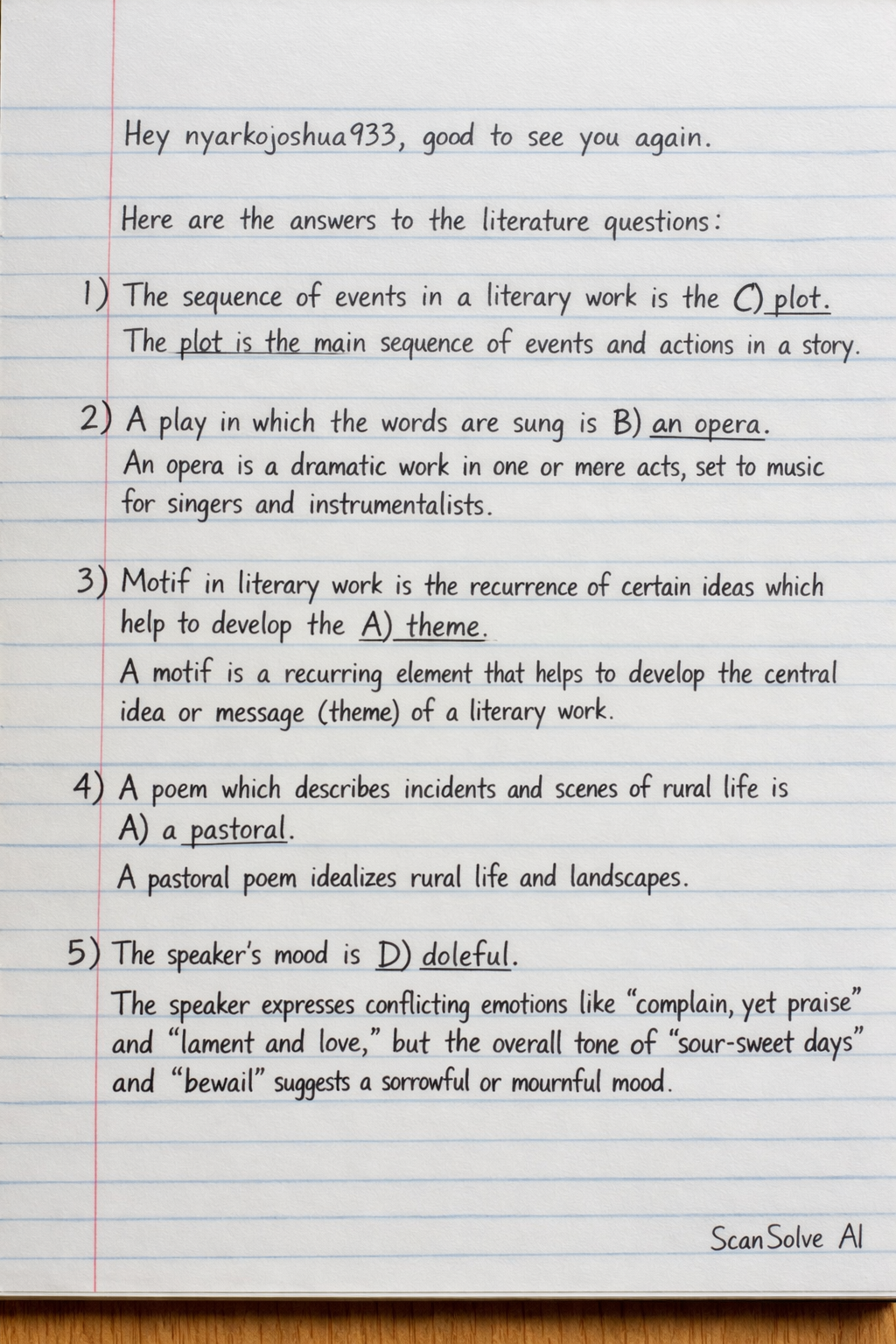
Here are the answers to the literature questions:
1) The sequence of events in a literary work is the
C) plot
The plot is the main sequence of events and actions in a story.
2) A play in which the words are sung is
B) an opera
An opera is a dramatic work in one or more acts, set to music for singers and instrumentalists.
3) Motif in literary work is the recurrence of certain ideas which help to develop the
A) theme
A motif is a recurring element that helps to develop the central idea or message (theme) of a literary work.
4) A poem which describes incidents and scenes of rural life is
A) a pastoral
A pastoral poem idealizes rural life and landscapes.
5) The speaker's mood is
D) doleful
The speaker expresses conflicting emotions like "complain, yet praise" and "lament and love," but the overall tone of "sour-sweet days" and "bewail" suggests a sorrowful or mournful mood.
6) The dominant literary device used is
B) oxymoron
Phrases like "sour-sweet" and "complain, yet praise" combine contradictory terms, which is an oxymoron.
7) Not on my sole, but on thy soul, harsh Jew illustrates
B) Pun
This line uses a pun, a play on words, by using "sole" (bottom of the foot) and "soul" (spiritual part of a person), which are homophones.
8) The options for question 8 are not visible in the image, so I cannot answer this question.
9) The expression devastated sorrow illustrates
A) transferred epithet
A transferred epithet is when an adjective grammatically modifies a noun other than the person or thing it is actually describing (e.g., "devastated" describes Celia, but is transferred to "sorrow").
10) The attitude of the writer is one of
D) anger
The phrase "Her star cursing the rogue" indicates a strong negative emotion directed at the thief, which the writer portrays as anger.
11) The last line illustrates
A) zeugma
The line "That stole her purse and her heart" uses zeugma, where a single verb ("stole") applies to two different objects ("purse" and "heart") in a way that one is literal and the other is figurative.
12) Her love for the boy was not unending illustrates
B) litotes
Litotes is a figure of speech that employs an understatement by using double negatives or an ironic understatement (e.g., "not unending" implies that it did end or was limited).
13) Our sighs are quiet echoes of our hearts illustrates
B) metonymy
Metonymy is a figure of speech in which a thing or concept is referred to by the name of something closely associated with that thing or concept (e.g., "sighs" are an outward manifestation closely associated with the emotions of the "heart").
14) A speech directly addressed to the audience and added at the end of a drama is
C) an epilogue
An epilogue is a section or speech at the end of a book or play that serves as a comment on or a conclusion to what has happened.
15) A literary work in which characters and events represent ideas is
D) an allegory
An allegory is a story, poem, or picture that can be interpreted to reveal a hidden meaning, typically a moral or political one.
16) A literary work that essentially develops plot and characters through dialogue and action is
C) drama
Drama is a mode of fictional representation through dialogue and performance.
17) In literature, setting refers to
A) time and place
The setting of a story is the time and geographical location within a narrative or work of fiction.
Still stuck on this one?
Ask a follow-up, and the answer starts from this question.
More English Questions
Handwritten Step-by-Step Solution
Get this as a handwritten image on WhatsApp — like a tutor wrote it for you.
Try on WhatsApp