
Do them in English
ScanSolve AI Answer
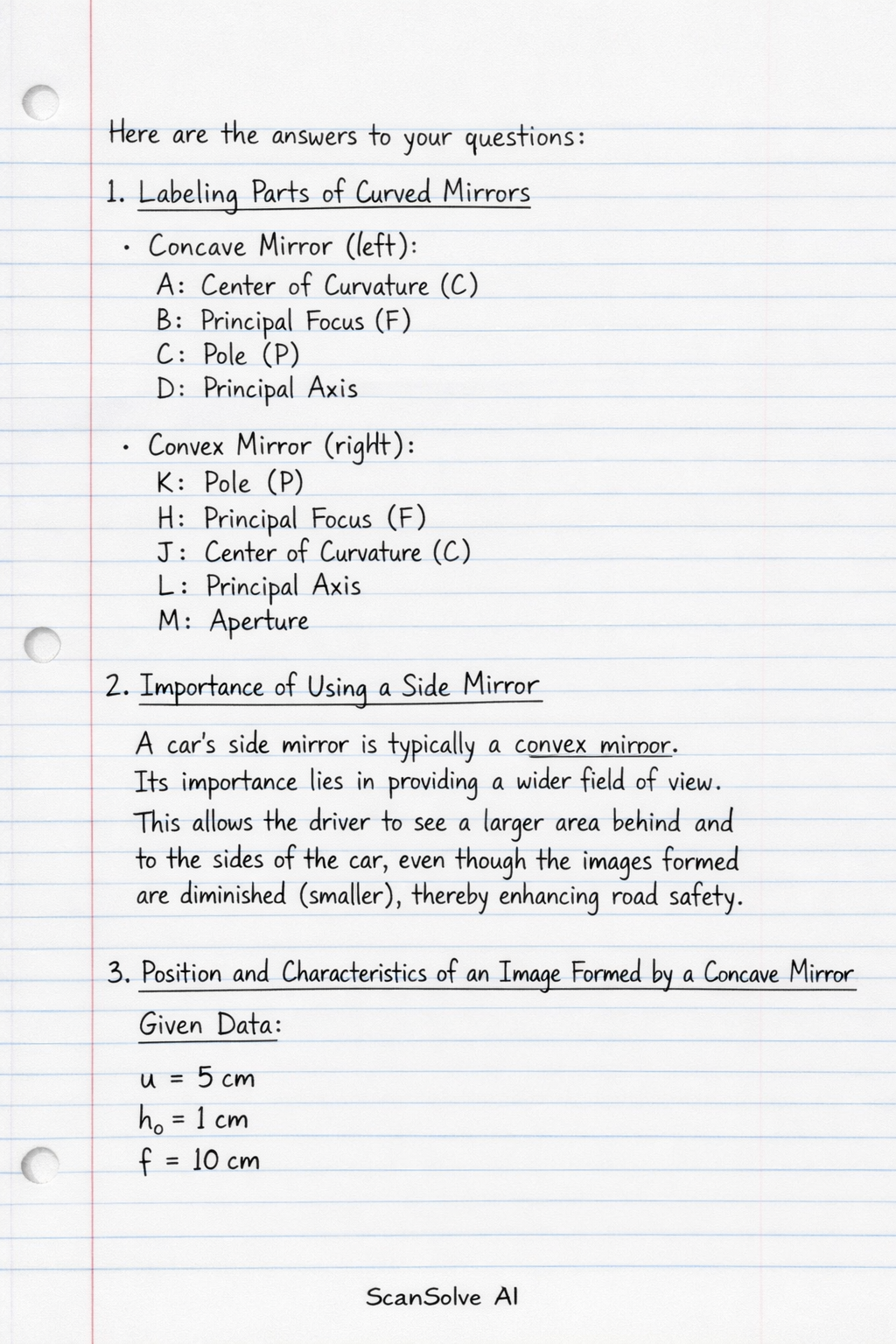
Here are the answers to your questions:
1. Labeling Parts of Curved Mirrors
- Concave Mirror (left):
- A: Center of Curvature (C)
- B: Principal Focus (F)
- C: Pole (P)
- D: Principal Axis
- Convex Mirror (right):
- K: Pole (P)
- H: Principal Focus (F)
- J: Center of Curvature (C)
- L: Principal Axis
- M: Aperture
2. Importance of Using a Side Mirror
A car's side mirror is typically a convex mirror. Its importance lies in providing a wider field of view. This allows the driver to see a larger area behind and to the sides of the car, even though the images formed are diminished (smaller), thereby enhancing road safety.
3. Position and Characteristics of an Image Formed by a Concave Mirror
-
Given Data:
- Object distance () =
- Object height () =
- Focal length () =
-
Step 1: Use the Mirror Formula to find the image distance (). The mirror formula is given by:
Substitute the given values:
-
Step 2: Solve for .
The negative sign indicates that the image is formed behind the mirror and is virtual.
-
Step 3: Calculate the Magnification () and Image Height (). The magnification formula is:
Substitute the values:
Also, magnification is given by:
The positive magnification indicates an erect image.
-
Step 4: State the Position and Characteristics of the Image.
- Position: The image is formed .
- Characteristics: The image is .
4. Why Supermarket Security Managers Use Convex Mirrors
Supermarket security managers use convex mirrors because they provide a very wide field of view. This allows them to monitor a large section of the store simultaneously, which is crucial for security surveillance, even though the images formed are diminished and virtual.
5. Object Placed Between F and C of a Concave Mirror
*a) Locating the Position of the Image using Ray Tracing: 1. Draw a ray from the top of the object parallel to the principal axis. After reflection, this ray will pass through the principal focus (F). 2. Draw a second ray from the top of the object passing through the principal focus (F). After reflection, this ray will become parallel to the principal axis. 3. The point where these two reflected rays intersect is the top of the image. 4. The image will be formed beyond the center of curvature (C).
*b) Describing the Characteristics of the Image: * The image is (can be projected onto a screen). * The image is (upside down). * The image is (larger than the object). * The image is formed .
Still stuck on this one?
Ask a follow-up, and the answer starts from this question.
More English Questions
Handwritten Step-by-Step Solution
Get this as a handwritten image on WhatsApp — like a tutor wrote it for you.
Try on WhatsApp