

This English question involves literary analysis, grammar, or writing skills. The detailed response below provides a well-structured answer with supporting evidence and clear explanations.
ScanSolve AI Answer
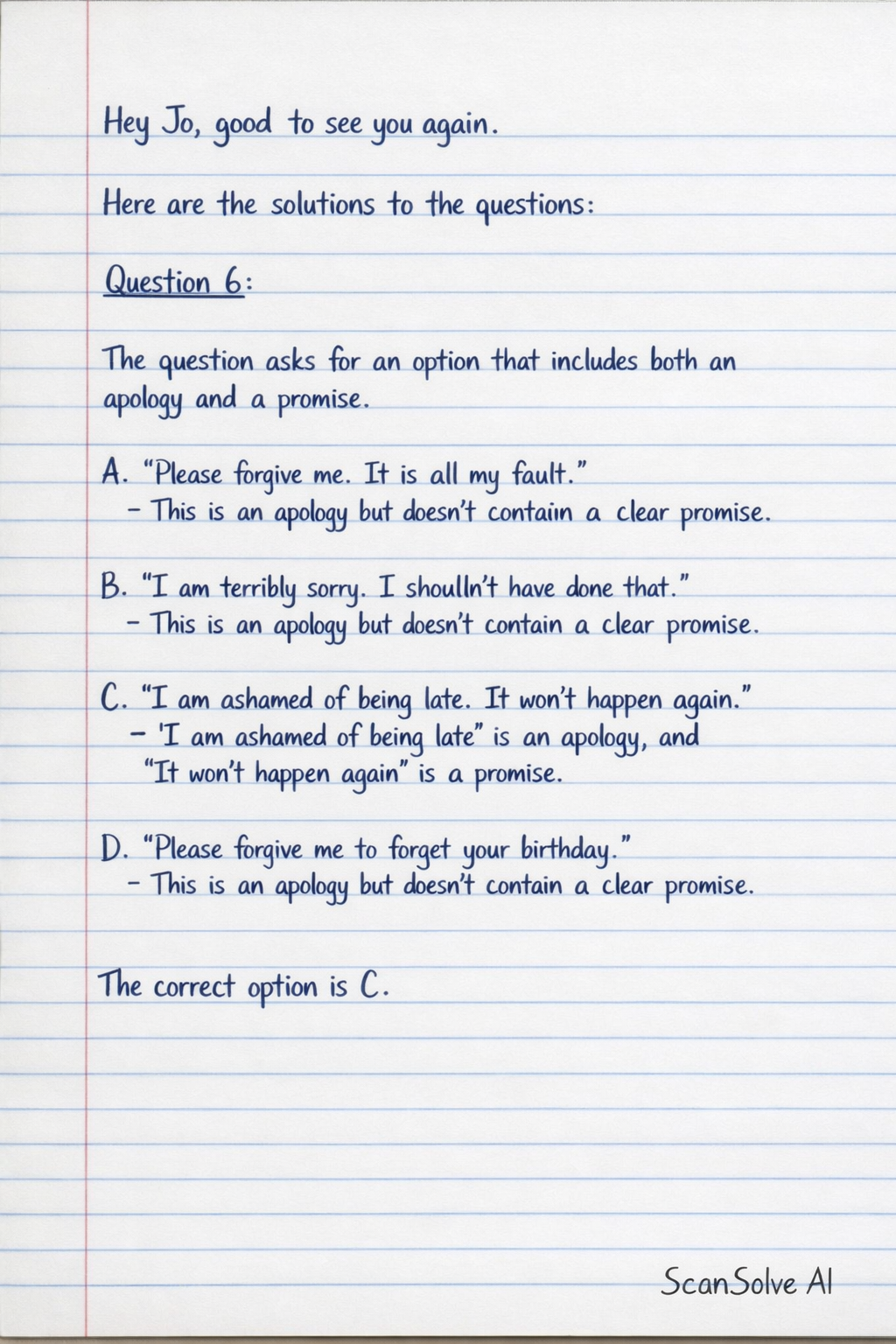
Hey Jo, good to see you again. Here are the solutions to the questions: Question 6: The question asks for an option that includes both an apology and a promise. A. "Please forgive me. It is all my fault." - This is an apology but doesn't contain a clear promise. B. "I am terribly sorry. I shouldn't have done that." - This is an apology but doesn't contain a clear promise. C. "I am ashamed of being late. It won't happen again." - "I am ashamed of being late" is an apology, and "It won't happen again" is a promise. D. "Please forgive me to forget your birthday." - This is an apology but doesn't contain a clear promise. The correct option is C. Question 7: Tom is apologizing for missing the train. Adam's response should be an acceptance or dismissal of the apology. A. "Don't worry about it" - This is an appropriate response, accepting the apology. B. "Don't mention it" - This is an appropriate response, accepting the apology. C. "Forget about it" - This is an appropriate response, accepting the apology. D. "I am ashamed of it" - This is an apology itself, not a response to an apology. It would mean Adam is apologizing, which doesn't fit the context. The option that is not an appropriate response is D. Question 8: The sentence describes someone who is often late but doesn't perform the act of apologizing. A. "excuses" - "She never excuses to her friends" is grammatically incorrect in this context. B. "apologizes" - "She never apologizes to her friends" correctly conveys that she doesn't say sorry. C. "forgives" - "She never forgives to her friends" is grammatically incorrect and doesn't fit the meaning. D. "feel sorry" - "She never feel sorry" is grammatically incorrect (should be "feels sorry") and doesn't fit the structure "to her friends". The correct option is B. Question 9: The speaker is explaining why they missed a party and is asking for understanding. A. "forgive" - "I hope you can forgive me" is a common and appropriate way to ask for pardon after missing an event. B. "pardon" - While similar, "pardon me" is often used for minor offenses or asking someone to repeat something. "Pardon me for missing" is less common than "forgive me for missing" in this context. C. "excuse" - "Excuse me" is used for minor interruptions or asking permission. "Excuse me for missing" is possible but "forgive" is stronger for a missed important event. D. "apologize" - "Apologize me" is grammatically incorrect. One would say "apologize to me" or "apologize for missing". The most appropriate option is A. Question 10: The speaker is taking responsibility for losing the keys and expressing regret. A. "It doesn't matter" - This contradicts the speaker's statement "I should have been more careful." B. "You couldn't help it" - This contradicts the speaker taking responsibility. C. "No harm done" - This contradicts the speaker's regret and implies the situation is not serious, which doesn't fit "I should have been more careful." D. "It is all my fault" - This directly expresses responsibility and fits perfectly with "I should have been more careful." The correct option is D. Send me the next one 📸