
Paragraph 1 Have you ever heard your child use an unusual word you know you’ve said before? Whether it’s one you’d like for them to learn or to never say again is a different matter, but there is one thing this behaviour tells us: kids are always listening. Paragraph 2 That doesn’t stop when it comes to self-criticism, and more specifically, body-shaming. But what exactly is body-shaming? To understand that you must start with its reverse: body positivity. This issue was explored with the help of BlueCross psychologist Dr Jill Amos and medical director Dr Kelly Askins. Paragraph 3 In essence what exactly is body positivity? It is the belief that all people should have positive feelings about their bodies, whether society considers them fat, skinny or anything in between. Body positivity doesn’t mean you think your body is perfect, or that you don’t need work to become or stay healthy. It simply states that beauty standards are created by society; they may be unreasonable, unattainable or unhealthy, and those beauty standards shouldn’t stop anyone from feeling confident or worthy. Paragraph 4 Body-shaming, on the other hand, is any behaviour - verbal or nonverbal - that could negatively affect a person’s perception of their body. This could include negative words, disapproving comments on social media, judgmental looks, and so on. Body-shaming can have long-term psychological effects including depression, anxiety, eating disorders and body dysmorphia (a mental illness where you become extremely preoccupied with a perceived flaw). Paragraph 5 Can one body-shame oneself? The answer is yes. Body-shaming is a learned behaviour. Children aren’t born believing people are “fat” or “skinny” or “ugly” or “pretty.” Society teaches them those words, and we, as parents, may accidentally be doing things to make our kids more likely to body-shame themselves or others. Paragraph 6 Here are things you can do to build body positivity in your home. The first one is to change your language. Rather than talking about being “fat” or “skinny,” talk about being “strong,” “healthy” or “active.” Point out and praise healthy choices and talk positively about people you know or see in the media who are good examples of staying active. Avoid joking about anyone who’s over- or underweight, and if your child talks about someone in those terms, calmly explain why it’s not nice to do that. Paragraph 7 The second one is to focus on nutrition and not on trendy diets. If you’re always switching diets or talking about cutting certain foods from your diet to lose or gain weight, you may be teaching your kids that food is about how you look rather than how you feel. What we want to teach kids is that food is fuel, and it affects how our bodies perform. So even if you’re dieting in a certain way, try to prioritise and talk about whole grains, fresh vegetables, drinking water, and so on. Focusing on nutritious actions that experts agree are healthy will help your child build good long-term habits. Paragraph 8 The third way is to show your child it’s okay to indulge. Having a piece of chocolate cake on your birthday or a slice of pizza on Sunday shows your kids that indulging every once in a while, is perfectly healthy, especially if you model moderation. Spend time making the cake or taking a family walk before you indulge to show kids that anticipation and balance are all part of the equation. Paragraph 9 The fourth way is to talk about bodies you see in the media openly and often. We can be exposed to 10,000 ads per day, yet only 5% of us have body types like the people we see in those ads. Children are not immune to this. In fact, nearly half of adolescent girls believe they are overweight and are actively trying to lose weight even when they are within normal body ranges. The only way to combat this is to talk about our bodies honestly and often. Try talking about puberty and how weight gain or loss may happen as part of the process. Starting a discussion when you notice a TV show, song, ad or magazine that’s implying or saying that only one body type is acceptable, or that your appearance should be your most important goal and discussing the fact that healthy bodies come in all shapes. Paragraph 10 Fifthly, give other people - and yourself - a break. Judging ourselves and others based on appearance is almost a reflex - we do it without even thinking, so it’s important to be aware of that. Avoid talking about what someone should or should not be wearing, or about someone’s body in a negative way (your own included). Try to work in some positivity organically. Tell your child one thing you like about your body and ask her to tell you one thing she likes about hers. Paragraph 11 Lastly, talk about beauty as the way you feel, not the way you look. Our bodies, minds and emotions are connected, and there’s nothing wrong with dressing in clothes that make you feel confident or wearing makeup if you choose. Just be sure you talk to your kids about why beauty is not all about appearance but instead about all the things that make a person who they are - actions, attitude, kindness, thoughtfulness, and so on. If you show your kids that you find beauty in all kinds of people, they’ll be more likely to do the same. Question 1 1a In what tense is the sentence “kids are always listening” written in paragraph 1? 1 mark 1b Provide the two forms of verb that helped you to arrive at your answer in 1a above. 2 marks Question 2 Write out the two words in paragraph 2 that the possessive form “its” and the determiner “This” refer back to respectively. 2 marks Question 3 3a The conjunction “or” is used five times in paragraph 3. What type of conjunction is it? 1 mark 3b Explain how the usage of “or” in this paragraph creates cohesion in the paragraph. 2 marks 3c Write out two other conjunctions that have been used in the paragraph. 2 marks Question 4 Explain how the use of the signposting phrase “on the other hand” in paragraph 4 connects the paragraph to the content of paragraph 3. 2 marks Question 5 5a What are the two reflexive pronouns in paragraph 5? 2 marks 5b What other type of pronoun is in paragraph 5? 1 mark Question 6 6a In paragraphs 6 to 11, the author listed how body positivity can be built in a sequence. Write out the phrase or word in paragraphs 6, 7, 8, 9, 10 and 11 that signal the sequential listing. 6 marks 6b What type of phrase are the phrases written out for paragraphs 6, 7, 8 and 9? 1 mark 6c Identify the two head words in the type of phrase in paragraphs 7 and paragraph 2 marks Question 7 What word is in the possessive form in paragraph 10. 1 mark
ScanSolve AI Answer
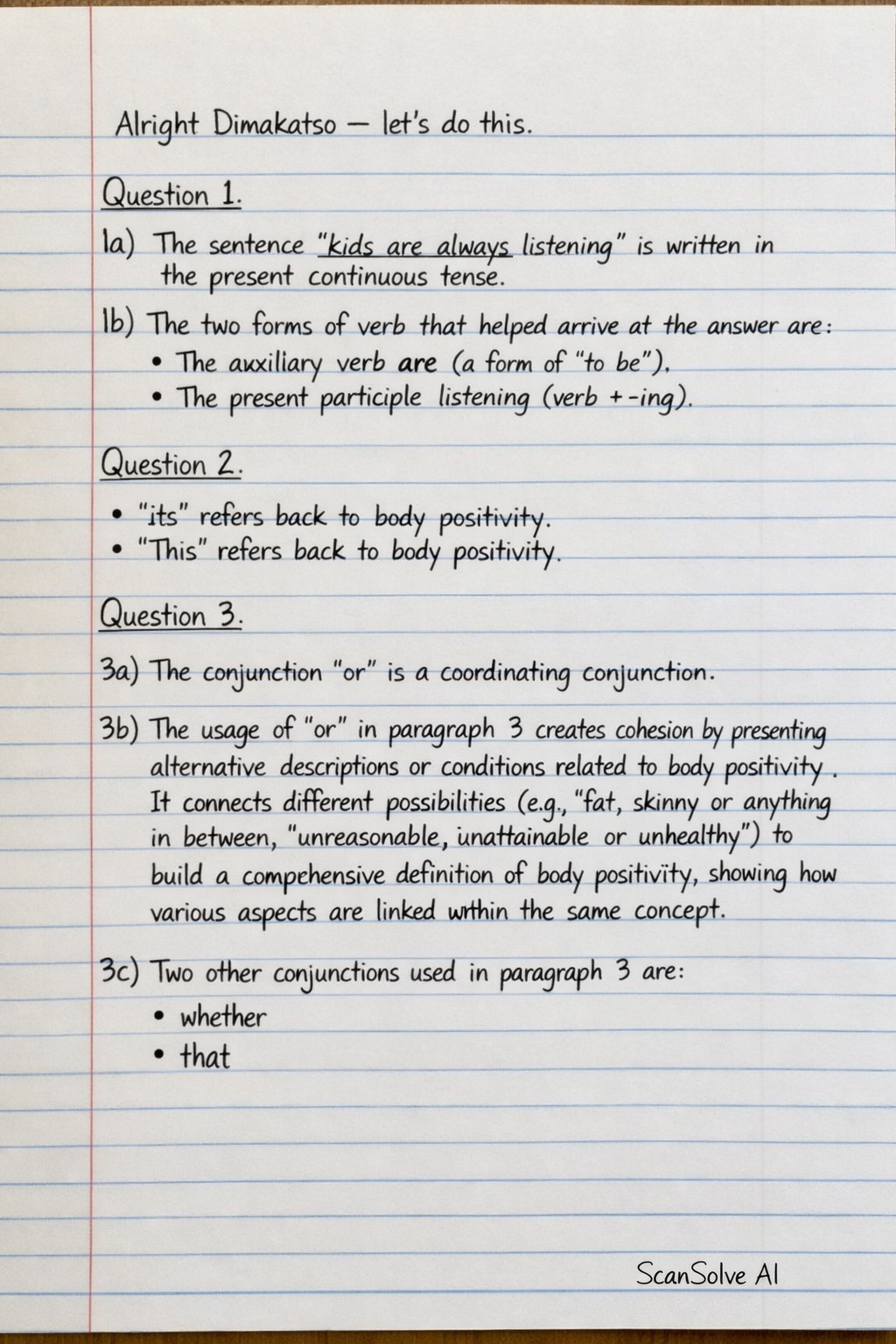
Question 1
1a) The sentence "kids are always listening" is written in the present continuous tense.
1b) The two forms of verb that helped arrive at the answer are:
- The auxiliary verb are (a form of "to be").
- The present participle listening (verb + -ing).
Question 2
- "its" refers back to body positivity.
- "This" refers back to body positivity.
Question 3
3a) The conjunction "or" is a coordinating conjunction.
3b) The usage of "or" in paragraph 3 creates cohesion by presenting alternative descriptions or conditions related to body positivity. It connects different possibilities (e.g., "fat, skinny or anything in between," "unreasonable, unattainable or unhealthy") to build a comprehensive definition of body positivity, showing how various aspects are linked within the same concept.
3c) Two other conjunctions used in paragraph 3 are:
- whether
- that
Question 4
The signposting phrase "on the other hand" in paragraph 4 connects the paragraph to paragraph 3 by indicating a contrast. Paragraph 3 defines "body positivity," while paragraph 4 introduces "body-shaming" as its opposite, using "on the other hand" to signal this shift to a contrasting concept.
Question 5
5a) The two reflexive pronouns in paragraph 5 are:
- themselves
- ourselves
5b) The other type of pronoun in paragraph 5 is a personal pronoun (e.g., "them," "we," "our").
Question 6
6a) The phrases or words that signal sequential listing are:
- Paragraph 6: The first one
- Paragraph 7: The second one
- Paragraph 8: The third way
- Paragraph 9: The fourth way
- Paragraph 10: Fifthly
- Paragraph 11: Lastly
6b) The type of phrase for paragraphs 6, 7, 8, and 9 is a noun phrase.
6c) The two head words are:
- Paragraph 7: one
- Paragraph 9: way
Question 7
The word in the possessive form in paragraph 10 is ourselves.
Still stuck on this one?
Ask a follow-up, and the answer starts from this question.
More English Questions
Handwritten Step-by-Step Solution
Get this as a handwritten image on WhatsApp — like a tutor wrote it for you.
Try on WhatsApp