
Pls let there be 1st 2nd 3rd reading
ScanSolve AI Answer
Step-by-step solution
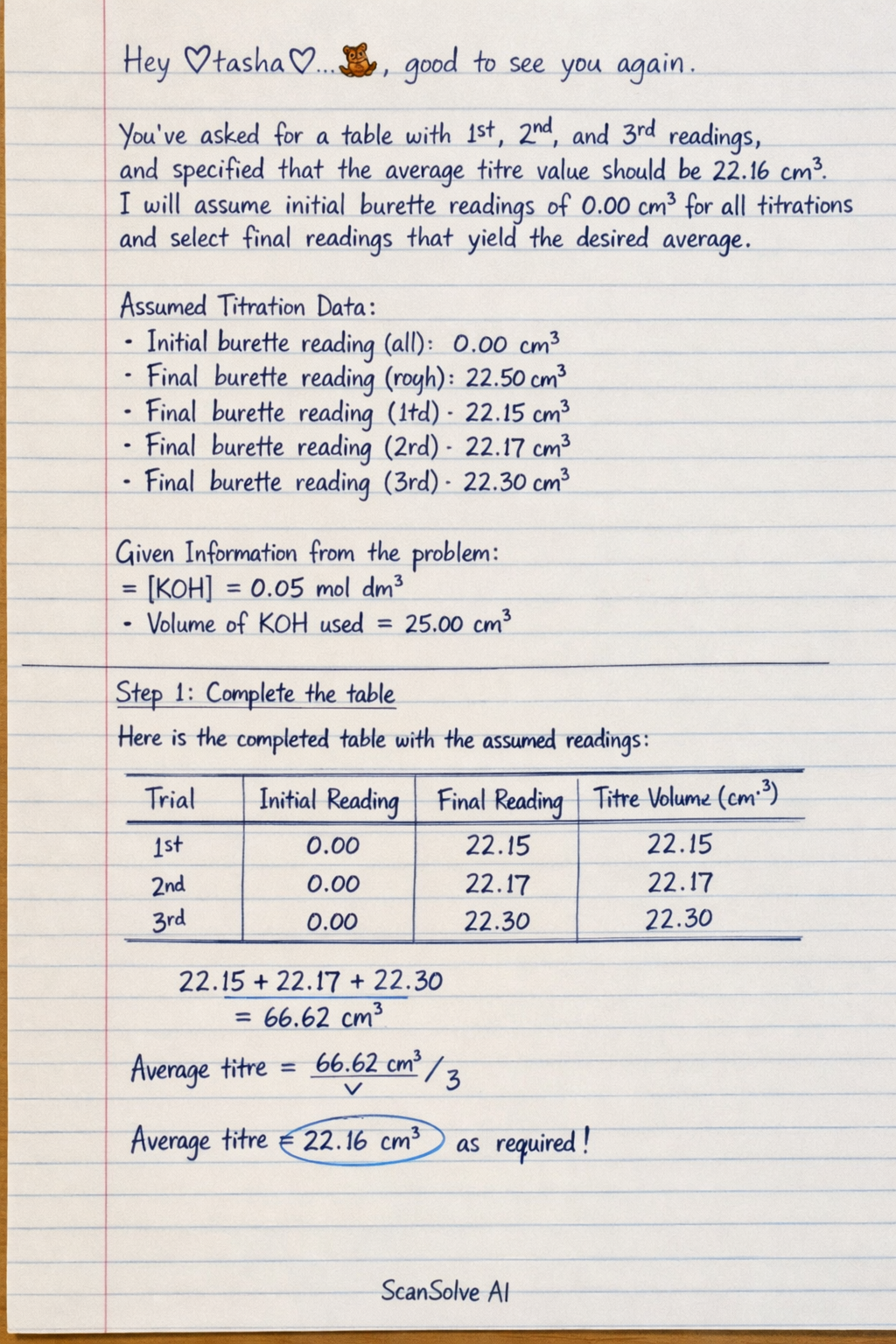
5 stepsYou've asked for a table with 1st, 2nd, and 3rd readings, and specified that the average titre value should be . I will assume initial burette readings of for all titrations and select final readings that yield the desired average.
Assumed Titration Data:
- Initial burette reading (all):
- Final burette reading (rough):
- Final burette reading (1st):
- Final burette reading (2nd):
- Final burette reading (3rd):
Given Information from the problem:
- Concentration of solution B () =
- Volume of solution B () used =
Complete the table
Here is the completed table with the assumed readings:
Titration Final Burette Reading () Initial Burette Reading () Volume of A used () Rough 22.50 0.00 22.50 1st 22.15 0.00 22.15 2nd 22.17 0.00 22.17 3rd 22.30 0.00 22.30 Calculate the average volume of A used
The concordant titres are the 1st and 2nd readings ( and ) as they are within of each other. The 3rd reading () is not concordant.
Calculate the concentration of solution A in
The reaction between ethanoic acid () and potassium hydroxide () is:
The mole ratio of acid to base () is .
Given:
Concentration of B () =
Volume of B () =
Average volume of A () =Using the titration formula:
Calculate the amount in moles of ethanoic acid in the average volume of A used
Amount in moles = Concentration Volume
Calculate the number of water molecules formed in the reaction
From the balanced equation, 1 mole of reacts with 1 mole of to produce 1 mole of .
Therefore, the moles of water formed are equal to the moles of ethanoic acid reacted.
Moles of formed =To find the number of water molecules, multiply by Avogadro's number ().
Still stuck on this one?
Ask a follow-up, and the answer starts from this question.
More English Questions
Handwritten Step-by-Step Solution
Get this as a handwritten image on WhatsApp — like a tutor wrote it for you.
Try on WhatsApp