
We read your photo as:
Provide solutions with explanations in English
ScanSolve AI Answer
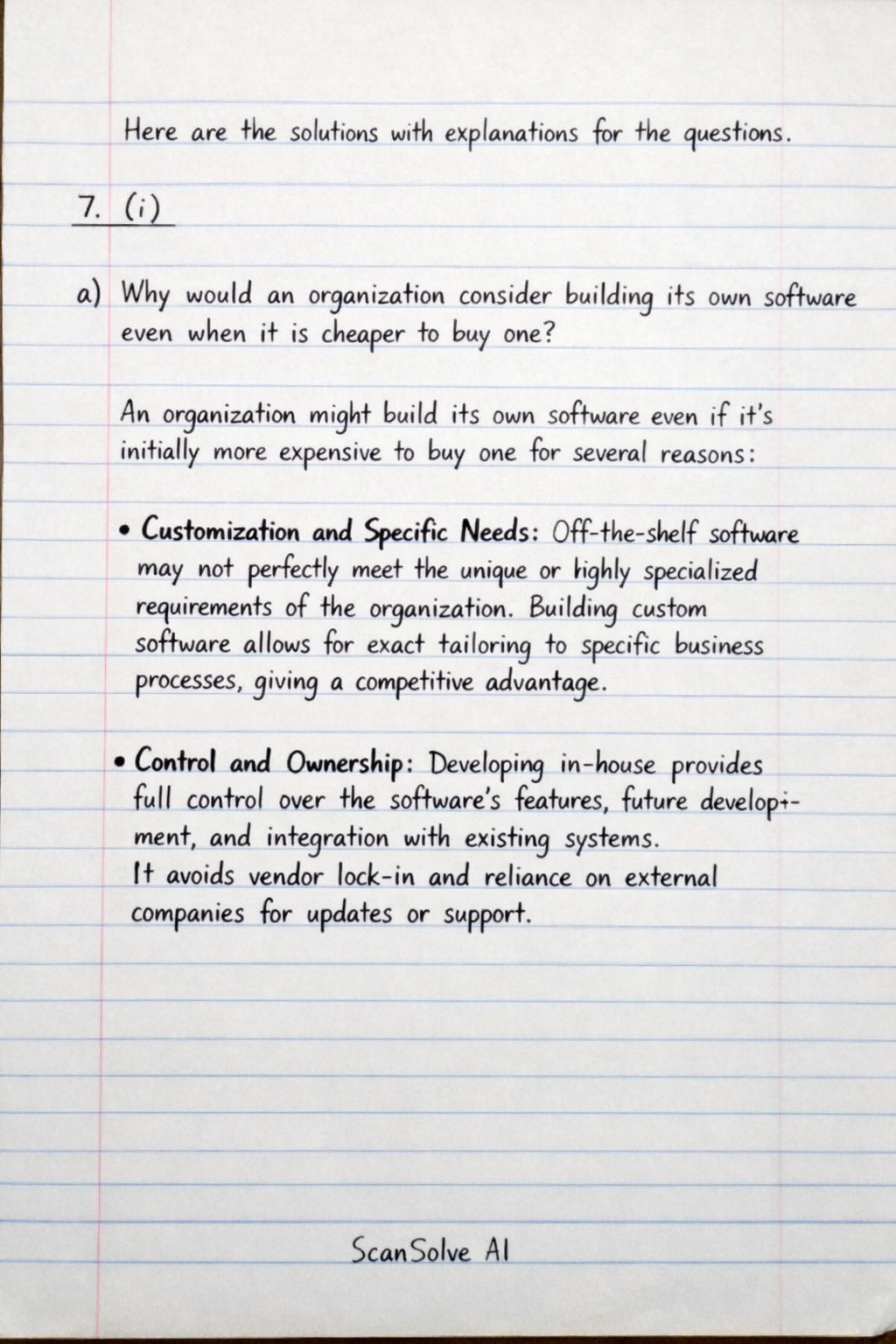
Here are the solutions with explanations for the questions.
7. (i)
a) Why would an organisation consider building its own software even when it is cheaper to buy one?
An organization might build its own software even if it's initially more expensive to buy one for several reasons:
- Customization and Specific Needs: Off-the-shelf software may not perfectly meet the unique or highly specialized requirements of the organization. Building custom software allows for exact tailoring to specific business processes, giving a competitive advantage.
- Control and Ownership: Developing in-house provides full control over the software's features, future development, and integration with existing systems. It avoids vendor lock-in and reliance on external companies for updates or support.
b) What is the purpose of the system development life cycle (SDLC)?
The purpose of the System Development Life Cycle (SDLC) is to provide a structured, systematic, and disciplined approach to developing, maintaining, and enhancing information systems. It ensures that all phases of development, from initial planning to deployment and maintenance, are thoroughly managed, leading to high-quality software that meets user requirements within budget and on schedule.
c) What is the difference between the pilot implementation methodology and the parallel methodology?
- Pilot Implementation: In this methodology, the new system is introduced to a small, selected group of users or a specific department first. If successful, it is then rolled out to the rest of the organization. The old system continues to operate for the majority of users until the pilot is complete.
- Parallel Implementation: In this methodology, the new system and the old system run simultaneously for a period. All users operate both systems at the same time, processing data through both, until the new system is proven reliable. This provides a complete backup in case the new system fails.
The key difference is that pilot implementation introduces the new system to a subset of users, while parallel implementation runs both systems concurrently for all users.
d) State and describe two objectives of the design phase of the SDLC.
Two objectives of the design phase of the SDLC are:
- To define the system architecture: This involves determining the overall structure of the system, including its components, modules, interfaces, and data flow. It outlines how the system will be built to meet the functional and non-functional requirements identified in the analysis phase.
- To specify detailed system components: This objective focuses on creating detailed specifications for each part of the system, such as database design (schemas, tables), user interface design (screens, reports), network architecture, and algorithms for processing. These detailed designs serve as blueprints for the development team.
7. (ii)
a) State two ways through which confidentiality of information can be achieved.
Two ways through which confidentiality of information can be achieved are:
- Access Control: Implementing strict access controls ensures that only authorized individuals, processes, or systems can view or access sensitive information. This includes mechanisms like user authentication (passwords, biometrics), authorization (roles, permissions), and physical security measures.
- Encryption: Encrypting data, both at rest (stored) and in transit (transmitted), transforms it into an unreadable format using cryptographic algorithms. Only those with the correct decryption key can convert the data back into its original, readable form, thus protecting it from unauthorized disclosure.
b) Give an example of a scenario where availability can be compromised.
An example of a scenario where availability can be compromised is a Distributed Denial of Service (DDoS) attack. In this scenario, multiple compromised computer systems (a botnet) flood a target server or network with a massive volume of traffic, overwhelming its resources and making it unable to respond to legitimate user requests. This effectively renders the service or information unavailable to its intended users.
c) State three characteristics of information that make it useful for decision-making.
Three characteristics of information that make it useful for decision-making are:
- Accuracy: The information must be correct, free from errors, and reliable. Inaccurate information can lead to flawed analysis and poor decisions.
- Timeliness: The information must be available when needed and up-to-date. Outdated information may no longer be relevant or reflect the current situation, leading to ineffective decisions.
- Relevance: The information must be pertinent and directly related to the decision being made. Irrelevant information can distract from key issues and complicate the decision-making process.
Still stuck on this one?
Ask a follow-up, and the answer starts from this question.
More English Questions
Handwritten Step-by-Step Solution
Get this as a handwritten image on WhatsApp — like a tutor wrote it for you.
Try on WhatsApp