

This English question involves literary analysis, grammar, or writing skills. The detailed response below provides a well-structured answer with supporting evidence and clear explanations.
ScanSolve AI Answer
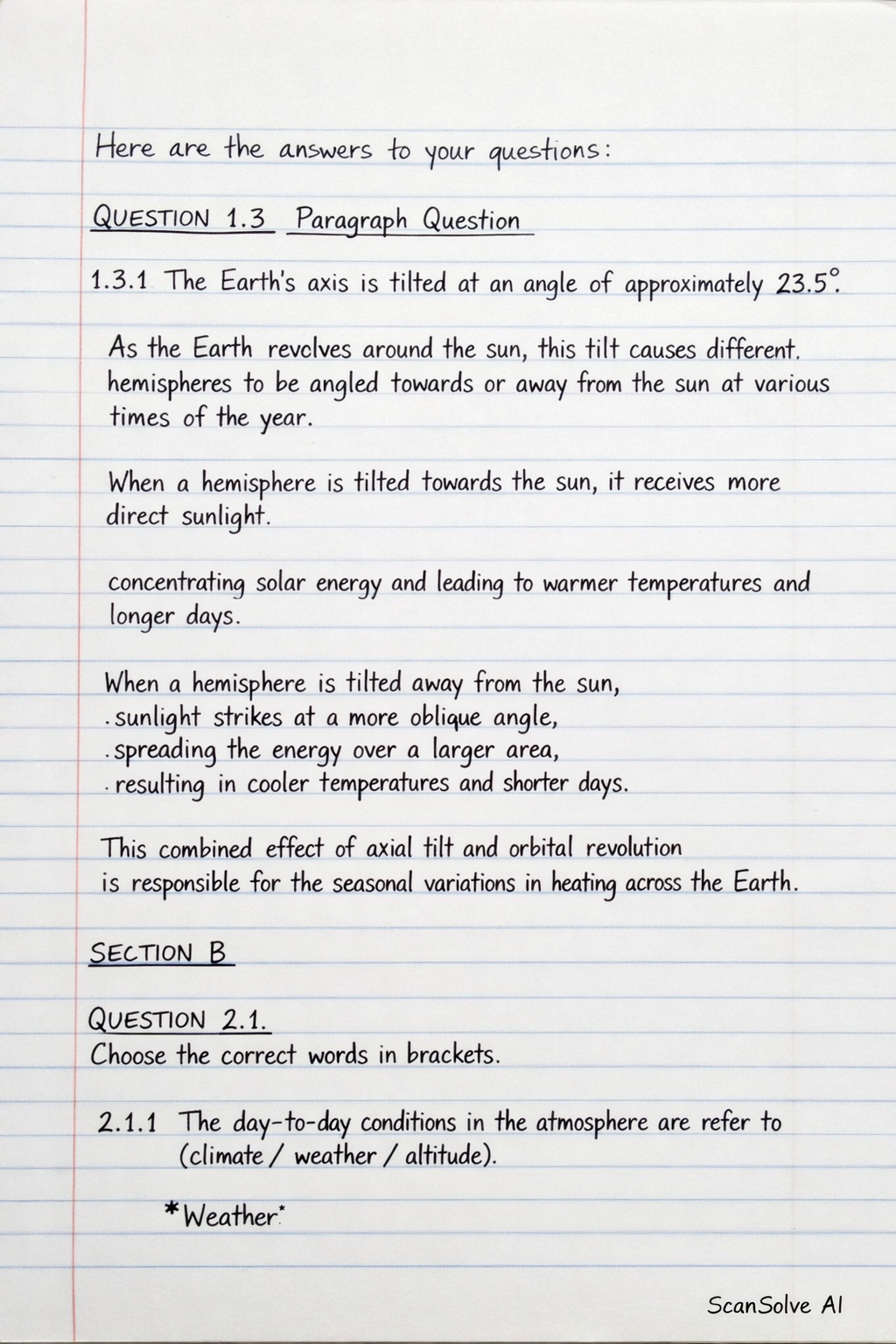
Here are the answers to your questions: QUESTION 1.3 Paragraph Question 1.3.1 The Earth's axis is tilted at an angle of approximately 23.5^. As the Earth revolves around the sun, this tilt causes different hemispheres to be angled towards or away from the sun at various times of the year. When a hemisphere is tilted towards the sun, it receives more direct sunlight, concentrating solar energy and leading to warmer temperatures and longer days. Conversely, when a hemisphere is tilted away from the sun, sunlight strikes at a more oblique angle, spreading the energy over a larger area, resulting in cooler temperatures and shorter days. This combined effect of axial tilt and orbital revolution is responsible for the seasonal variations in heating across the Earth. SECTION B QUESTION 2.1 Choose the correct words in brackets. 2.1.1 The day-to-day conditions in the atmosphere are refer to (climate/ weather/ altitude) Weather 2.1.2 Places close to the equator have (warmer/ cooler/ drier) temperatures than places further away from the equator. Warmer Send me the next one 📸