
This English question involves literary analysis, grammar, or writing skills. The detailed response below provides a well-structured answer with supporting evidence and clear explanations.
ScanSolve AI Answer
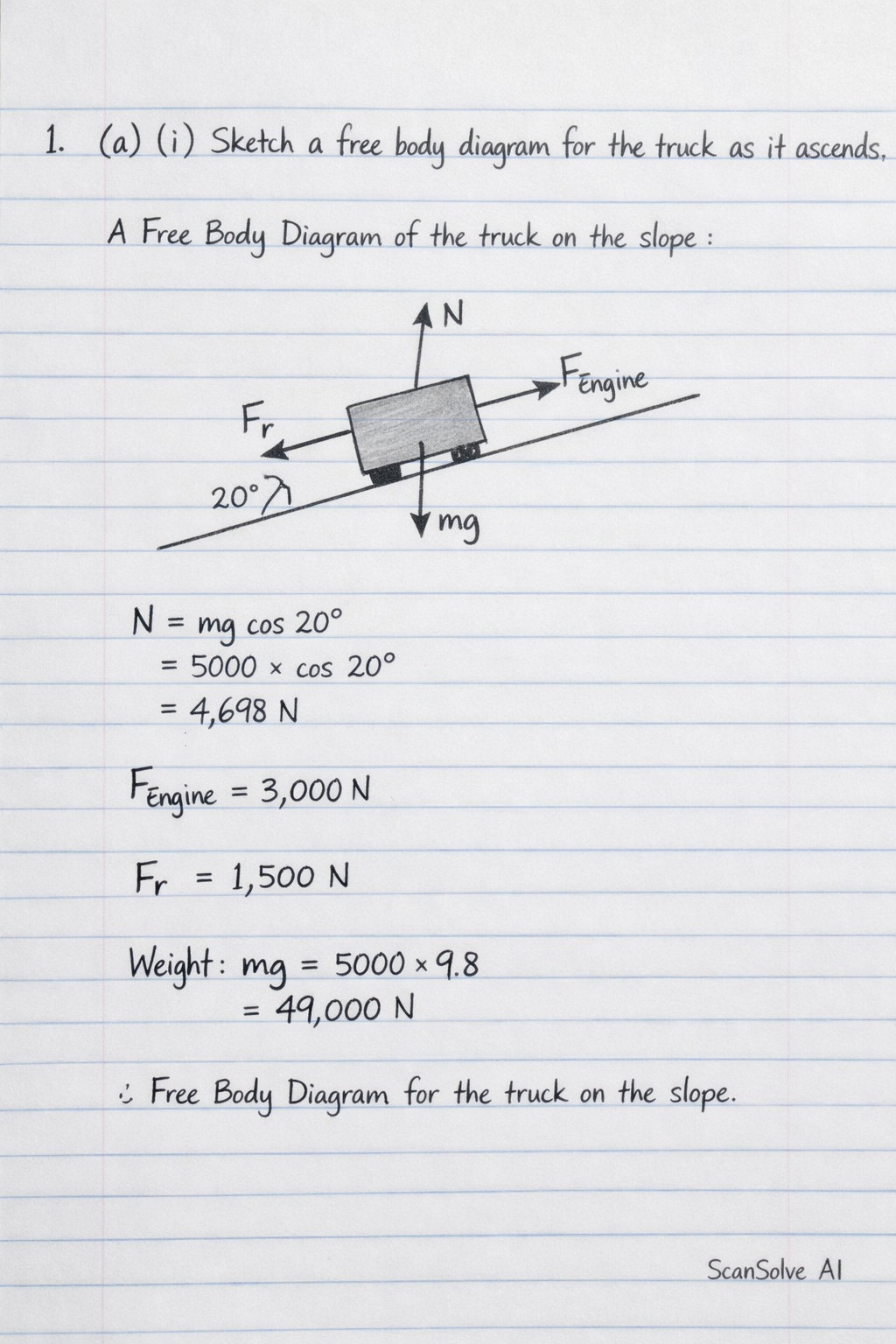
Here are the solutions to questions 1 and 2 from the image: Question 1: a) (i) Sketch a free body diagram for the truck as it ascends. A free body diagram for the truck ascending the slope includes the following forces: Weight (mg): Acts vertically downwards. Normal Force (N): Acts perpendicular to the slope, upwards. Engine Force (F_engine): Acts parallel to the slope, upwards (in the direction of motion). Resistive Force (F_r): Acts parallel to the slope, downwards (opposing motion). [scale=0.8] % Slope (0,0) -- (6,2.1); [dashed] (0,0) -- (6,0); (0.5,0) arc (0:20:0.5); at (0.8,0.2) 20^; % Truck (simplified as a block) [fill=lightgray] (2,1.05) rectangle (3.5,1.55); [thick] (2,1.05) -- (3.5,1.05); % Bottom of truck [thick] (2,1.55) -- (3.5,1.55); % Top of truck [thick] (2,1.05) -- (2,1.55); % Left of truck [thick] (3.5,1.05) -- (3.5,1.55); % Right of truck % Center of mass (approx) (CM) at (2.75, 1.3); % Forces % Weight [->, thick] (CM) -- +(0,-2) node[below] mg; % Normal Force [->, thick] (CM) -- ((CM) + (-0.7, 2)) node[above left] N; % Engine Force [->, thick] (CM) -- ((CM) + (2, 0.7)) node[above right] F_engine; % Resistive Force [->, thick] (CM) -- ((CM) + (-1.5, -0.5)) node[below left] F_r; a) (ii) Determine the size of the force from the engine required to just keep it ascending at the constant speed. Step 1: Identify given values and conditions. Mass of truck, m = 2.0 × 10^3 kg Angle of inclination, = 20^ Resistive forces, F_r = 500 N The truck ascends at a constant speed, which means its acceleration a = 0. Acceleration due to gravity, g = 9.8 m/s^2. Step 2: Apply Newton's Second Law along the slope. For constant speed, the net force along the slope is zero. The forces acting along the slope are the engine force upwards, the component of gravity downwards, and the resistive force downwards. F_net = F_engine - mg - F_r = ma Since a=0: F_engine - mg - F_r = 0 F_engine = mg + F_r Step 3: Substitute the values and calculate F_engine. F_engine = (2.0 × 10^3 kg)(9.8 m/s^2) (20^) + 500 N F_engine = (19600 N) × 0.34202 + 500 N F_engine = 6703.592 + 500 N F_engine = 7203.592 N The size of the force from the engine is 7203.6 N. --- Question 2: a) (i) State the principle of conservation of linear momentum. The principle of conservation of linear momentum states that for an isolated system (where no external forces act), the total linear momentum of the system remains constant over time. a) (ii) State the principle of conservation of kinetic energy. The principle of conservation of kinetic energy states that in an elastic collision, the total kinetic energy of the system before the collision is equal to the total kinetic energy of the system after the collision. b) A bullet of mass 20 g is fired horizontally into a block of wood of mass 600 g which is suspended by a light string 1.5 m long. The bullet gets embedded in the block and the block swings through an angle of 30° to the vertical. Calculate the initial speed of the bullet. Step 1: Convert masses to kilograms and identify given values. Mass of bullet, m_b = 20 g = 0.020 kg Mass of block, m_bl = 600 g = 0.600 kg Length of string, L = 1.5 m Angle of swing, = 30^ Acceleration due to gravity, g = 9.8 m/s^2 Step 2: Calculate the vertical height h the block-bullet system rises. The height h can be found using trigonometry: h = L - L h = L(1 - ) h = 1.5 m (1 - 30^) h = 1.5 m (1 - 0.8660) h = 1.5 m (0.1340) h = 0.201 m Step 3: Use conservation of mechanical energy to find the speed of the block-bullet system immediately after the collision (V). The kinetic energy immediately after the collision is converted into gravitational potential energy at the maximum height. Let M = m_b + m_bl be the total mass of the block and bullet. (1)/(2)MV^2 = Mgh V^2 = 2gh V = sqrt(2gh) V = sqrt(2 × 9.8 m/s)^2 × 0.201 m V = sqrt(3.9396 m)^2/s^2 V ≈ 1.985 m/s Step 4: Use conservation of linear momentum to find the initial speed of the bullet (u_b). The collision is inelastic (bullet embeds in block), so linear momentum is conserved. Initial momentum = Final momentum m_b u_b + m_bl (0) = (m_b + m_bl) V m_b u_b = (m_b + m_bl) V u_b = (m_b + m_bl) Vm_b u_b = (0.020 kg + 0.600 kg) × 1.985 m/s0.020 kg u_b = (0.620 kg) × 1.985 m/s0.020 kg u_b = 1.2307 kg·m/s0.020 kg u_b = 61.535 m/s The initial speed of the bullet is 61.5 m/s.