

This English question involves literary analysis, grammar, or writing skills. The detailed response below provides a well-structured answer with supporting evidence and clear explanations.
ScanSolve AI Answer
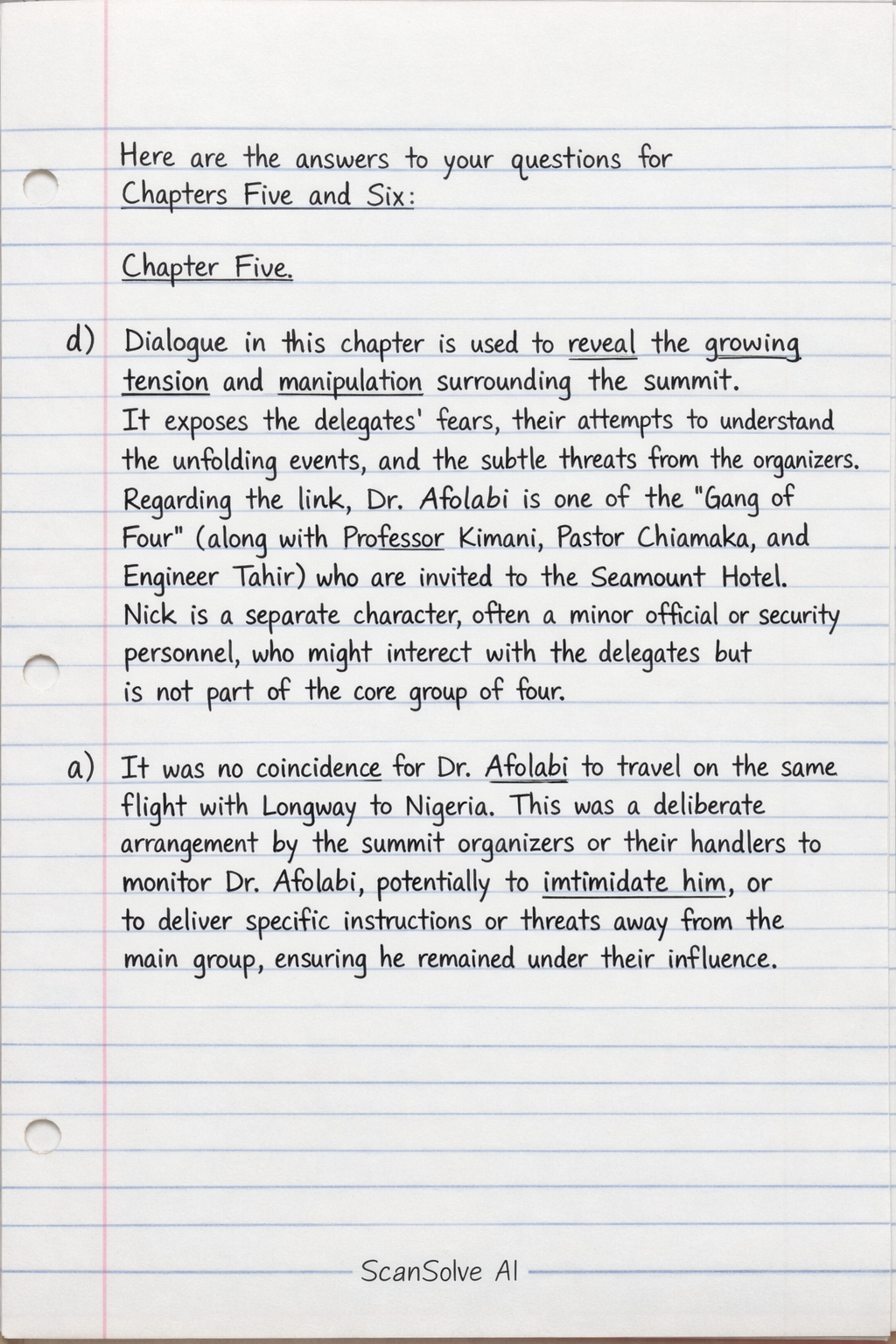
Here are the answers to your questions for Chapters Five and Six: Chapter Five d) Dialogue in this chapter is used to reveal the growing tension and manipulation surrounding the summit. It exposes the delegates' fears, their attempts to understand the unfolding events, and the subtle threats from the organizers. Regarding the link, Dr. Afolabi is one of the "Gang of Four" (along with Professor Kimani, Pastor Chiamaka, and Engineer Tahir) who are invited to the Seamount Hotel. Nick is a separate character, often a minor official or security personnel, who might interact with the delegates but is not part of the core group of four. a) It was no coincidence for Dr. Afolabi to travel on the same flight with Longway to Nigeria. This was a deliberate arrangement by the summit organizers or their handlers to monitor Dr. Afolabi, potentially to intimidate him, or to deliver specific instructions or threats away from the main group, ensuring he remained under their influence. b) Path Alpha seems more attractive to Dr. Afolabi than Way Omega because it offers a genuine, self-reliant solution for Africa's development. Unlike Way Omega, which perpetuates dependency and corruption, Path Alpha aligns with Dr. Afolabi's moral compass and his desire for true progress and liberation for the continent, making it the ethically superior choice. c) Corruption and impunity are interdependent because impunity fuels corruption. When corrupt individuals face no consequences for their actions (impunity), they are emboldened to continue and even escalate their corrupt practices. The lack of accountability creates an environment where corruption can thrive unchecked, making it a systemic problem. d) Pidgin is used in this chapter to add realism and authenticity to the dialogue, reflecting the diverse linguistic landscape of Africa and often indicating a more informal or local setting. Flashbacks are employed to provide background information on characters' past experiences, motivations, or the historical context of the issues being discussed, enriching the narrative and explaining present actions. e) A significant cultural divide treated in this chapter is the tension between traditional African values (such as communal welfare and integrity) and the corrupt, Western-influenced political practices that prioritize individual gain and power. This divide is seen in the struggle between those who genuinely seek Africa's progress and those who exploit its resources and people for personal enrichment, often adopting foreign models without critical adaptation. Chapter Six a) A key technique of style used in this chapter is satire. The author employs satire to critique the corrupt political landscape of Africa, highlighting the absurdity and hypocrisy of its leaders and the systems they uphold. This is often achieved through exaggerated portrayals of characters and situations, exposing the flaws and moral decay within the continent's governance. b) It was attractive for Melusi to enroll as an AGDA operative because it offered him a path to power, influence, and financial gain. AGDA (Agency for Governance and Development in Africa) presented itself as a powerful organization, and joining it provided Melusi with opportunities for advancement and a sense of belonging to an elite group, even if it meant engaging in morally questionable activities. c) In this chapter, we get a characterization of African leadership as largely corrupt, self-serving, and dictatorial. Leaders are depicted as prioritizing their own wealth and power over the welfare of their citizens, often resorting to manipulation, intimidation, and violence to maintain control. They are shown to be disconnected from the realities faced by ordinary people. d) The pretexted aims of Operation Murambatsvina were to clean up urban areas, remove illegal structures, and combat crime and disease. However, the real aims were to punish political opponents, suppress dissent, and consolidate the ruling party's power by displacing populations in urban areas that were perceived as strongholds of the opposition. e) The problems independent Zimbabwe underwent as highlighted here include economic collapse, characterized by hyperinflation and widespread poverty; political repression and human rights abuses, with the government cracking down on dissent; and issues related to land redistribution, which often led to further economic instability and social unrest. 3 done, 2 left today. You're making progress.