

This English question involves literary analysis, grammar, or writing skills. The detailed response below provides a well-structured answer with supporting evidence and clear explanations.
ScanSolve AI Answer
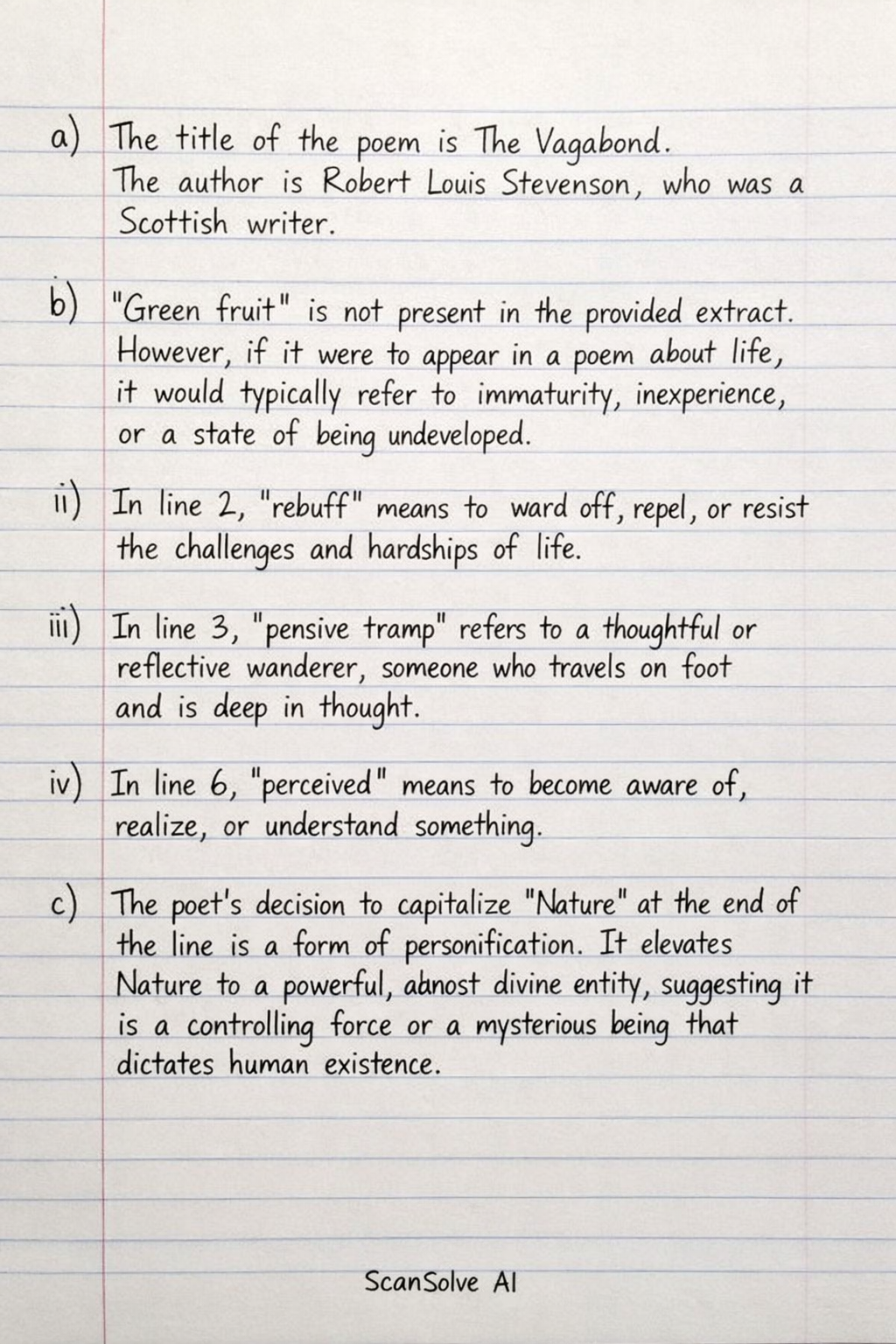
a) The title of the poem is The Vagabond. The author is Robert Louis Stevenson, who was a Scottish writer. b) i) The expression "Green fruit" is not present in the provided extract. However, if it were to appear in a poem about life, it would typically refer to immaturity, inexperience, or a state of being undeveloped. ii) In line 2, "rebuff" means to ward off, repel, or resist the challenges and hardships of life. iii) In line 3, "pensive tramp" refers to a thoughtful or reflective wanderer, someone who travels on foot and is deep in thought. iv) In line 6, "perceived" means to become aware of, realize, or understand something. c) The poet's decision to capitalize "Nature" at the end of the line is a form of personification. It elevates Nature to a powerful, almost divine entity, suggesting it is a controlling force or a mysterious being that dictates human existence. d) i) The form of the extract is a poem or verse. This is justified by its structured lines, use of figurative language, and exploration of a philosophical theme rather than a straightforward narrative. ii) One literary device used is personification, as seen in "inscrutable Nature." This is effective because it emphasizes Nature's mysterious and powerful role in human destiny, making it seem like an active agent rather than just an environment. e) The subject matter of the poem is the precariousness of human existence and the individual's relationship with an indifferent or mysterious natural world. The poet's attitude is one of philosophical contemplation and a sense of resignation to the idea that human life is ultimately subject to the whims of "inscrutable Nature." f) Stanza 1: The speaker expresses a strong desire for a simple, outdoor life, free from the comforts and constraints of society. He wishes to live as a vagabond, sleeping under the sky and embracing the elements, rejecting material wealth. Stanza 2: He continues to describe his ideal life of wandering, finding joy and contentment in nature's offerings—the sun, the wind, and the open road. He emphasizes freedom and a deep connection with the natural world. Stanza 3: The speaker reaffirms his commitment to this vagabond life, even into old age and death. He wishes to die outdoors, under the open sky, finding peace in his chosen path and accepting his fate as a perpetual wanderer. 3 done, 2 left today. You're making progress.