Translate the above expressions to English

English

ScanSolve AI Answer

Answers

2 parts
a

28.54 m\text{28.54 m}

b

88.88 m\text{88.88 m}

Step-by-step solution

6 steps

Here is the translation of the above expressions to English:

Here is the solution to your question:

Part a· 3 steps

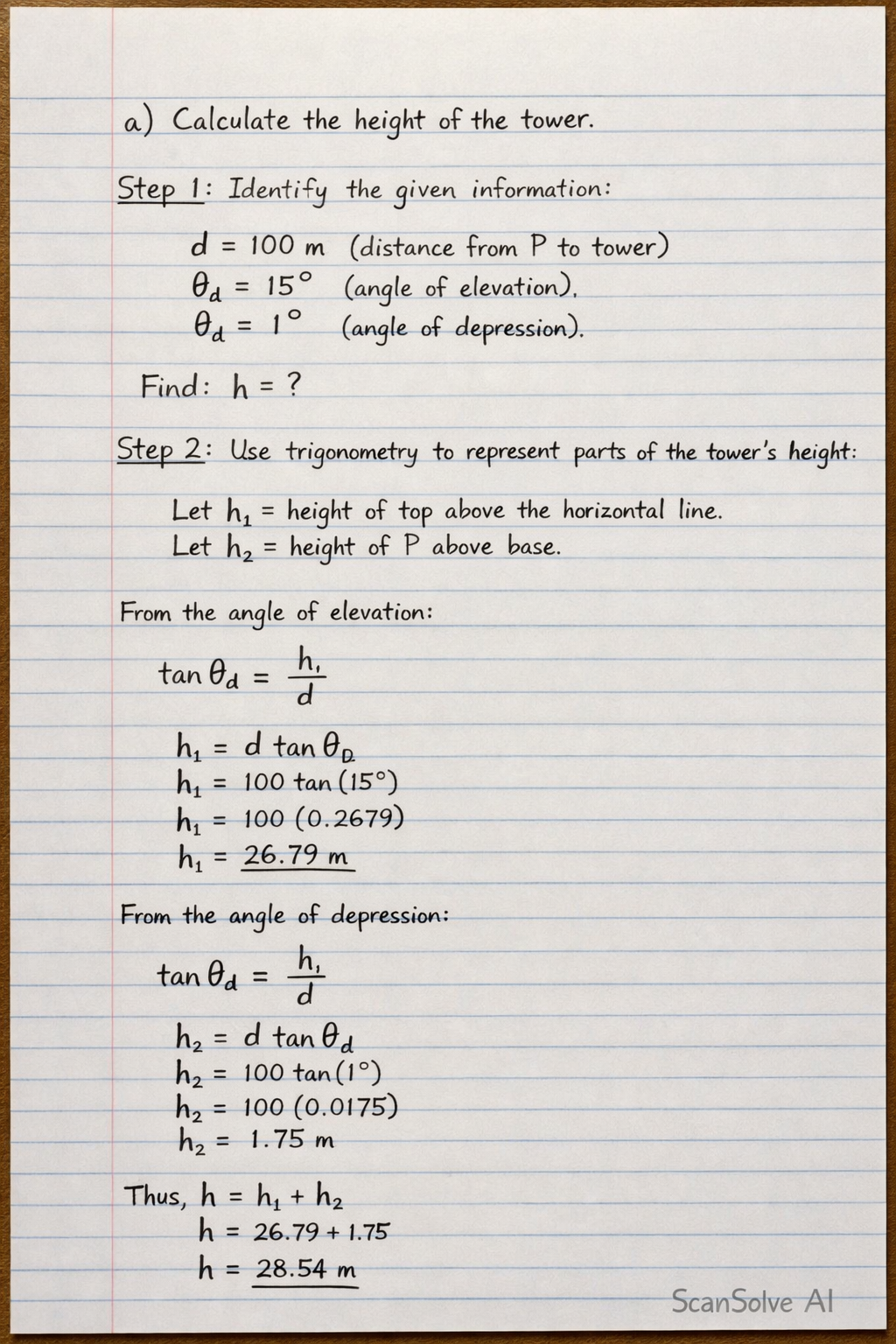
Calculate the height of the tower.

  1. Identify the given information.

    We are given the horizontal distance from point PP to the tower, d=100 md = 100 \, \text{m}.
    The angle of elevation of the top of the tower from PP, θe=15∘\theta_e = 15^\circ.
    The angle of depression of the base of the tower from PP, θd=1∘\theta_d = 1^\circ.
    We need to calculate the height of the tower, hh.

  2. Use trigonometry to represent parts of the tower's height.

    Let h1h_1 be the height of the top of the tower above the horizontal line passing through PP.
    Let h2h_2 be the height of PP above the base of the tower.
    From the angle of elevation:

    tan⁡(θe)=h1d  ⟹  h1=dtan⁡(θe)=100tan⁡(15∘)\tan(\theta_e) = \frac{h_1}{d} \implies h_1 = d \tan(\theta_e) = 100 \tan(15^\circ)

    From the angle of depression:

    tan⁡(θd)=h2d  ⟹  h2=dtan⁡(θd)=100tan⁡(1∘)\tan(\theta_d) = \frac{h_2}{d} \implies h_2 = d \tan(\theta_d) = 100 \tan(1^\circ)
  3. Calculate the total height of the tower.

    The total height of the tower hh is the sum of h1h_1 and h2h_2.

    h=h1+h2=100tan⁡(15∘)+100tan⁡(1∘)h = h_1 + h_2 = 100 \tan(15^\circ) + 100 \tan(1^\circ) h=100(tan⁡(15∘)+tan⁡(1∘))h = 100 (\tan(15^\circ) + \tan(1^\circ)) h=100(0.267949+0.017455)h = 100 (0.267949 + 0.017455) h=100(0.285404)h = 100 (0.285404) h≈28.54 mh \approx 28.54 \, \text{m}

    The height of the tower is 28.54 m\boxed{\text{28.54 m}}.

Part b

88.88 m\text{88.88 m}

i) Calculate the distance from point P to Q.

  1. Draw a diagram and label the points and angles.

    Let RR be the base of the tower.
    From PP, RR is on a bearing of 030∘030^\circ and a horizontal distance PR=100 mPR = 100 \, \text{m}.
    From QQ, RR is on a bearing of 330∘330^\circ and a horizontal distance QR=70 mQR = 70 \, \text{m}.
    Points PP and QQ are on the same horizontal plane.

  2. Calculate the interior angle of triangle PQRPQR.

    The bearing of RR from PP is 030∘030^\circ. Thus, the angle between the North line from PP and PRPR is 30∘30^\circ.
    The bearing of RR from QQ is 330∘330^\circ. Thus, the angle between the North line from QQ and QRQR is 330∘330^\circ.

    To use the cosine rule, we need the angle ∠PRQ\angle PRQ.
    Bearing of PP from RR: 030∘+180∘=210∘030^\circ + 180^\circ = 210^\circ.
    Bearing of QQ from RR: 330∘−180∘=150∘330^\circ - 180^\circ = 150^\circ.
    The angle ∠PRQ\angle PRQ is the difference between these two bearings.

    ∠PRQ=210∘−150∘=60∘\angle PRQ = 210^\circ - 150^\circ = 60^\circ
  3. Use the cosine rule to calculate the distance PQPQ.

    In triangle PQRPQR, we have PR=100 mPR = 100 \, \text{m}, QR=70 mQR = 70 \, \text{m}, and ∠PRQ=60∘\angle PRQ = 60^\circ.
    The cosine rule states:

    PQ2=PR2+QR2−2(PR)(QR)cos⁡(∠PRQ)PQ^2 = PR^2 + QR^2 - 2(PR)(QR)\cos(\angle PRQ) PQ2=1002+702−2(100)(70)cos⁡(60∘)PQ^2 = 100^2 + 70^2 - 2(100)(70)\cos(60^\circ) PQ2=10000+4900−14000(12)PQ^2 = 10000 + 4900 - 14000 \left(\frac{1}{2}\right) PQ2=14900−7000PQ^2 = 14900 - 7000 PQ2=7900PQ^2 = 7900 PQ=7900PQ = \sqrt{7900} PQ=100×79PQ = \sqrt{100 \times 79} PQ=1079PQ = 10\sqrt{79} PQ≈10×8.88819PQ \approx 10 \times 8.88819 PQ≈88.88 mPQ \approx 88.88 \, \text{m}

    The distance from PP to QQ is 88.88 m\boxed{\text{88.88 m}}.

Was this helpful?

Try one yourself

A new problem that tests the same skill.

Still stuck on this one?

Ask a follow-up, and the answer starts from this question.

Got a different question?Ask your own question
Handwritten step-by-step solution preview

Handwritten Step-by-Step Solution

Get this as a handwritten image on WhatsApp — like a tutor wrote it for you.

Try on WhatsApp