
We read your photo as:
Please use English while explaining
ScanSolve AI Answer
Answers
2 partsStep-by-step solution
10 stepsOkay Mukisa, I can definitely help you with these radical equations in English.
Here are the steps to solve the radical equations:
Part a· 6 steps
Solve
Determine the domain for where the terms under the radicals are non-negative.
The expressions under the square roots must be non-negative:
Therefore, must be in the interval .Isolate one radical and then square both sides of the equation.
Rearrange the equation to isolate one radical:
Square both sides:
Isolate the remaining radical and simplify.
Divide both sides by 2:
Since the right side is a square root (and thus non-negative), the left side must also be non-negative:
So, any solution must satisfy the initial domain conditions and . This means must be in the interval .
Square both sides again and solve the resulting quadratic equation.
Divide by 2:
Factor the quadratic equation:
Thus, or .
Check the solutions against the domain conditions.
From Step 3, we required .
- For : is within the interval .
- For : 2 is not within the interval . Thus, is an extraneous solution.
Verify the valid solution in the original equation.
For :
The solution is correct.
The solution for equation a) is:
Part b
Solve
Determine the domain for where the terms under the radicals are non-negative.
The expressions under the square roots must be non-negative:
Therefore, must be in the interval .Isolate one radical and then square both sides of the equation.
Rearrange the equation:
Square both sides:
Isolate the remaining radical and simplify.
Divide both sides by 2:
Since the left side (square root) is non-negative, the right side must also be non-negative:
Compare the conditions for the variable.
From Step 1, we required .
From Step 3, we required .
There is no value of that can satisfy both conditions ( and ) simultaneously. This means there is no valid solution for this equation.The solution for equation b) is:
Try one yourself
A new problem that tests the same skill.
Still stuck on this one?
Ask a follow-up, and the answer starts from this question.
More English Questions
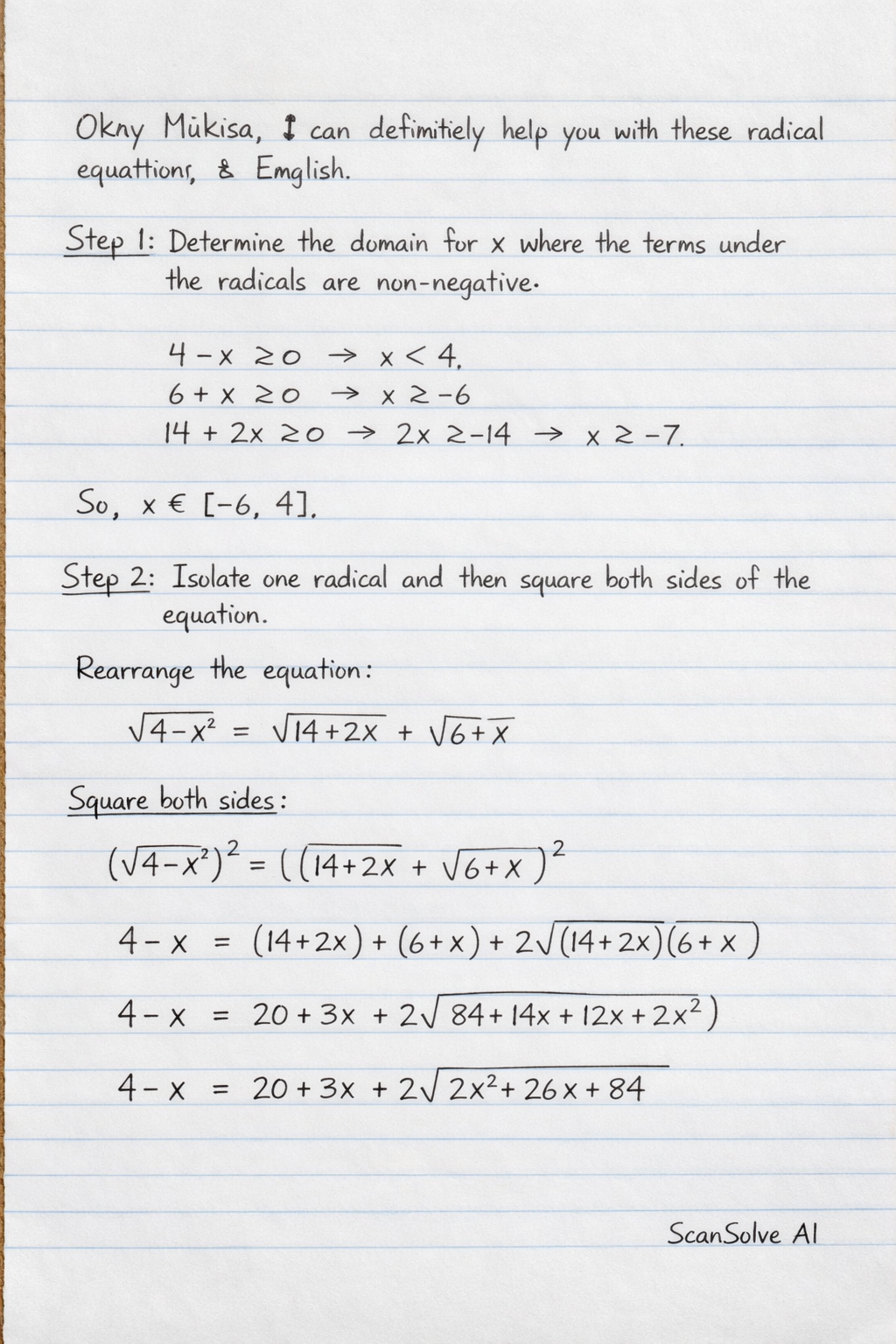
Handwritten Step-by-Step Solution
Get this as a handwritten image on WhatsApp — like a tutor wrote it for you.
Try on WhatsApp