
We read your photo as:
With close reference to the extract, explain how Keats presents his fears and what "teeming brain" suggests about the speaker.
ScanSolve AI Answer
Here are the answers to your questions based on the provided poem extract:
-
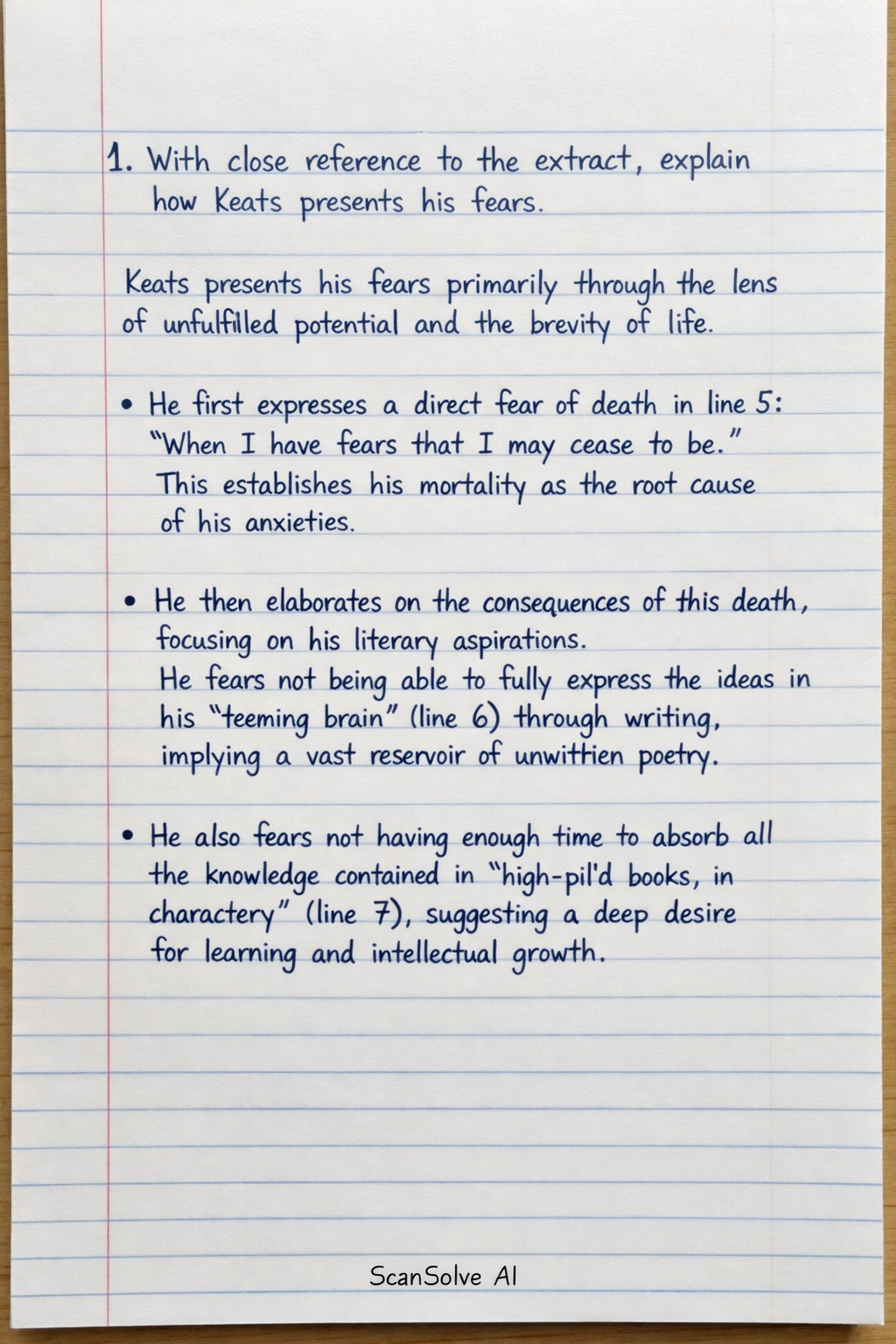
With close reference to the extract, explain how Keats presents his fears. Keats presents his fears primarily through the lens of unfulfilled potential and the brevity of life.
- He first expresses a direct fear of death in line 5: "When I have fears that I may cease to be." This establishes his mortality as the root cause of his anxieties.
- He then elaborates on the consequences of this death, focusing on his literary aspirations. He fears not being able to fully express the ideas in his "teeming brain" (line 6) through writing, implying a vast reservoir of unwritten poetry.
- He also fears not having enough time to absorb all the knowledge contained in "high-pil'd books, in characterý" (line 7), suggesting a deep desire for learning and intellectual growth.
- Furthermore, he fears not living long enough to capture the beauty and inspiration he perceives in the world, particularly the "Huge cloudy symbols of a high romance" (line 10) seen in the night sky. He worries he will "never live to trace / Their shadows, with the magic hand of chance" (lines 11-12), meaning he won't be able to immortalize these profound romantic visions in his art.
-
What does the phrase "teeming brain" (line 6) suggest about the speaker? The phrase "teeming brain" suggests that the speaker's mind is overflowing with ideas, thoughts, and creative potential. It implies a rich and abundant source of inspiration waiting to be expressed.
-
Identify and explain the figure of speech in "Hold like rich garners the full-ripen'd grain" (line 7). The figure of speech is a simile. It compares the speaker's desire to fill his mind with knowledge and ideas (like a brain holding thoughts) to a "rich garner" (a granary or storehouse) holding "full-ripen'd grain." This emphasizes the value, abundance, and readiness of the knowledge he wishes to acquire and store.
-
How does the imagery of the night sky in lines 9–12 contribute to the poem's meaning? The imagery of the night sky, with its "starred face" and "Huge cloudy symbols of a high romance," contributes to the poem's meaning by representing the vast, mysterious, and inspiring realm of love, beauty, and profound experience that Keats fears he will not live long enough to fully comprehend or immortalize in his poetry. The "cloudy symbols" suggest grand, perhaps elusive, romantic ideals that he longs to capture but fears will remain untraced due to his impending mortality.
-
In your opinion, is Keats more afraid of death or of leaving his work unfinished? Support your answer with evidence from the extract. In my opinion, Keats is more afraid of leaving his work unfinished. While he mentions the fear of death directly ("cease to be" in line 5), the majority of the extract elaborates on the consequences of that death in terms of his unfulfilled creative and intellectual potential.
- He fears his "pen has gleaned my teeming brain" (line 6), meaning his ideas will remain unwritten.
- He worries about not having read enough "high-pil'd books" (line 7) or harvested his thoughts "like rich garners the full-ripen'd grain" (line 8).
- Most significantly, he laments that he may "never live to trace / Their shadows, with the magic hand of chance" (lines 11-12), referring to his inability to capture the grand romantic visions inspired by the night sky. These lines all emphasize the loss of creative output and intellectual fulfillment rather than just the cessation of life itself.
Still stuck on this one?
Ask a follow-up, and the answer starts from this question.
More English Questions
Handwritten Step-by-Step Solution
Get this as a handwritten image on WhatsApp — like a tutor wrote it for you.
Try on WhatsApp