

This English question involves literary analysis, grammar, or writing skills. The detailed response below provides a well-structured answer with supporting evidence and clear explanations.
ScanSolve AI Answer
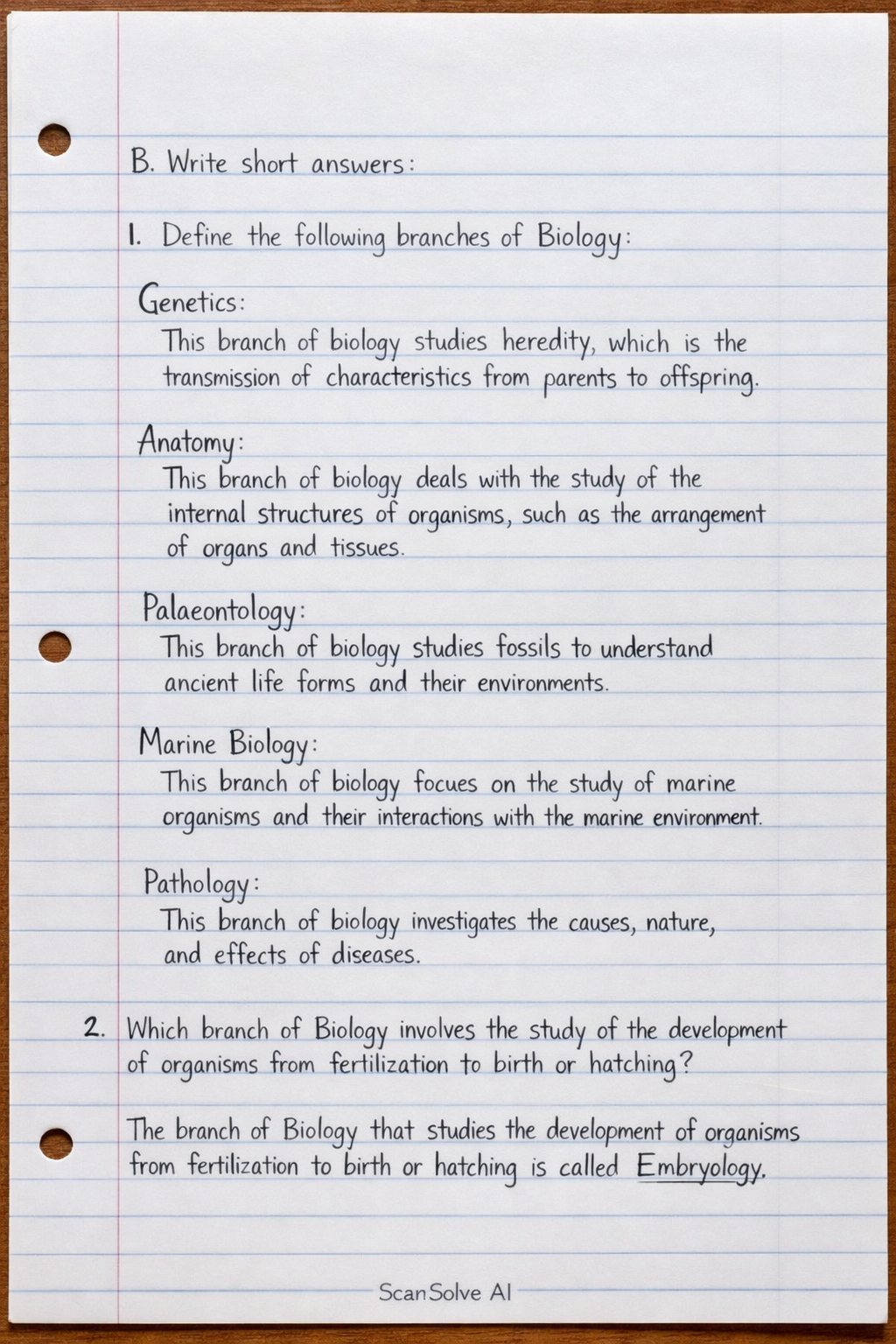
Here are the answers to your Biology Class 9 questions, entirely in English. B. Write short answers: 1. Define the following branches of Biology: Genetics: This branch of biology studies heredity, which is the transmission of characteristics from parents to offspring. Anatomy: This branch of biology deals with the study of the internal structures of organisms, such as the arrangement of organs and tissues. Palaeontology: This branch of biology studies fossils to understand ancient life forms and their environments. Marine Biology: This branch of biology focuses on the study of marine organisms and their interactions with the marine environment. Pathology: This branch of biology investigates the causes, nature, and effects of diseases. 2. Which branch of Biology involves the study of the development of organisms from fertilization to birth or hatching? The branch of Biology that studies the development of organisms from fertilization to birth or hatching is called Embryology. 3. How is the profession of medicine and surgery different from animal husbandry? Medicine and surgery deal with the diagnosis, treatment, and surgical intervention for human diseases, while animal husbandry focuses on the breeding, care, and management of domestic animals for products like food, fiber, or labor. 4. Differentiate between Morphology and Physiology: Morphology: This branch of biology studies the form and structure* of organisms, both external and internal. Physiology: This branch of biology studies the functions* of organisms, explaining how different parts of the body work. 5. What is Computational Biology? Computational Biology is a branch of biology that uses computer science, mathematics, and statistics to solve biological problems, analyze large biological data sets, and create models. 6. What is the role of observation and experimentation in the scientific method? In the scientific method, observation identifies a problem and provides initial information, leading to the formation of a hypothesis. Experimentation then tests this hypothesis to determine its validity. Both are fundamental to gaining scientific knowledge. C. The Science of Biology 1. Link the study of Biology with that of Physics, Chemistry, Statistics, Geography, Economics and Computer Science: Physics: Biophysics studies the physical principles underlying biological processes, such as movement or nerve impulses. Chemistry: Biochemistry investigates the chemical basis of life, including metabolism and photosynthesis. Statistics: Biostatistics applies statistical methods to analyze biological data, for example, in population studies. Geography: Biogeography studies the distribution of organisms in time and space, explaining why certain species are found in specific regions. Economics: Bioeconomics applies economic principles to biological resources and environmental issues. Computer Science: Bioinformatics uses computational tools to manage and analyze biological data, such as in genomics. 2. Explain how the study of Biology can lead to different professional studies. The study of Biology provides a foundation for numerous professional fields: Medicine, Dentistry, Pharmacy: For understanding the human body, diseases, and medications. Agriculture, Horticulture: For improving crops and livestock, and pest control. Fisheries: For managing and cultivating fish populations. Forestry: For managing and conserving forest resources. Environmental Science: For conservation efforts and pollution control. Biotechnology: For genetic engineering and drug development. 3. Science is a collaborative field in which scientists work together to share knowledge. Prove this statement by giving examples: This statement is correct; science is inherently collaborative. Example 1: The Human Genome Project: Thousands of scientists worldwide collaborated to map the entire human genome. Example 2: Climate Change Research: Scientists from various disciplines (biology, physics, chemistry) work together to understand and address climate change. Example 3: Drug Discovery: Teams of biologists, chemists, and pharmacologists collaborate to develop new medicines. 4. How a hypothesis is converted to theory, law and principle? Hypothesis: An educated guess or a testable statement based on observations. Theory: When a hypothesis is repeatedly confirmed through extensive experimentation and observation, and provides a comprehensive explanation for a natural phenomenon, it develops into a theory. Law/Principle: A scientific law or principle is a statement that describes an observed natural phenomenon but does not explain why* it occurs. It is often a mathematical relationship or a universally accepted truth. A theory, after consistent and universal validation, can lead to the formulation of a law. 5. What are the basic steps a scientist adopts in order to solve a scientific problem? A scientist adopts the following basic steps to solve a scientific problem: Observation Hypothesis formation Deduction Experimentation Summarization of results Reporting results 6. Describe the work of different scientists in discovering the cause of malaria: A.F.A. King: Observed that people sleeping in open areas or near stagnant water were more likely to get malaria. Laveran: Discovered malaria parasites in the blood of malaria patients. Ronald Ross: Demonstrated that mosquitoes (female Anopheles) transmit malaria by biting infected birds and then healthy ones. He also found malaria parasites in the salivary glands of mosquitoes. 7. Write a descriptive note on the experiments performed by Ross: Ronald Ross conducted crucial experiments to understand malaria transmission. Experiment 1 (on birds): Ross allowed female Anopheles mosquitoes to bite a malaria-infected bird. He then kept these mosquitoes and later dissected them, finding malaria parasites in their stomach and salivary glands. Experiment 2 (transmission): Subsequently, he allowed these infected mosquitoes to bite healthy sparrows. These sparrows then developed malaria. Conclusion: Ross concluded that mosquitoes are the vectors for malaria. D. Inquisitive questions 1. Why is it important to classify biology into different branches such as botany, zoology, and microbiology? How does specialization benefit scientific research? Importance of Classification: Biology is a vast field. Classifying it into branches like botany (plants), zoology (animals), and microbiology (microorganisms) is crucial because it allows for a deeper, more focused study of specific life forms and their processes. This makes the subject manageable and allows for detailed investigation. Benefits of Specialization: Specialization enables scientists to become experts in a particular area, leading to: In-depth knowledge and understanding. Development of specialized techniques and tools. Faster progress in specific research areas. Efficient problem-solving within that domain. Collaboration among experts to tackle complex issues. 2. How can a scientist apply the scientific method to confirm an observation that a certain plant species grows more quickly in shady places than in direct sunlight? A scientist can apply the scientific method as follows: Observation: The plant species grows more quickly in shady places compared to direct sunlight. Hypothesis: This specific plant species grows faster in shade than in direct sunlight. Deduction: If the hypothesis is correct, then plants grown in shade will show greater growth (e.g., height, leaf count) than those grown in direct sunlight. Experimentation: Obtain a large number of identical plants of the species. Divide them into two groups (control and experimental). Control Group: Place in direct sunlight. Experimental Group: Place in a shady location. Ensure all other variables (water, soil, temperature, nutrients) are kept constant for both groups. Measure growth parameters (e.g., height, number of leaves, biomass) over a set period. Repeat the experiment multiple times. Results: Compare the growth data obtained from both groups. Conclusion: If the plants in the shady group consistently show significantly greater growth, the hypothesis is supported. If not, the hypothesis is rejected or modified. Last free one today — make it count tomorrow, or type /upgrade for unlimited.