
Solve English ma karna ha
ScanSolve AI Answer
Step-by-step solution
16 stepsHere are the solutions to your questions in English:
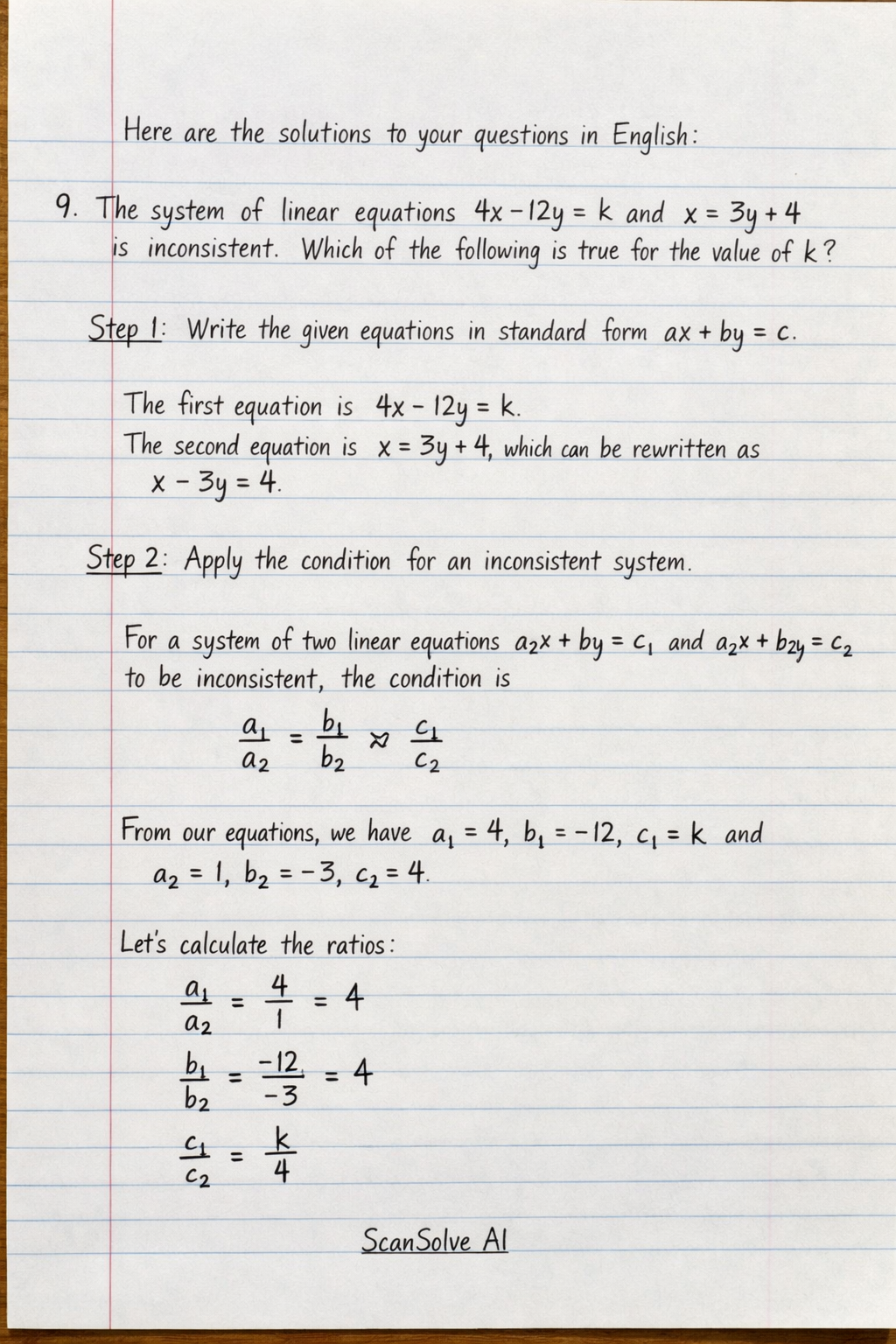
9. The system of linear equations and is inconsistent. Which of the following is true for the value of ?
Write the given equations in the standard form .
The first equation is .
The second equation is , which can be rewritten as .Apply the condition for an inconsistent system.
For a system of two linear equations and to be inconsistent, the condition is .
From our equations, we have and .
Let's calculate the ratios:Use the inconsistency condition to find the value of .
This implies that .
Multiply both sides by 4:Therefore, the value of must not be equal to 16.
The final answer is .
10. The diameter of a circle which passes through and whose center is is:
Find the radius of the circle.
The center of the circle is and it passes through the point . The radius is the distance between the center and any point on the circle. We use the distance formula: .
Calculate the radius.
Find the diameter of the circle.
The diameter is twice the radius: .
The final answer is .
11. Two dice are thrown simultaneously. The probability of getting both odd numbers is:
Determine the total number of possible outcomes.
When two dice are thrown, each die has 6 possible outcomes. So, the total number of possible outcomes is .
Determine the number of favorable outcomes.
For both dice to show odd numbers, each die must land on an odd number. The odd numbers on a single die are , which are 3 possibilities.
So, the number of favorable outcomes (both odd) is .
These outcomes are: .Calculate the probability.
The probability of an event is given by the formula .
The final answer is .
12. Raju is wearing a conical birthday cap of diameter 16 cm and height 24 cm. The slant height of the cap is:
Find the radius of the cone.
The diameter of the base of the cone is cm.
The radius cm.
The height of the cone is cm.Use the formula for the slant height.
For a cone, the slant height , radius , and height are related by the Pythagorean theorem: .
Calculate the slant height.
Simplify the slant height.
The final answer is .
13. The quadratic equation has real and distinct roots. Which of the following is true for the value of ?
Identify the coefficients of the quadratic equation.
The given quadratic equation is .
Comparing it with the standard form , we have:
(since there is no term)
Apply the condition for real and distinct roots.
A quadratic equation has real and distinct roots if its discriminant is greater than 0.
Calculate the discriminant and solve the inequality for .
Substitute the values of into the discriminant formula:
For real and distinct roots, :
To solve for , divide both sides by . Remember to reverse the inequality sign when dividing by a negative number:
Therefore, the value of must be less than 0.
The final answer is .
Still stuck on this one?
Ask a follow-up, and the answer starts from this question.
More English Questions
Handwritten Step-by-Step Solution
Get this as a handwritten image on WhatsApp — like a tutor wrote it for you.
Try on WhatsApp