
We read your photo as:
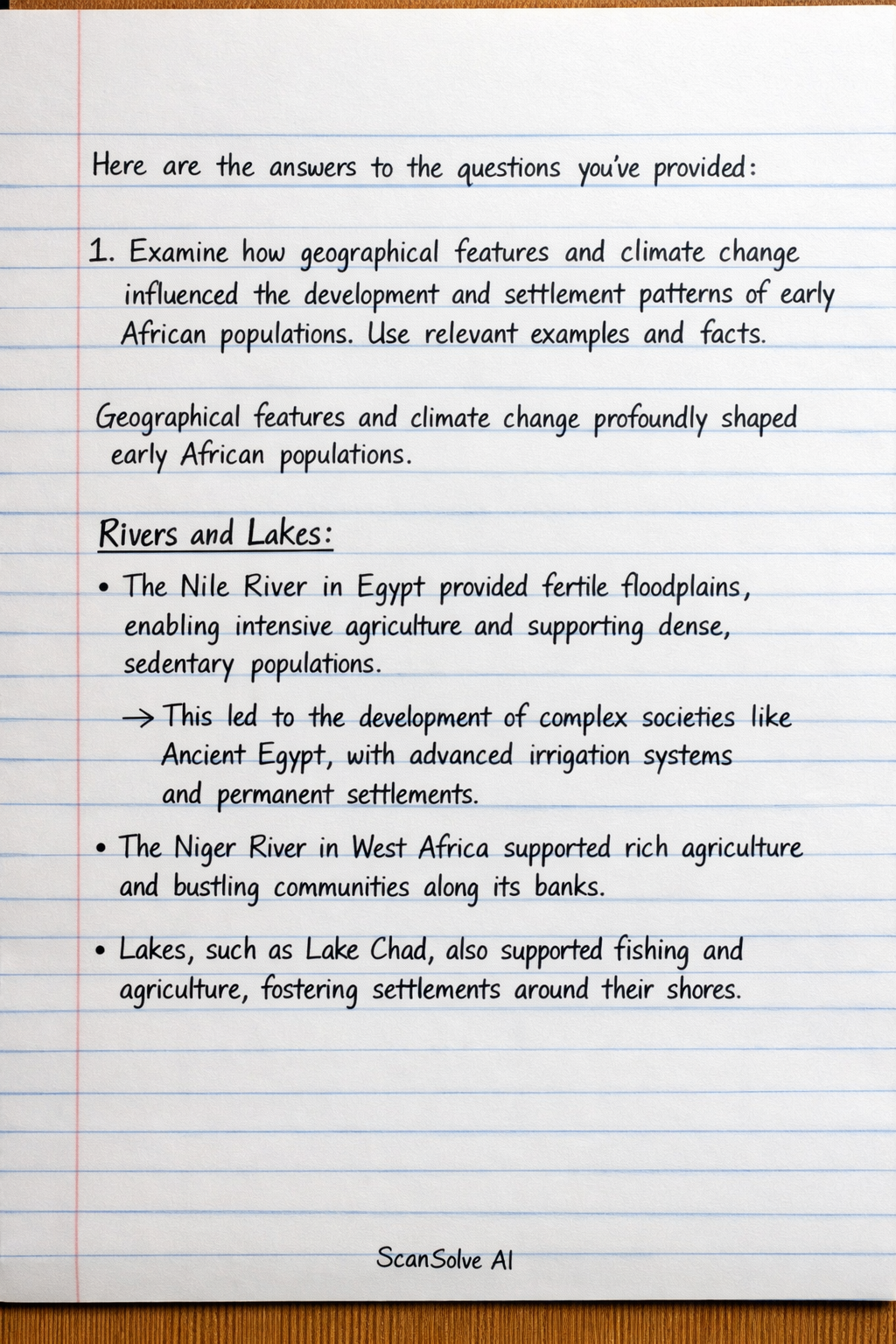
Examine how geographical features and climate change influenced the development and settlement patterns of early African populations. Use relevant examples and facts.
ScanSolve AI Answer
Here are the answers to the questions you've provided:
1. Examine how geographical features and climate change influenced the development and settlement patterns of early African populations. Use relevant examples and facts.
Geographical features and climate change profoundly shaped early African populations.
- Rivers and Lakes: The Nile River in Egypt and the Niger River in West Africa provided fertile floodplains, enabling intensive agriculture and supporting dense, sedentary populations. This led to the development of complex societies like Ancient Egypt, with advanced irrigation systems and permanent settlements. Lakes, such as Lake Chad, also supported fishing and agriculture, fostering settlements around their shores.
- Deserts: The vast Sahara Desert acted as a significant barrier, limiting direct interaction between North and Sub-Saharan Africa. However, it also spurred the development of specialized nomadic groups and trans-Saharan trade routes connecting oases, influencing settlement patterns to concentrate along these routes or in more fertile fringes like the Sahel.
- Coastlines: The Swahili Coast in East Africa facilitated maritime trade with the Arabian Peninsula and Asia, leading to the growth of port cities like Kilwa and Mombasa. These settlements became centers of commerce and cultural exchange.
- Rainforests: Dense rainforests in Central and West Africa presented challenges for large-scale agriculture and dense settlements, leading to more dispersed populations practicing shifting cultivation or hunter-gatherer lifestyles.
- Climate Change: Periods of increased rainfall (e.g., the "Green Sahara" period) allowed for the expansion of agriculture and pastoralism into areas that are now arid, leading to wider population distribution. Conversely, periods of desertification and drought, such as the drying of the Sahara, forced migrations of populations towards more reliable water sources like the Nile Valley or the Sahel, concentrating settlements and sometimes leading to conflict over resources. This environmental pressure was a major driver of population shifts and the formation of new societies.
2. Analyze any five (5) causes and socio-economic implications of road accidents in Ghana and propose three evidence-based strategies to minimize them.
Causes of Road Accidents in Ghana:
- Driver Error: Speeding, reckless driving, drunk driving, and distracted driving (e.g., phone use) are major contributors.
- Poor Road Infrastructure: Potholes, inadequate signage, lack of street lighting, and poorly designed roads increase accident risk.
- Vehicle Mechanical Faults: Many vehicles are not roadworthy due to poor maintenance, leading to brake failures, tire bursts, or steering issues.
- Pedestrian Negligence: Jaywalking, not using designated crossings, and walking on busy roads contribute to pedestrian-involved accidents.
- Weak Enforcement of Traffic Laws: Inconsistent application of traffic regulations and penalties can lead to a disregard for road safety rules.
Socio-Economic Implications:
Road accidents in Ghana result in significant loss of life and severe injuries, placing a heavy burden on families and the healthcare system. They lead to a loss of productivity due to disability or death of economically active individuals, increased healthcare costs, and damage to vehicles and infrastructure. This economic strain impacts national development and individual livelihoods.
Evidence-Based Strategies to Minimize Accidents:
- Improved Road Safety Education and Awareness: Implementing continuous public campaigns targeting drivers, pedestrians, and passengers on safe road practices, coupled with mandatory road safety modules in driver licensing.
- Enhanced Enforcement of Traffic Laws: Utilizing technology like speed cameras and breathalyzers, increasing police visibility, and ensuring consistent and strict penalties for traffic offenses to deter reckless behavior.
- Investment in Road Infrastructure and Maintenance: Upgrading existing roads, constructing safer pedestrian walkways, installing adequate lighting and signage, and implementing traffic calming measures in high-risk areas.
3. Discuss any four role of indigenous technologies in shaping ancient African societies and evaluate their potential application to modern challenges.
Indigenous technologies played crucial roles in shaping ancient African societies and offer valuable insights for modern challenges.
- Agriculture and Food Production: Technologies like terracing (e.g., in the Ethiopian Highlands), irrigation systems (e.g., shadufs along the Nile), and crop rotation allowed for sustainable food production, supporting larger populations and leading to settled agricultural communities.
- Modern Application: These methods can inform sustainable agriculture practices, promoting water conservation and soil fertility in the face of climate change and food insecurity.
- Metallurgy: The development of iron smelting (e.g., by the Nok culture and in Meroe) revolutionized tool-making, leading to more efficient agricultural implements, weapons, and construction tools. This advanced agriculture and defense capabilities.
- Modern Application: Understanding traditional metallurgy can inspire resource-efficient and low-carbon approaches to material processing, and inform the use of local resources.
- Architecture and Construction: Indigenous building techniques, such as the use of mud-brick (e.g., Great Mosque of Djenné) and stone masonry (e.g., Great Zimbabwe), provided durable and climate-appropriate housing, defensive structures, and monumental architecture.
- Modern Application: These techniques offer sustainable and cost-effective building solutions, utilizing local materials and passive cooling/heating designs relevant for eco-friendly construction in contemporary Africa.
- Water Management: Technologies for rainwater harvesting, well digging, and water storage were essential for survival in arid and semi-arid regions, ensuring access to water for communities and livestock.
- Modern Application: Reviving and adapting traditional water harvesting and storage methods can significantly enhance water security in drought-prone areas, complementing modern infrastructure.
4. Compare the impact of indigenous technology on irrigation systems and transportation in Ancient Africa.
Indigenous technologies had distinct yet equally profound impacts on irrigation and transportation in Ancient Africa.
Impact on Irrigation Systems:
Indigenous irrigation technologies, such as shadufs (lever-based water lifts), simple canals, and terracing, enabled ancient African societies to manage water resources effectively. Their impact was primarily on:
- Agricultural Productivity: These technologies allowed for the cultivation of crops in areas with irregular rainfall or away from direct river banks, leading to increased food production and surpluses.
- Population Growth and Settlement: Reliable food sources supported larger, more sedentary populations, fostering the development of permanent settlements and complex societies, such as Ancient Egypt along the Nile.
- Economic Specialization: Food surpluses freed labor for other activities, leading to economic specialization and the growth of crafts and trades within communities.
Impact on Transportation:
Indigenous transportation technologies included the use of canoes and boats for river and coastal travel, animal domestication (e.g., camels for trans-Saharan routes, donkeys), and the development of footpaths and trade routes. Their impact was primarily on:
- Trade and Economic Exchange: These technologies facilitated the movement of goods (e.g., gold, salt, ivory) over short and long distances, connecting diverse regions and fostering extensive trade networks like the trans-Saharan trade and Indian Ocean trade.
- Cultural Diffusion and Interaction: Transportation enabled the spread of ideas, religions, languages, and technologies across different societies, leading to cultural exchange and the formation of new cultural identities.
- Political and Military Expansion: Efficient movement of people and resources supported the expansion of empires and kingdoms, allowing for better administration and defense of territories.
Comparison:
While both areas were crucial for societal development, irrigation technologies primarily impacted internal development, settlement, and food security within specific geographical areas. Transportation technologies, on the other hand, focused on external connections, trade, and the interaction between different societies and regions, overcoming geographical barriers to foster broader networks. Irrigation led to the flourishing of settled agricultural civilizations, while transportation facilitated the dynamic exchange that enriched these civilizations and connected them to the wider world.
5. Describe the importance of ethics to the development of irrigation systems in Africa.
Ethics are paramount to the sustainable and equitable development of irrigation systems in Africa.
- Equitable Access: Ethical considerations ensure that irrigation benefits are distributed fairly, preventing powerful groups from monopolizing water resources at the expense of marginalized communities. This promotes social justice and reduces potential conflicts over water.
- Environmental Sustainability: Ethical development demands responsible water management to prevent over-extraction, salinization of soils, and ecological degradation. It ensures that irrigation practices do not harm ecosystems or compromise the long-term availability of water for future generations.
Still stuck on this one?
Ask a follow-up, and the answer starts from this question.
More Geography Questions
Handwritten Step-by-Step Solution
Get this as a handwritten image on WhatsApp — like a tutor wrote it for you.
Try on WhatsApp