

This geography problem is solved step by step below, with detailed explanations to help you understand the method and arrive at the correct answer.
ScanSolve AI Answer
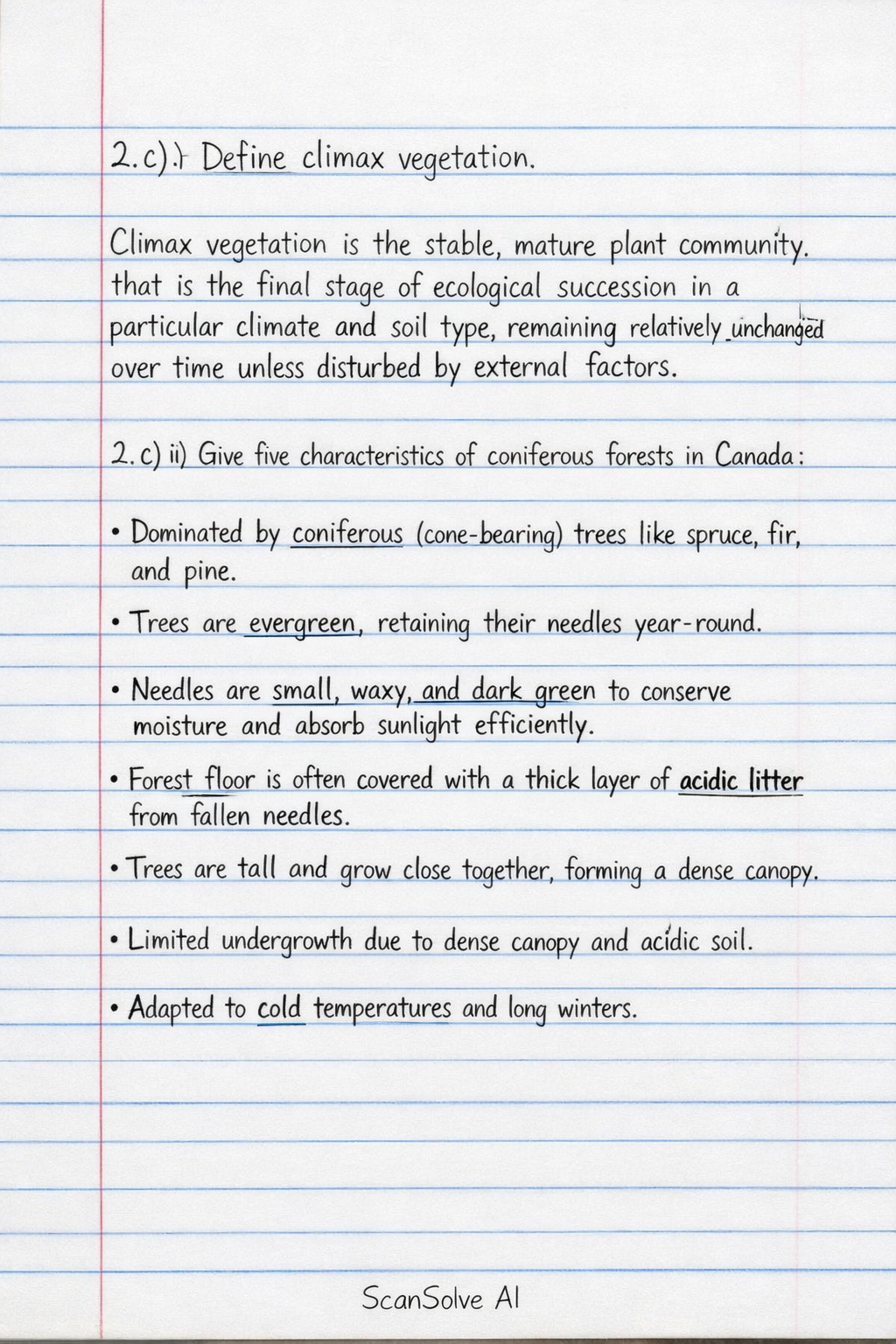
2. c) i) Define climax vegetation. Climax vegetation is the stable, mature plant community that is the final stage of ecological succession in a particular climate and soil type, remaining relatively unchanged over time unless disturbed by external factors. 2. c) ii) Give five characteristics of coniferous forests in Canada. Dominated by coniferous* (cone-bearing) trees like spruce, fir, and pine. Trees are evergreen*, retaining their needles year-round. Needles are small, waxy, and dark green* to conserve moisture and absorb sunlight efficiently. Forest floor is often covered with a thick layer of acidic litter* from fallen needles. Trees are tall and grow close together*, forming a dense canopy. Limited undergrowth* due to dense canopy and acidic soil. Adapted to cold temperatures and long winters*. 2. d) i) Give four significances of Savanna vegetation. Provides habitat and food* for a wide variety of wildlife, including large herbivores and carnivores. Supports pastoralism and livestock grazing*, which is crucial for many communities. Contributes to biodiversity* with its mix of grasses and scattered trees. Plays a role in the carbon cycle* through photosynthesis by its extensive grass cover. Source of medicinal plants* and other non-timber forest products. Attracts tourism* due to its iconic wildlife and landscapes. 2. d) ii) Name two main areas with equatorial rainforest. Amazon Basin* (South America) Congo Basin* (Central Africa) Southeast Asia* (e.g., Indonesia, Malaysia) 3. a) i) What is re-afforestation? Re-afforestation is the process of planting trees in areas that were previously forested but have been cleared or degraded, aiming to restore the forest ecosystem. 3. a) ii) Give four reasons why re-afforestation programs are being carried out (4 marks). To restore degraded land* and prevent soil erosion. To combat climate change* by absorbing carbon dioxide from the atmosphere. To conserve biodiversity* by providing habitats for wildlife. To provide timber and non-timber forest products* for economic benefits. To regulate water cycles* and protect water sources. To enhance aesthetic value* and provide recreational areas. 3. b) i) Name three softwood trees found in Kenya. Podo* (Podocarpus spp.) Cedar* (Juniperus procera) Cypress* (Cupressus lusitanica) Pine* (Pinus patula, Pinus radiata) 3. b) ii) Explain how the following factors influence growth of natural forests: a) Soil: Soil provides nutrients, water, and anchorage* for trees. Deep, fertile, well-drained soils with adequate organic matter support vigorous forest growth, while shallow, infertile, or waterlogged soils limit it. b) Rainfall: Rainfall is essential for tree hydration and nutrient transport*. Sufficient and well-distributed rainfall promotes lush forest growth, whereas prolonged droughts or excessive rainfall (leading to waterlogging) can hinder or prevent forest development. c) Human activities: Human activities such as deforestation, logging, agriculture, and urbanization directly destroy or degrade natural forests. Conversely, conservation efforts, afforestation, and sustainable forest management* can promote forest growth and regeneration. d) Altitude: Altitude influences temperature, rainfall, and atmospheric pressure. Higher altitudes generally have lower temperatures and often higher precipitation*, leading to distinct forest types (e.g., montane forests) adapted to these cooler, wetter conditions, while very high altitudes may be too harsh for tree growth.