
We read your photo as:
3 (a) (i) State THREE problems faced by natural vegetation across the world today. (ii) Outline THREE ways by which plants in hot deserts adapt to the climatic characteristics of the area.
Geography
ScanSolve AI Answer
This answer stops before the end.
It was cut off when it was first written. Ask ScanSolve this question again for the full working.
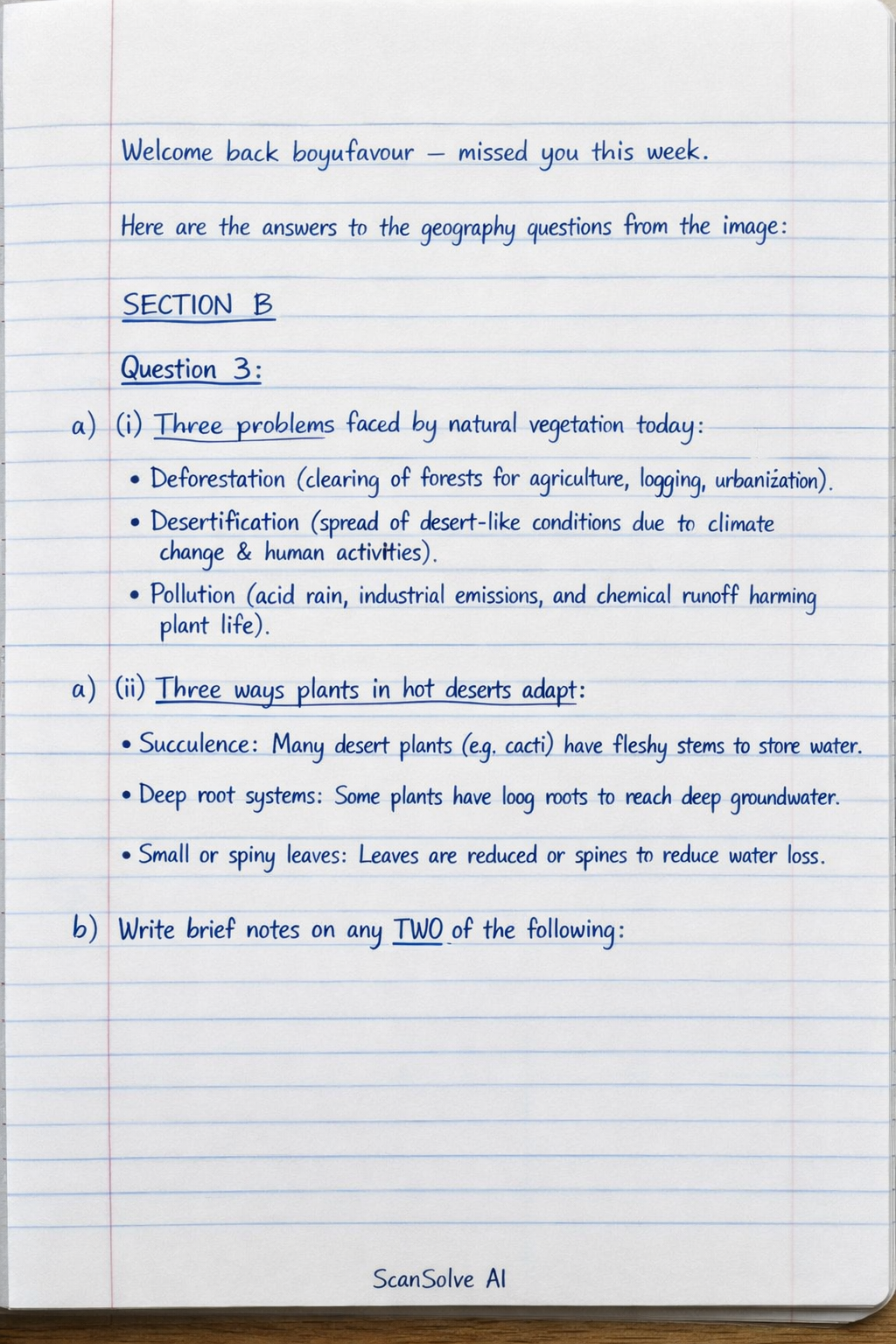
Here are the answers to the geography questions from the image:
SECTION B
Question 3:
- a) (i) State THREE problems faced by natural vegetation across the world today.
- Deforestation (clearing of forests for agriculture, logging, urbanization).
- Desertification (spread of desert-like conditions due to climate change and human activities).
- Pollution (acid rain, industrial emissions, and chemical runoff damaging plant life).
- a) (ii) Outline THREE ways by which plants in hot deserts adapt to the climatic characteristics of the area.
- Succulence: Many desert plants (e.g., cacti) have fleshy stems or leaves to store water, allowing them to survive long dry periods.
- Deep root systems: Some plants develop very long roots to reach deep groundwater sources.
- Small or spiny leaves: Leaves are often reduced in size, waxy, or modified into spines to minimize water loss through transpiration.
- b) Write brief notes on any TWO of the following:
- i) Orographic or relief rainfall (formation). Orographic rainfall occurs when moist air is forced to rise over a mountain barrier. As the air ascends, it cools, condenses, and forms clouds, leading to precipitation on the windward side of the mountain. The leeward side, in contrast, experiences a rain shadow effect, receiving little rainfall.
- ii) Weather (definition and factors). Weather is the state of the atmosphere at a specific place and time, described by variables such as temperature, precipitation, humidity, wind speed and direction, atmospheric pressure, and cloud cover. These factors interact to create the daily atmospheric conditions we experience.
- iii) Equatorial climate (characteristics and location). The equatorial climate is characterized by consistently high temperatures (around ), high humidity, and heavy convectional rainfall throughout the year, resulting in a very small annual temperature range. It is typically found between and North and South of the equator, for example, in the Amazon Basin and the Congo Basin.
- iv) Cold ocean current (Name, characteristics, effects). A cold ocean current, such as the Benguela Current off the coast of Southwest Africa, flows from polar regions towards the equator, bringing cold water. Its characteristics include lower water temperatures and often nutrient-rich waters due to upwelling. Its effects include lowering coastal air temperatures, creating fog, and contributing to arid conditions on adjacent landmasses (e.g., the Namib Desert).
- c) "Volcanic areas are very risky zones yet people still choose to live there." Suggest FOUR reasons for this.
- Fertile soils: Volcanic ash weathers to form extremely fertile soils, ideal for agriculture.
- Geothermal energy: Volcanic activity provides a source of geothermal energy, which can be harnessed for electricity and heating.
- Mineral deposits: Volcanic regions are often rich in valuable minerals, attracting mining activities.
- Tourism: The dramatic landscapes, hot springs, and unique ecosystems attract tourists, creating economic opportunities.
SECTION C
Question 4:
- a) On the world map provided, insert and name:
- i) TWO important fishing grounds in the Northern Hemisphere:
- Grand Banks (off Newfoundland, Canada)
- North Sea (between UK and Scandinavia)
- ii) TWO areas of high concentration of industries:
- Ruhr Valley (Germany)
- Northeastern USA (e.g., Great Lakes region)
- iii) TWO areas of low population density:
- Siberia (Russia)
- Sahara Desert (North Africa)
- iv) TWO shipping routes:
- Suez Canal (Egypt)
- Panama Canal (Panama)
- i) TWO important fishing grounds in the Northern Hemisphere:
- b) Using specific examples, distinguish between:
- i) Push and pull factors of migration.
- Push factors are negative conditions that compel people to leave their homes, such as war (e.g., conflict in Syria causing refugees to leave) or unemployment (e.g., lack of jobs in rural areas).
- Pull factors are attractive conditions that draw people to a new location, such as better job opportunities (e.g., economic prospects in major cities) or political stability (e.g., seeking asylum in a peaceful country).
- ii) Rural and urban settlements.
- Rural settlements are characterized by low population density, a predominance of primary economic activities like agriculture, and a close-knit community structure (e.g., a small farming village in Cameroon).
- Urban settlements have high population density, a focus on secondary and tertiary economic activities (manufacturing and services), diverse populations, and extensive infrastructure (e.g., the city of Douala).
- iii) Primary and Secondary industries.
- Primary industries involve the extraction of raw materials directly from the earth, such as farming, fishing, mining, and forestry.
- Secondary industries process these raw materials into finished or semi-finished goods, including manufacturing (e.g., car production) and construction.
- i) Push and pull factors of migration.
- c) (i) Briefly explain why in most Least Industrialised Countries (LICs) more people are engaged in agriculture yet their output is low. In LICs, a large proportion of the population is engaged in agriculture, often at a subsistence level. Output is low due to a lack of modern technology, limited access to capital for fertilizers and improved seeds, poor infrastructure for storage and transport, and vulnerability to natural disasters like droughts and floods.
- c) (ii) Describe THREE things these nations can do to emerge.
- Invest in education and healthcare: Improving human capital through better education and health services enhances productivity and innovation.
- Diversify the economy: Shifting focus from primary agriculture to manufacturing and services can create more jobs and higher value products.
- Improve infrastructure: Developing reliable transport networks, energy supply, and communication systems attracts investment and facilitates economic activity.
Question 5:
- a) (i) State the economic characteristics of stage 3 of Rostow's model of Economic Growth. Stage 3, the Take-off stage, is characterized by rapid growth in a limited number of leading manufacturing sectors, a significant increase in investment (often exceeding 10% of national income), and the development of modern social and political institutions that support industrialization.
- a) (ii) Use a table to classify the following countries into AICS, NICs and LICS: Britain, Nigeria, Cameroon, Japan, Hong Kong, Canada, South Africa, China.
- b) Distinguish between the following:
- i) Population density and population distribution.
- Population density is a numerical measure, representing the average number of people per unit area (e.g., people per square kilometer).
- Population distribution describes the spatial pattern of where people live across a given area, indicating whether they are clustered, dispersed, or linear.
- ii) Pastoral farming and Arable farming.
- Pastoral farming involves the rearing of livestock, such as cattle, sheep, or goats, for products like meat, milk, wool, or hides.
- Arable farming focuses on the cultivation of crops, such as wheat, maize, rice, or vegetables.
- iii) Light industry and heavy industry.
- Light industry typically produces small consumer goods, requires less capital, has lower environmental impact, and is often located near markets (e.g., electronics assembly, clothing manufacturing).
- Heavy industry produces large, bulky, and often capital-intensive products, usually with a significant environmental impact, and is often located near raw materials or major transport hubs (e.g., steel production, shipbuilding).
- i) Population density and population distribution.
- c) (i) Briefly explain TWO negative impacts of mining on the environment.
- Habitat destruction and deforestation: Mining operations often require clearing large areas of land, destroying natural habitats and leading to deforestation.
- Water pollution: Mining can release toxic chemicals, heavy metals, and acid mine drainage into rivers and groundwater, contaminating water sources.
Was this helpful?
Still stuck on this one?
Ask a follow-up, and the answer starts from this question.
Got a different question?Ask your own question
More Geography Questions
QState THREE problems faced by natural vegetation across the world today.QOutline TWO causes of each of the following environmental hazards common in MEDCs: i) Floods ii)…QDescribe landforms created by agents of denudation, give examples of grasslands and deserts, define…QQ1a(i) Name three groups of micro organisms. (ii) Give one example of each group. (iii) State four…QDefine the term environmental resource. Outline four advantages of vegetation to mankind. Identify…
Handwritten Step-by-Step Solution
Get this as a handwritten image on WhatsApp — like a tutor wrote it for you.
Try on WhatsApp