

This geography problem is solved step by step below, with detailed explanations to help you understand the method and arrive at the correct answer.
ScanSolve AI Answer
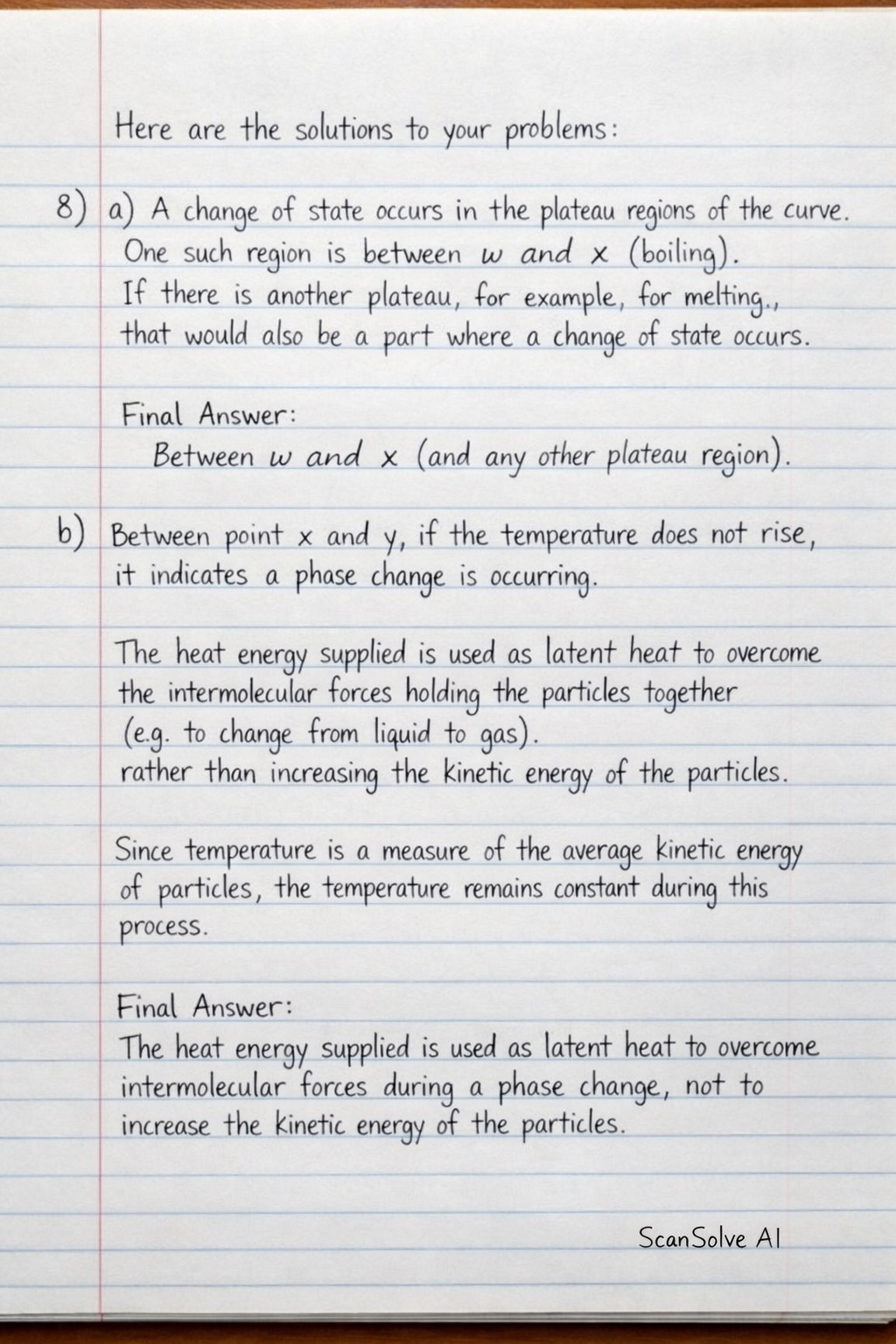
Here are the solutions to your problems: 8) a) A change of state occurs in the plateau regions of the curve. Based on the previous context, one such region is between w and x (boiling). If there is another plateau, for example, for melting, that would also be a part where a change of state occurs. The final answer is Between w and x (and any other plateau region). b) Between point x and y, if the temperature does not rise, it indicates a phase change is occurring. The heat energy supplied is used as latent heat to overcome the intermolecular forces holding the particles together (e.g., to change from liquid to gas), rather than increasing the kinetic energy of the particles. Since temperature is a measure of the average kinetic energy of particles, the temperature remains constant during this process. The final answer is The heat energy supplied is used as latent heat to overcome intermolecular forces during a phase change, not to increase the kinetic energy of the particles. 5) a) A: The particles are closely packed in a regular arrangement, indicating a solid*. B: The particles are close but randomly arranged and can move past each other, indicating a liquid*. The final answer is: A: Solid* B: Liquid* b) x: The process of changing from a solid (A) to a liquid (B) is melting*. y: The process of changing from a liquid (B) to a gas (C, implied by the widely spaced particles) is boiling* (or vaporization). The final answer is: x: Melting* y: Boiling* 9) To demonstrate diffusion in liquids, the learners would require: Water* Potassium permanganate* (or ink/food coloring) Beaker* (or a test tube/measuring cylinder)