
We read your photo as:
Constructing age sex population pyramid of developed and developing countries
ScanSolve AI Answer
Step-by-step solution
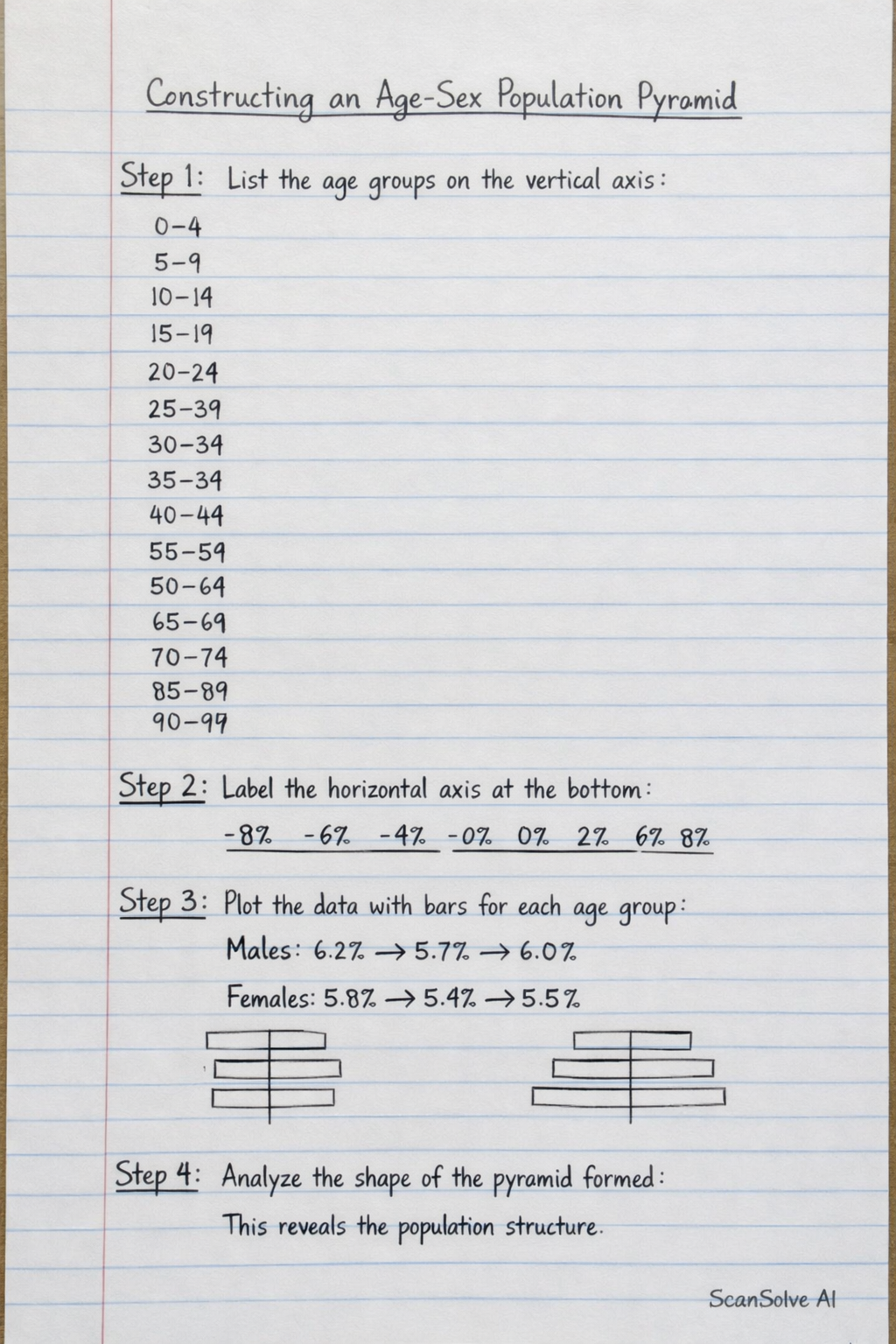
4 stepsThe image shows the setup for constructing an age-sex population pyramid, which is a graphical illustration that shows the distribution of various age groups in a population, which forms the shape of a pyramid when the population is growing.
Here's how to interpret and construct it:
The vertical axis on the left lists the age groups (e.g., 0-4, 5-9, up to 90-95).
These are typically 5-year intervals. The youngest age groups are at the bottom, and the oldest are at the top.
The horizontal axis at the bottom represents the percentage or number of the population.
The center line (0) separates males (usually on the left) from females (usually on the right). The numbers increase outwards from the center.
To construct the pyramid, you would plot horizontal bars for each age group, extending left for males and right for females, corresponding to their percentage or number in the total population.
The shape of the pyramid provides insights into a country's population structure.
- Developing countries often have a broad base (many young people) and a narrow top (fewer older people), indicating high birth rates and lower life expectancy.
- Developed countries tend to have a narrower base, a more rectangular middle, and a broader top, reflecting lower birth rates and higher life expectancy.
Still stuck on this one?
Ask a follow-up, and the answer starts from this question.
More Geography Questions
Handwritten Step-by-Step Solution
Get this as a handwritten image on WhatsApp — like a tutor wrote it for you.
Try on WhatsApp