
We read your photo as:
A) Calculate the shortest distance between A and B along their parallel of latitude, correct to 3 significant figures.
ScanSolve AI Answer
Answers
3 partsStep-by-step solution
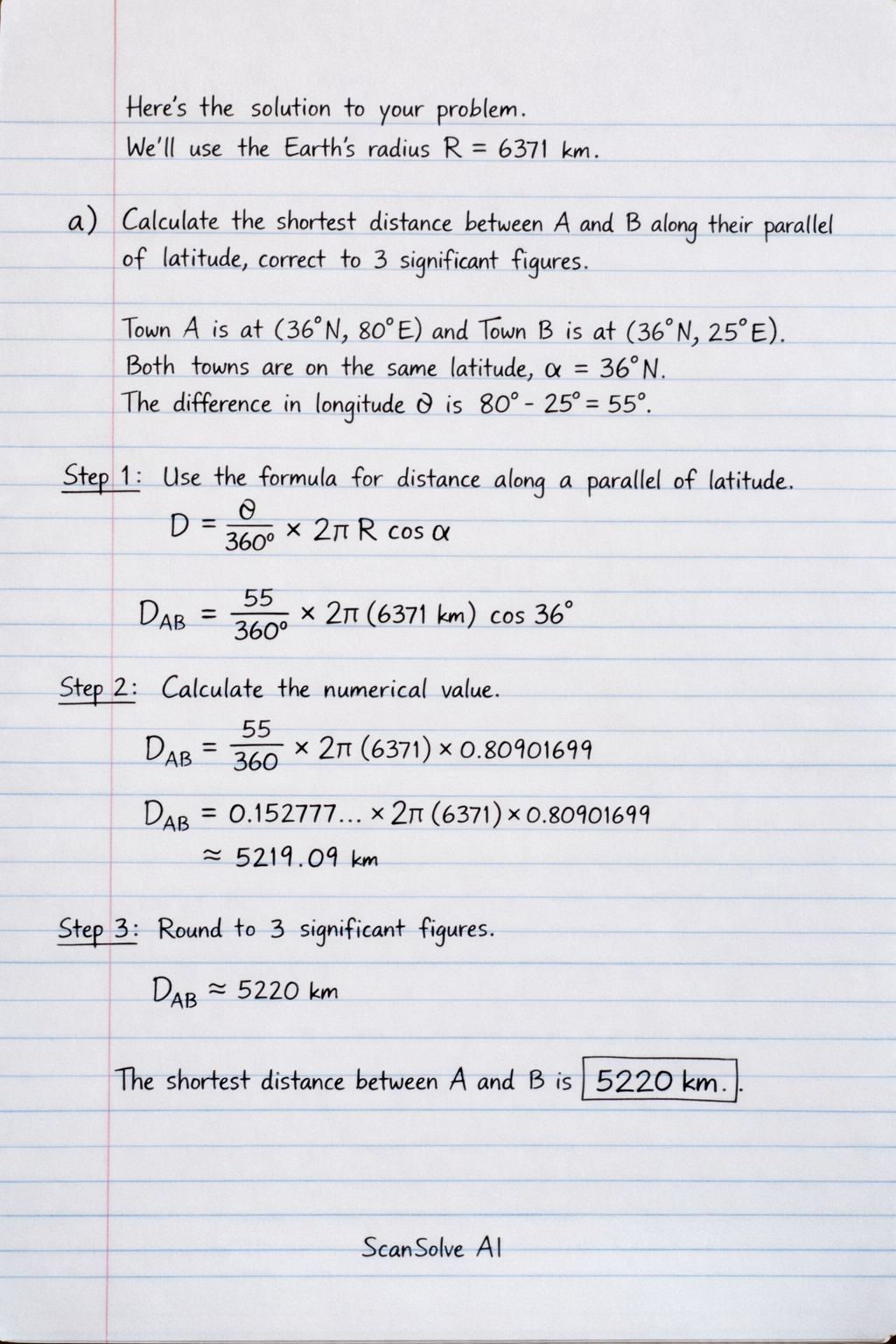
9 stepsHere's the solution to your problem. We'll use the Earth's radius km.
Part a· 3 steps
Calculate the shortest distance between A and B along their parallel of latitude, correct to 3 significant figures.
Town A is at and Town B is at .
Both towns are on the same latitude, .
The difference in longitude is .
Apply the formula for distance along a parallel of latitude.
The formula is .
Calculate the numerical value.
Round to 3 significant figures.
The shortest distance between A and B is .
Part b
What percentage of the equator is the parallel of latitude ? Correct to the nearest whole number.
Use the relationship between the circumference of a parallel of latitude and the equator.
The circumference of a parallel of latitude at angle is .
The circumference of the equator is .
The percentage is .
Here, .Calculate the percentage.
Round to the nearest whole number.
The parallel of latitude is approximately
\boxed{\text{81%}}of the equator.
Part c
P is a point due south of B. The distance along the great circle through B and P is 12,500 km. Calculate, correct to the nearest degree, the latitude of P.
Town B is at . Point P is due south of B, so its longitude is also .
The distance along a great circle (meridian) is , where is the difference in latitude.
Given km.
Calculate the difference in latitude .
Determine the latitude of P.
Since P is due south of B, its latitude will be .
A negative latitude indicates the Southern Hemisphere.
Round to the nearest degree.
So, the latitude of P is .
The latitude of P is .
Try one yourself
A new problem that tests the same skill.
Still stuck on this one?
Ask a follow-up, and the answer starts from this question.
More Geography Questions
Handwritten Step-by-Step Solution
Get this as a handwritten image on WhatsApp — like a tutor wrote it for you.
Try on WhatsApp