Costa number one a state the Dalton's law of passion pressure b example of a natural gas contains 6.80 moles of me 10 0.75 moles of E10 and 0.45 miles of propane in if the total pressure of the gas mixture is 2.20 ATM calculate depression pressure of each gas question c the temperature in the upper atmosphere is 250k Kelvin calculate the root mean Square in Bracket RMS speed of oxygen or two and healium H E molecules at this temperature d make the following conversions Roman figure 1 38 g to kilogram to 1 hour 15 minutes to seconds 3 100 cl to liters for 20 EV to joules five minus 273 °c Kelvin constant 4 derive the ideal gas equation PV is equals to NRT b briefly explain liquefaction of gases c list two methane methods of liquefying gas d give two examples of gases that are easily the confide and mention one common use of each. Answer on paper
|Geography
ScanSolve AI Answer
4 steps
Answer
m3
here are the solutions to the questions you've provided:
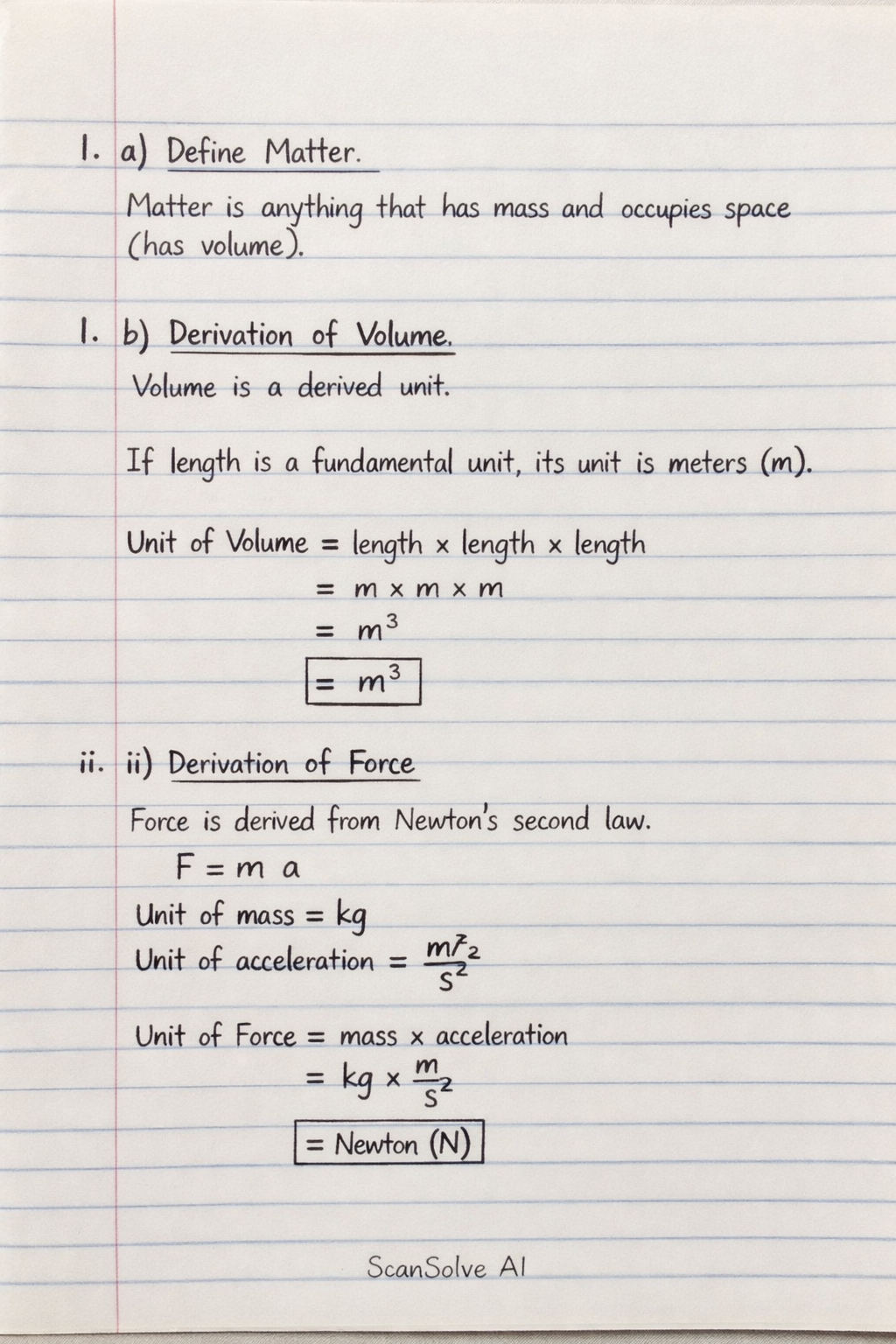
1. a) Define Matter
Matter is anything that has mass and occupies space (has volume).
1. b) Show simple derivations for the following units:
i) Volume
Volume is a derived unit. If length is a fundamental unit, its unit is, for example, meters (m).
The unit of volume is derived by multiplying length three times:
\text{Unit of Volume} = length \times length \times length = m \times m \times m = \text{m^3}
ii) Force
Force is a derived unit based on Newton's second law, which states that force equals mass times acceleration (F=ma).
The unit of mass is kilograms (kg).
The unit of acceleration is meters per second squared (m/s2).
The unit of force is derived by multiplying the unit of mass by the unit of acceleration:
Unit of Force=mass×acceleration=kg×m/s2=Newton (N)
1. c) Why does ice float on water even though both are the same substance?
Ice floats on water because it is less dense than liquid water. This occurs because, as water freezes, its molecules arrange into an open, crystalline structure due to hydrogen bonding, which causes the volume to increase and thus its density to decrease compared to liquid water at 0°C.
1. d) In a Tabular form, differentiate between the three states of matter based on the following:
| Property | Solid | Liquid | Gas |
| :--------------------------- | :---------------------------------- | :-------------------------------------- | :-------------------------------------- |
| i) Compressibility | Very low (almost incompressible) | Low | High |
| ii) Distance between particles | Very close, fixed positions | Close, but can move past each other | Very far apart |
| iii) Kinetic energy of particles | Low (vibrational motion) | Medium (translational, rotational, vibrational) | High (rapid, random translational motion) |
2. a) State Charles' law
Charles's Law states that for a fixed amount of gas at constant pressure, the volume of the gas is directly proportional to its absolute temperature. Mathematically, this can be expressed as V∝T or TV=constant.
2. b) Draw the graphical representation of Charles law
A graphical representation of Charles's Law shows a straight line passing through the origin when volume (V) is plotted against absolute temperature (T) at constant pressure. This indicates a direct proportionality between volume and absolute temperature.
2. c) A diver inhales air at the surface where the pressure is 1 atm and fills their lungs to a volume of 5.71 dm³. If the diver descends to a depth where the pressure is 4.2 atm, what will be the volume of the air in their lungs if no air escapes and the temperature remains constant?
Step 1: Identify the given values and the relevant gas law.
Given:
Initial pressure, P1=1 atm
Initial volume, V1=5.71dm3
Final pressure, P2=4.2 atm
Since the temperature and amount of gas are constant, Boyle's Law applies:
P1V1=P2V2
Step 2: Substitute the known values into Boyle's Law equation.
(1atm)(5.71dm3)=(4.2atm)V2
Step 3: Solve for the final volume, V2.
V2=4.2atm(1atm)(5.71dm3)V2=4.25.71dm3V2≈1.3595dm3
Step 4: Round the answer to an appropriate number of significant figures (3 significant figures).
V_2 = \text{1.36 dm^3}
2. d) Calculate the volume occupied by 0.0880 Kg of nitrogen gas (N₂) at a temperature of 325K and a pressure of 2.50 atm. Assume the gas behaves ideally.
Step 1: Convert the mass of nitrogen gas to grams and calculate the number of moles (n).
Given:
Mass of N₂ = 0.0880Kg=88.0 g
Molar mass of N₂ (M) = 2×14.01g/mol=28.02 g/moln=Mmass=28.02g/mol88.0g≈3.1406 mol
Step 2: Identify the given temperature, pressure, and the ideal gas constant.
Given:
Temperature, T=325 K
Pressure, P=2.50 atm
Ideal gas constant, R=0.0821L⋅atm/(mol⋅K)
Step 3: State the Ideal Gas Law equation.
PV=nRT
Step 4: Rearrange the equation to solve for volume (V) and substitute the values.
V=PnRTV=2.50atm(3.1406mol)(0.0821L⋅atm/(mol⋅K))(325K)
Step 5: Calculate the volume and round to an appropriate number of significant figures (3 significant figures).
V=2.50atm83.746L⋅atmV≈33.498 LV=33.5 L
3. a) State the Daltons law of partial pressure
Dalton's Law of Partial Pressures states that the total pressure exerted by a mixture of non-reacting gases is equal to the sum of the partial pressures of the individual gases. Mathematically, Ptotal=P1+P2+P3+…, where Pi is the partial pressure of each component gas.
3. b) A sample of natural gas contains 6.80 moles of methane, 0.75 moles of ethane and 0.45 moles of propane. If the total pressure of the gas mixture is 2.20 atm, calculate the partial pressure of each gas.
Step 1: Calculate the total number of moles (ntotal) in the gas mixture.
Given:
nmethane=6.80 molnethane=0.75 molnpropane=0.45 molntotal=6.80mol+0.75mol+0.45mol=8.00 mol
Step 2: Calculate the mole fraction (Xi) for each gas.
Xmethane=ntotalnmethane=8.00mol6.80mol=0.850Xethane=ntotalnethane=8.00mol0.75mol=0.09375Xpropane=ntotalnpropane=8.00mol0.45mol=0.05625
Step 3: Calculate the partial pressure (Pi) for each gas using the formula Pi=XiPtotal.
Given Ptotal=2.20 atm.
Pmethane=0.850×2.20atm=1.87 atmPethane=0.09375×2.20atm=0.20625 atmPpropane=0.05625×2.20atm=0.12375 atm
Step 4: Round the partial pressures to an appropriate number of significant figures (3 significant figures).
Pmethane=1.87 atmPethane=0.206 atmPpropane=0.124 atm
3. c) The temperature in the upper atmosphere is 250K. calculate the root-mean-square (rms) speeds of oxygen (O₂) and helium (He) molecules at this temperature.
Step 1: State the formula for root-mean-square speed and identify constants.
Given:
Temperature, T=250 K
Gas constant, R=8.314J/(mol⋅K)
The formula for root-mean-square speed is:
urms=M3RT
where M is the molar mass in kg/mol.
Step 2: Calculate urms for oxygen (O₂).
Molar mass of O₂ (MO2) = 32.00g/mol=0.03200 kg/molurms,O2=0.03200kg/mol3×(8.314J/(mol⋅K))×(250K)urms,O2=0.03200kg/mol6235.5J/molurms,O2=194859.375m2/s2urms,O2≈441.43 m/s
Step 3: Calculate urms for helium (He).
Molar mass of He (MHe) = 4.00g/mol=0.00400 kg/molurms,He=0.00400kg/mol3×(8.314J/(mol⋅K))×(250K)urms,He=0.00400kg/mol6235.5J/molurms,He=1558875m2/s2urms,He≈1248.55 m/s
Step 4: Round the answers to an appropriate number of significant figures (3 significant figures).
The root-mean-square speed of oxygen (O₂) is 441m/s.
The root-mean-square speed of helium (He) is 1250m/s.
3. d) Make the following conversions:
i) 38g to Kilogram38g×1000g1kg=0.038 kg
ii) 1h15mins to Seconds1h×1h3600s=3600 s15min×1min60s=900 s3600s+900s=4500 s
iii) 100 cl to Litres100cl×100cl1L=1 L
iv) 20 eV to Joules20eV×1eV1.602×10−19J=3.204×10⁻¹⁸J
v) -273 °C to KelvinK=°C+273.15K=−273+273.15=0.15 K
(If using the approximation K=°C+273, then K=−273+273=0 K)
4. a) Derive the ideal gas equation, PV = nRT
Step 1: Combine the empirical gas laws.
The ideal gas law is derived by combining three fundamental gas laws:
Boyle's Law:V∝P1 (at constant n,T)
Charles's Law:V∝T (at constant n,P)
Avogadro's Law:V∝n (at constant P,T)
Combining these proportionalities, we get:
V∝PnT
Step 2: Introduce the proportionality constant.
To convert this proportionality into an equation, a proportionality constant, R (the ideal gas constant), is introduced:
V=RPnT
Step 3: Rearrange the equation to its standard form.
Multiplying both sides by P gives the ideal gas equation:
PV=nRT
4. b) Briefly explain liquefaction of gases
Liquefaction of gases is the process of converting a gas into its liquid state. This is typically achieved by cooling the gas below its critical temperature and/or increasing its pressure above its critical pressure. The process involves reducing the kinetic energy of the gas molecules and bringing them close enough for intermolecular forces to become dominant, causing them to condense into a liquid.
4. c) List two methods of liquefying gases
Linde-Hampson cycle: This method utilizes the Joule-Thomson effect, where a gas cools upon expansion through a throttle valve. The cooled gas then pre-cools the incoming high-pressure gas in a counter-current heat exchanger, leading to a cumulative cooling effect and eventual liquefaction.
Claude cycle: This method combines the Joule-Thomson effect with external work done by an expander (like a turbine). The gas is cooled more efficiently by both the work done during expansion and the Joule-Thomson effect, making it suitable for large-scale gas liquefaction.
4. d) Give two (2) examples of gases that are easily liquefied and mention one common use of each
Propane (C₃H₈):
Common use: Fuel for heating, cooking, and vehicles (often as part of LPG - Liquefied Petroleum Gas).
Ammonia (NH₃):
Common use: Refrigerant in large industrial cooling systems due to its high latent heat of vaporization.
4. e) Briefly explain the following:
i) Enthalpy of Vaporization (ΔHvap):
The enthalpy of vaporization is the amount of energy (heat) required to transform a unit amount (e.g., one mole or one gram) of a substance from its liquid state to its gaseous state at a constant temperature and pressure, typically at its boiling point.
ii) Enthalpy of Sublimation (ΔHsub):
The enthalpy of sublimation is the amount of energy (heat) required to transform a unit amount of a substance directly from its solid state to its gaseous state without passing through the liquid phase, at a constant temperature and pressure.
iii) Enthalpy of Fusion (ΔHfus):
The enthalpy of fusion is the amount of energy (heat) required to transform a unit amount of a substance from its solid state to its liquid state at a constant temperature and pressure, typically at its melting point.
What's next?
Was this helpful?
Need help with your own homework?
Get instant step-by-step solutions to any question. Free to start.
here are the solutions to the questions you've provided: 1.
a) Define Matter Matter is anything that has mass and occupies space (has volume).
b) Show simple derivations for the following units: i) Volume Volume is a derived unit.
If length is a fundamental unit, its unit is, for example, meters (m).
Costa number one a state the Dalton's law of passion pressure b example of a natural gas contains 6.80 moles of me 10 0.75 moles of E10 and 0.45 miles of propane in if the total pressure of the gas mixture is 2.20 ATM calculate depression pressure of each gas question c the temperature in the upper atmosphere is 250k Kelvin calculate the root mean Square in Bracket RMS speed of oxygen or two and healium H E molecules at this temperature d make the following conversions Roman figure 1 38 g to kilogram to 1 hour 15 minutes to seconds 3 100 cl to liters for 20 EV to joules five minus 273 °c Kelvin constant 4 derive the ideal gas equation PV is equals to NRT b briefly explain liquefaction of gases c list two methane methods of liquefying gas d give two examples of gases that are easily the confide and mention one common use of each. Answer on paper
This geography problem is solved step by step below, with detailed explanations to help you understand the method and arrive at the correct answer.
ScanSolve AI Answer
here are the solutions to the questions you've provided: 1. a) Define Matter Matter is anything that has mass and occupies space (has volume). 1. b) Show simple derivations for the following units: i) Volume Volume is a derived unit. If length is a fundamental unit, its unit is, for example, meters (m). The unit of volume is derived by multiplying length three times: Unit of Volume = length × length × length = m × m × m = m^3 ii) Force Force is a derived unit based on Newton's second law, which states that force equals mass times acceleration (F = ma). The unit of mass is kilograms (kg). The unit of acceleration is meters per second squared (m/s^2). The unit of force is derived by multiplying the unit of mass by the unit of acceleration: Unit of Force = mass × acceleration = kg × m/s^2 = Newton (N) 1. c) Why does ice float on water even though both are the same substance? Ice floats on water because it is less dense than liquid water. This occurs because, as water freezes, its molecules arrange into an open, crystalline structure due to hydrogen bonding, which causes the volume to increase and thus its density to decrease compared to liquid water at 0°C. 1. d) In a Tabular form, differentiate between the three states of matter based on the following: | Property | Solid | Liquid | Gas | | :--------------------------- | :---------------------------------- | :-------------------------------------- | :-------------------------------------- | | i) Compressibility | Very low (almost incompressible) | Low | High | | ii) Distance between particles | Very close, fixed positions | Close, but can move past each other | Very far apart | | iii) Kinetic energy of particles | Low (vibrational motion) | Medium (translational, rotational, vibrational) | High (rapid, random translational motion) | 2. a) State Charles' law Charles's Law states that for a fixed amount of gas at constant pressure, the volume of the gas is directly proportional to its absolute temperature. Mathematically, this can be expressed as V T or (V)/(T) = constant. 2. b) Draw the graphical representation of Charles law A graphical representation of Charles's Law shows a straight line passing through the origin when volume (V) is plotted against absolute temperature (T) at constant pressure. This indicates a direct proportionality between volume and absolute temperature. 2. c) A diver inhales air at the surface where the pressure is 1 atm and fills their lungs to a volume of 5.71 dm³. If the diver descends to a depth where the pressure is 4.2 atm, what will be the volume of the air in their lungs if no air escapes and the temperature remains constant? Step 1: Identify the given values and the relevant gas law. Given: Initial pressure, P_1 = 1 atm Initial volume, V_1 = 5.71 dm^3 Final pressure, P_2 = 4.2 atm Since the temperature and amount of gas are constant, Boyle's Law applies: P_1V_1 = P_2V_2 Step 2: Substitute the known values into Boyle's Law equation. (1 atm)(5.71 dm^3) = (4.2 atm)V_2 Step 3: Solve for the final volume, V_2. V_2 = (1 atm)(5.71 dm^3)4.2 atm V_2 = (5.71)/(4.2) dm^3 V_2 ≈ 1.3595 dm^3 Step 4: Round the answer to an appropriate number of significant figures (3 significant figures). V_2 = 1.36 dm^3 2. d) Calculate the volume occupied by 0.0880 Kg of nitrogen gas (N₂) at a temperature of 325K and a pressure of 2.50 atm. Assume the gas behaves ideally. Step 1: Convert the mass of nitrogen gas to grams and calculate the number of moles (n). Given: Mass of N₂ = 0.0880 Kg = 88.0 g Molar mass of N₂ (M) = 2 × 14.01 g/mol = 28.02 g/mol n = massM = 88.0 g28.02 g/mol ≈ 3.1406 mol Step 2: Identify the given temperature, pressure, and the ideal gas constant. Given: Temperature, T = 325 K Pressure, P = 2.50 atm Ideal gas constant, R = 0.0821 L · atm / (mol · K) Step 3: State the Ideal Gas Law equation. PV = nRT Step 4: Rearrange the equation to solve for volume (V) and substitute the values. V = (nRT)/(P) V = (3.1406 mol)(0.0821 L · atm / (mol · K))(325 K)2.50 atm Step 5: Calculate the volume and round to an appropriate number of significant figures (3 significant figures). V = 83.746 L · atm2.50 atm V ≈ 33.498 L V = 33.5 L 3. a) State the Daltons law of partial pressure Dalton's Law of Partial Pressures states that the total pressure exerted by a mixture of non-reacting gases is equal to the sum of the partial pressures of the individual gases. Mathematically, P_total = P_1 + P_2 + P_3 + , where P_i is the partial pressure of each component gas. 3. b) A sample of natural gas contains 6.80 moles of methane, 0.75 moles of ethane and 0.45 moles of propane. If the total pressure of the gas mixture is 2.20 atm, calculate the partial pressure of each gas. Step 1: Calculate the total number of moles (n_total) in the gas mixture. Given: n_methane = 6.80 mol n_ethane = 0.75 mol n_propane = 0.45 mol n_total = 6.80 mol + 0.75 mol + 0.45 mol = 8.00 mol Step 2: Calculate the mole fraction (X_i) for each gas. X_methane = n_methanen_total = 6.80 mol8.00 mol = 0.850 X_ethane = n_ethanen_total = 0.75 mol8.00 mol = 0.09375 X_propane = n_propanen_total = 0.45 mol8.00 mol = 0.05625 Step 3: Calculate the partial pressure (P_i) for each gas using the formula P_i = X_i P_total. Given P_total = 2.20 atm. P_methane = 0.850 × 2.20 atm = 1.87 atm P_ethane = 0.09375 × 2.20 atm = 0.20625 atm P_propane = 0.05625 × 2.20 atm = 0.12375 atm Step 4: Round the partial pressures to an appropriate number of significant figures (3 significant figures). P_methane = 1.87 atm P_ethane = 0.206 atm P_propane = 0.124 atm 3. c) The temperature in the upper atmosphere is 250K. calculate the root-mean-square (rms) speeds of oxygen (O₂) and helium (He) molecules at this temperature. Step 1: State the formula for root-mean-square speed and identify constants. Given: Temperature, T = 250 K Gas constant, R = 8.314 J / (mol · K) The formula for root-mean-square speed is: u_rms = sqrt((3RT)/(M)) where M is the molar mass in kg/mol. Step 2: Calculate u_rms for oxygen (O₂). Molar mass of O₂ (M_O_2) = 32.00 g/mol = 0.03200 kg/mol u_rms, O_2 = sqrt(3 × (8.314 J) / (mol · K)) × (250 K)0.03200 kg/mol u_rms, O_2 = sqrt(6235.5 J/mol)0.03200 kg/mol u_rms, O_2 = sqrt(194859.375 m)^2/s^2 u_rms, O_2 ≈ 441.43 m/s Step 3: Calculate u_rms for helium (He). Molar mass of He (M_He) = 4.00 g/mol = 0.00400 kg/mol u_rms, He = sqrt(3 × (8.314 J) / (mol · K)) × (250 K)0.00400 kg/mol u_rms, He = sqrt(6235.5 J/mol)0.00400 kg/mol u_rms, He = sqrt(1558875 m)^2/s^2 u_rms, He ≈ 1248.55 m/s Step 4: Round the answers to an appropriate number of significant figures (3 significant figures). The root-mean-square speed of oxygen (O₂) is 441 m/s. The root-mean-square speed of helium (He) is 1250 m/s. 3. d) Make the following conversions: i) 38g to Kilogram 38 g × 1 kg1000 g = 0.038 kg ii) 1h15mins to Seconds 1 h × 3600 s1 h = 3600 s 15 min × 60 s1 min = 900 s 3600 s + 900 s = 4500 s iii) 100 cl to Litres 100 cl × 1 L100 cl = 1 L iv) 20 eV to Joules 20 eV × 1.602 × 10^-19 J1 eV = 3.204 × 10^-18 J v) -273 °C to Kelvin K = °C + 273.15 K = -273 + 273.15 = 0.15 K (If using the approximation K = °C + 273, then K = -273 + 273 = 0 K) 4. a) Derive the ideal gas equation, PV = nRT Step 1: Combine the empirical gas laws. The ideal gas law is derived by combining three fundamental gas laws: Boyle's Law: V (1)/(P) (at constant n, T) Charles's Law: V T (at constant n, P) Avogadro's Law: V n (at constant P, T) Combining these proportionalities, we get: V (nT)/(P) Step 2: Introduce the proportionality constant. To convert this proportionality into an equation, a proportionality constant, R (the ideal gas constant), is introduced: V = R (nT)/(P) Step 3: Rearrange the equation to its standard form. Multiplying both sides by P gives the ideal gas equation: PV = nRT 4. b) Briefly explain liquefaction of gases Liquefaction of gases is the process of converting a gas into its liquid state. This is typically achieved by cooling the gas below its critical temperature and/or increasing its pressure above its critical pressure. The process involves reducing the kinetic energy of the gas molecules and bringing them close enough for intermolecular forces to become dominant, causing them to condense into a liquid. 4. c) List two methods of liquefying gases 1. Linde-Hampson cycle: This method utilizes the Joule-Thomson effect, where a gas cools upon expansion through a throttle valve. The cooled gas then pre-cools the incoming high-pressure gas in a counter-current heat exchanger, leading to a cumulative cooling effect and eventual liquefaction. 2. Claude cycle: This method combines the Joule-Thomson effect with external work done by an expander (like a turbine). The gas is cooled more efficiently by both the work done during expansion and the Joule-Thomson effect, making it suitable for large-scale gas liquefaction. 4. d) Give two (2) examples of gases that are easily liquefied and mention one common use of each 1. Propane (C₃H₈): Common use: Fuel for heating, cooking, and vehicles (often as part of LPG - Liquefied Petroleum Gas). 2. Ammonia (NH₃): Common use: Refrigerant in large industrial cooling systems due to its high latent heat of vaporization. 4. e) Briefly explain the following: i) Enthalpy of Vaporization ( H_vap): The enthalpy of vaporization is the amount of energy (heat) required to transform a unit amount (e.g., one mole or one gram) of a substance from its liquid state to its gaseous state at a constant temperature and pressure, typically at its boiling point. ii) Enthalpy of Sublimation ( H_sub): The enthalpy of sublimation is the amount of energy (heat) required to transform a unit amount of a substance directly from its solid state to its gaseous state without passing through the liquid phase, at a constant temperature and pressure. iii) Enthalpy of Fusion ( H_fus): The enthalpy of fusion is the amount of energy (heat) required to transform a unit amount of a substance from its solid state to its liquid state at a constant temperature and pressure, typically at its melting point. What's next?