
We read your photo as:
A) Using your knowledge of geography help the members of your group understand how such an upland came into existence.
ScanSolve AI Answer
Here are the answers to your geography questions:
a) Using your knowledge of geography help the members of your group understand how such an upland came into existence.
The uplands in the South Western districts of Uganda (Kisoro, Kibale, Rukiga, Rubanda) are primarily formed due to geological processes associated with the Western Rift Valley. These processes include:
- Faulting and Block Uplifting: The region is part of a major rift system where the Earth's crust is being pulled apart. Tensional forces cause large sections of the crust to fracture along fault lines. Some blocks are then uplifted relative to others, forming horsts (block mountains) and elevated plateaus, which constitute the uplands.
- Volcanic Activity: The Western Rift Valley is also a zone of significant volcanic activity. Magma rises through cracks in the Earth's crust, leading to volcanic eruptions. Over time, repeated eruptions of lava and ash build up volcanic cones and extensive lava plateaus, contributing to the high-altitude landscape. The Virunga Mountains, for example, are a prominent volcanic range in this area.
- Erosion and Denudation: Once these uplifted blocks and volcanic structures are formed, they are continuously shaped by external forces. Agents like rivers, wind, and ice erode the softer rocks and transport sediments, leaving behind more resistant rock formations and carving out valleys, further defining the rugged upland topography.
b) Explain to the local community how they can improve their livelihood from subsistence to commercial and better life.
To transition from subsistence farming to a commercial and better life, the local community can adopt several strategies:
- Commercial Crop Cultivation: Identify and cultivate high-value cash crops that thrive in the upland climate, such as Irish potatoes, tea, coffee, pyrethrum, specific fruits, or vegetables. These crops have a higher market demand and fetch better prices than traditional subsistence crops.
- Improved Farming Techniques: Adopt modern agricultural practices like using improved seed varieties, applying appropriate fertilizers, implementing effective pest and disease control, and practicing terracing on slopes to prevent soil erosion and maximize land use.
- Value Addition and Processing: Instead of selling raw produce, encourage processing of agricultural products. For example, drying fruits, making jams, processing coffee beans, or packaging vegetables can significantly increase their market value and create additional income streams.
- Access to Markets and Cooperatives: Establish or join farmer cooperatives to collectively market produce, negotiate better prices, and reduce transport costs. Improve access to market information and develop better road infrastructure to connect farmers to larger markets.
- Diversification of Income Sources: Beyond crops, diversify into other income-generating activities like small-scale livestock farming (e.g., dairy goats, poultry), beekeeping, agro-tourism (leveraging the scenic landscape), or local craft production.
- Financial Literacy and Access to Credit: Educate community members on financial management, saving, and investment. Facilitate access to microfinance institutions or agricultural loans to enable them to invest in better equipment, seeds, or processing facilities.
- Education and Training: Provide training on modern farming techniques, business management skills, and market dynamics. This empowers farmers with the knowledge needed to make informed decisions and improve productivity.
- Sustainable Land Management: Implement sustainable practices such as crop rotation, agroforestry (integrating trees with crops), and organic farming to maintain soil fertility, protect the environment, and ensure long-term productivity for future generations.
Still stuck on this one?
Ask a follow-up, and the answer starts from this question.
More Geography Questions
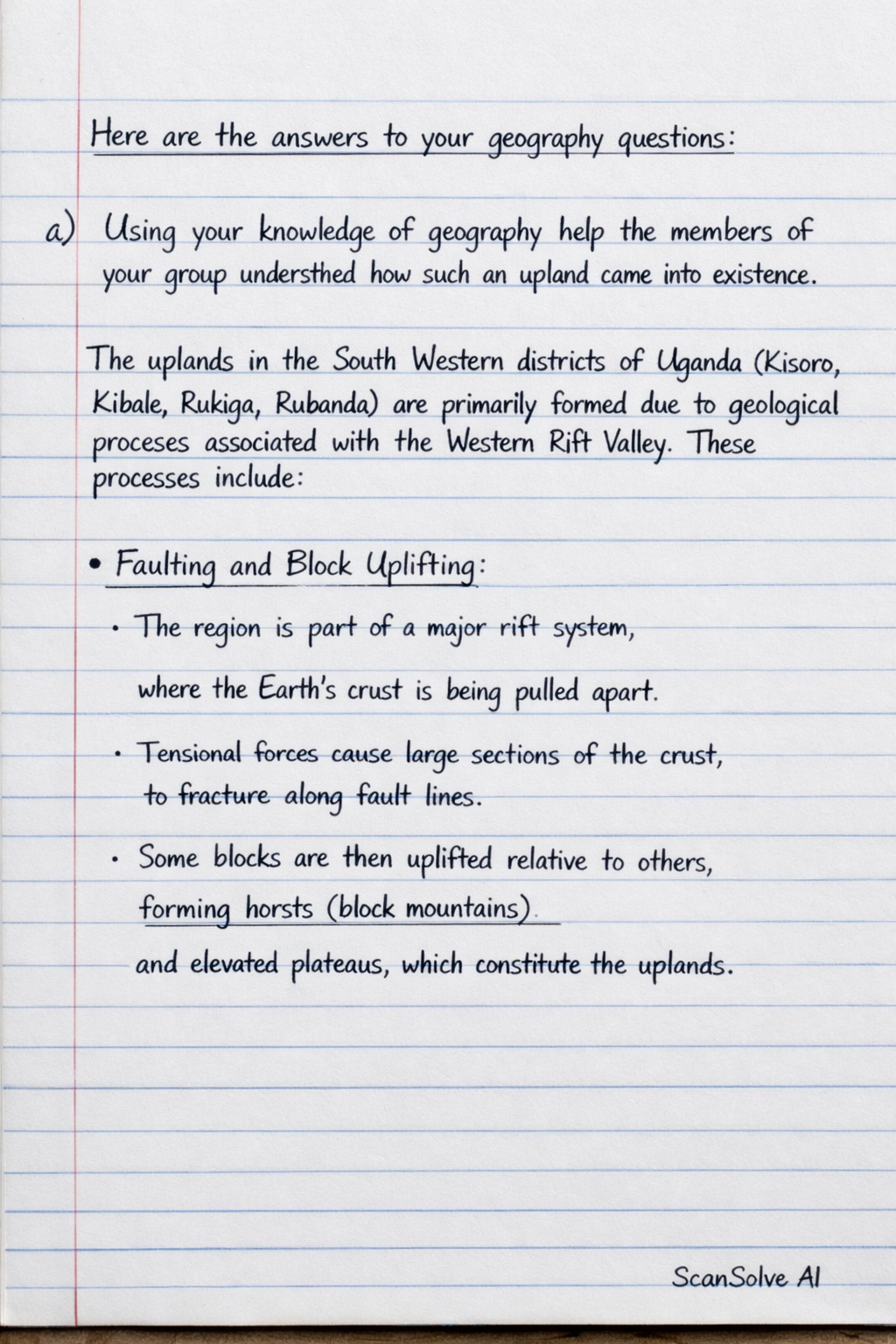
Handwritten Step-by-Step Solution
Get this as a handwritten image on WhatsApp — like a tutor wrote it for you.
Try on WhatsApp