
We read your photo as:
Find out the correct answers from the following statements: a) With reference to the Brahmaputra River, consider the following statements and select the correct answer using the code below. b) The concentration of tea gardens in the Upper Brahmaputra Valley of Assam is best explained by which of the following factors? Select the correct answer using the code below. c) Assertion (A): Urban population in Assam is significantly lower than rural population. Reason (R): Industrialization and urbanization in Assam are comparatively limited.
ScanSolve AI Answer
Answer
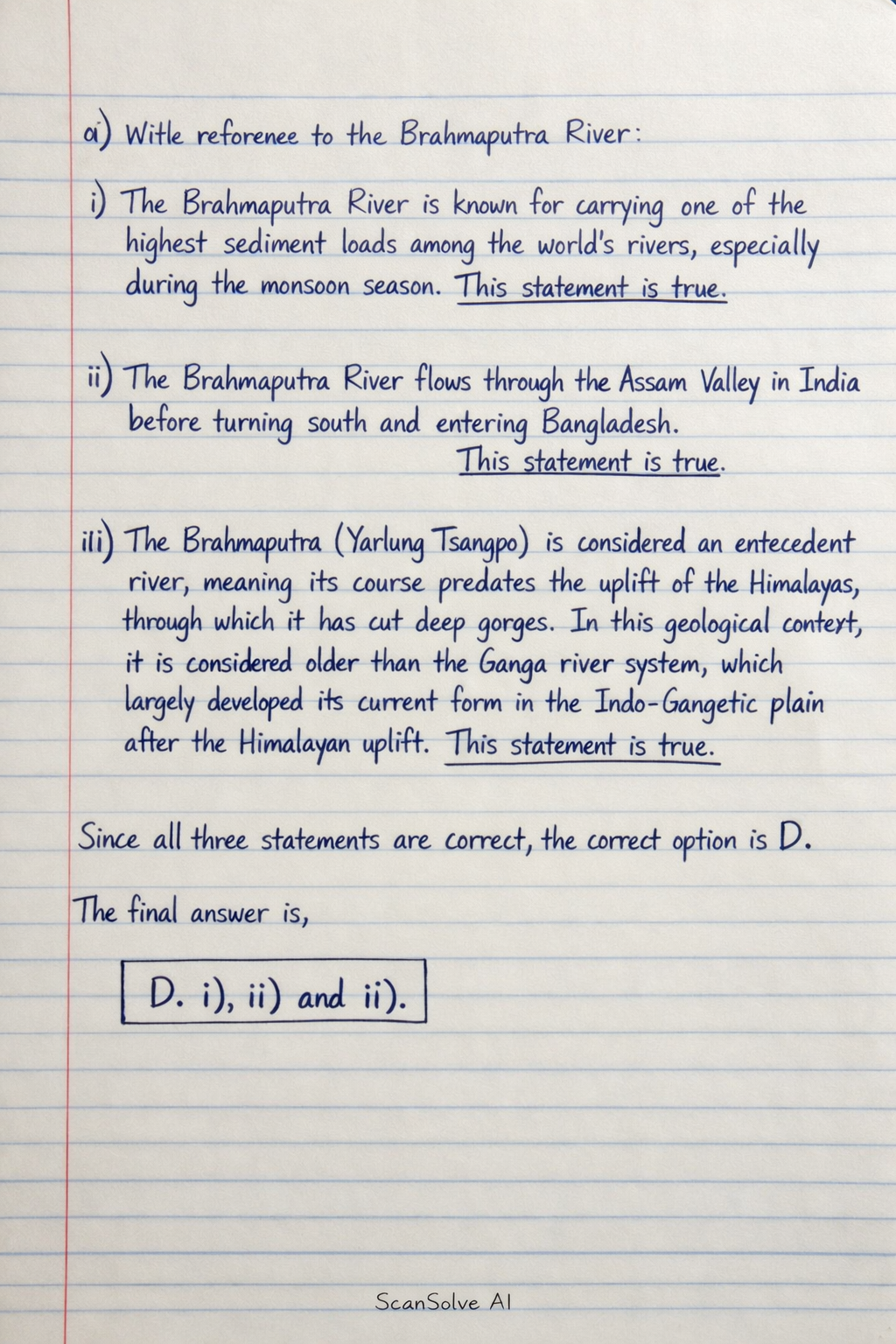
a) With reference to the Brahmaputra River:
i) The Brahmaputra River is known for carrying one of the highest sediment loads among the world's rivers, especially during the monsoon season. This statement is true.
ii) The Brahmaputra River flows through the Assam Valley in India before turning south and entering Bangladesh. This statement is true.
iii) The Brahmaputra (Yarlung Tsangpo) is considered an antecedent river, meaning its course predates the uplift of the Himalayas, through which it has cut deep gorges. In this geological context, it is considered older than the Ganga river system, which largely developed its current form in the Indo-Gangetic plain after the Himalayan uplift. This statement is true.
Since all three statements are correct, the correct option is D.
The final answer is
b) The concentration of tea gardens in the Upper Brahmaputra Valley of Assam is best explained by:
i) Tea plants require deep, well-drained, slightly acidic soils. The alluvial soils in the Upper Brahmaputra Valley, when well-drained, are suitable. This is a significant factor.
ii) Tea thrives in regions with high, well-distributed annual rainfall and a humid climate, which is characteristic of Assam. This is a crucial factor.
iii) Tea plants are sensitive to waterlogging. Gentle undulating topography ensures good drainage, preventing water accumulation. This is an important geographical factor.
iv) Tea cultivation is highly labor-intensive. The availability of labor, often at competitive rates, has historically been and continues to be a key economic factor for the concentration of tea gardens in the region.
All four factors contribute significantly to the concentration of tea gardens in the Upper Brahmaputra Valley.
The final answer is
c) Assertion (A): Urban population in Assam is significantly lower than rural population.
This assertion is true. Assam is predominantly a rural state, with a larger proportion of its population residing in rural areas compared to urban areas.
Reason (R): Industrialization and urbanization in Assam are comparatively limited.
This reason is also true. Assam's economy is largely agrarian, and the pace of industrialization and urbanization has been slower compared to many other states in India.
The limited industrialization and urbanization directly explain why the urban population in Assam is significantly lower than the rural population. Therefore, Reason (R) is the correct explanation for Assertion (A).
The final answer is
Try one yourself
A new problem that tests the same skill.
Still stuck on this one?
Ask a follow-up, and the answer starts from this question.
More Geography Questions
Handwritten Step-by-Step Solution
Get this as a handwritten image on WhatsApp — like a tutor wrote it for you.
Try on WhatsApp