
We read your photo as:
About the general trend in the intensity of solar energy received at the Earth's surface as latitude increases toward the poles.
ScanSolve AI Answer
Answer
Step-by-step solution
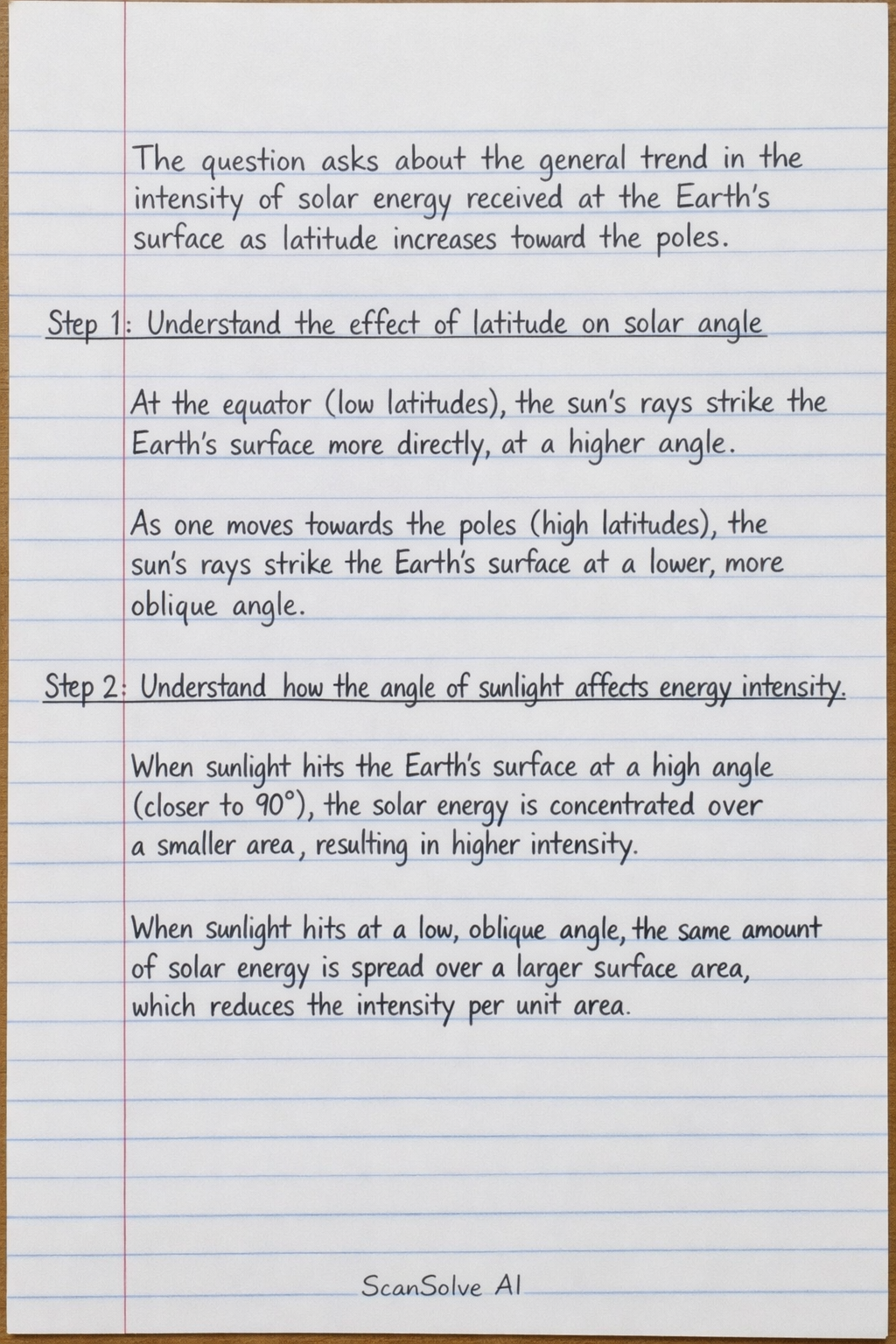
5 stepsThe question asks about the general trend in the intensity of solar energy received at the Earth's surface as latitude increases toward the poles.
Understand the effect of latitude on solar angle.
At the equator (low latitudes), the sun's rays strike the Earth's surface more directly, at a higher angle. As one moves towards the poles (high latitudes), the sun's rays strike the Earth's surface at a lower, more oblique angle.
Understand how the angle of sunlight affects energy intensity.
When sunlight hits the Earth's surface at a high angle (closer to 90 degrees), the solar energy is concentrated over a smaller area, resulting in higher intensity. When sunlight hits at a low, oblique angle, the same amount of solar energy is spread over a larger surface area, which reduces the intensity per unit area.
Consider atmospheric path length.
At higher latitudes, sunlight has to travel through a greater thickness of the atmosphere. This increased path length leads to more scattering and absorption of solar radiation by atmospheric gases and particles, further reducing the amount of energy that reaches the surface.
Conclude the general trend.
Combining these factors, as latitude increases from the equator towards the poles, the intensity of solar energy received at the Earth's surface generally decreases.
Select the correct option.
- a. It remains constant - Incorrect.
- b. It decreases - Correct.
- c. It is not affected by latitude - Incorrect.
- d. It increases - Incorrect.
The final answer is
Try one yourself
A new problem that tests the same skill.
Still stuck on this one?
Ask a follow-up, and the answer starts from this question.
More Geography Questions
Handwritten Step-by-Step Solution
Get this as a handwritten image on WhatsApp — like a tutor wrote it for you.
Try on WhatsApp