
We read your photo as:
Explain why north-facing slopes are warmer in the Southern Hemisphere and why houses in South Africa face north. Also, describe how land shape affects solar radiation and draw a diagram illustrating w
ScanSolve AI Answer
-
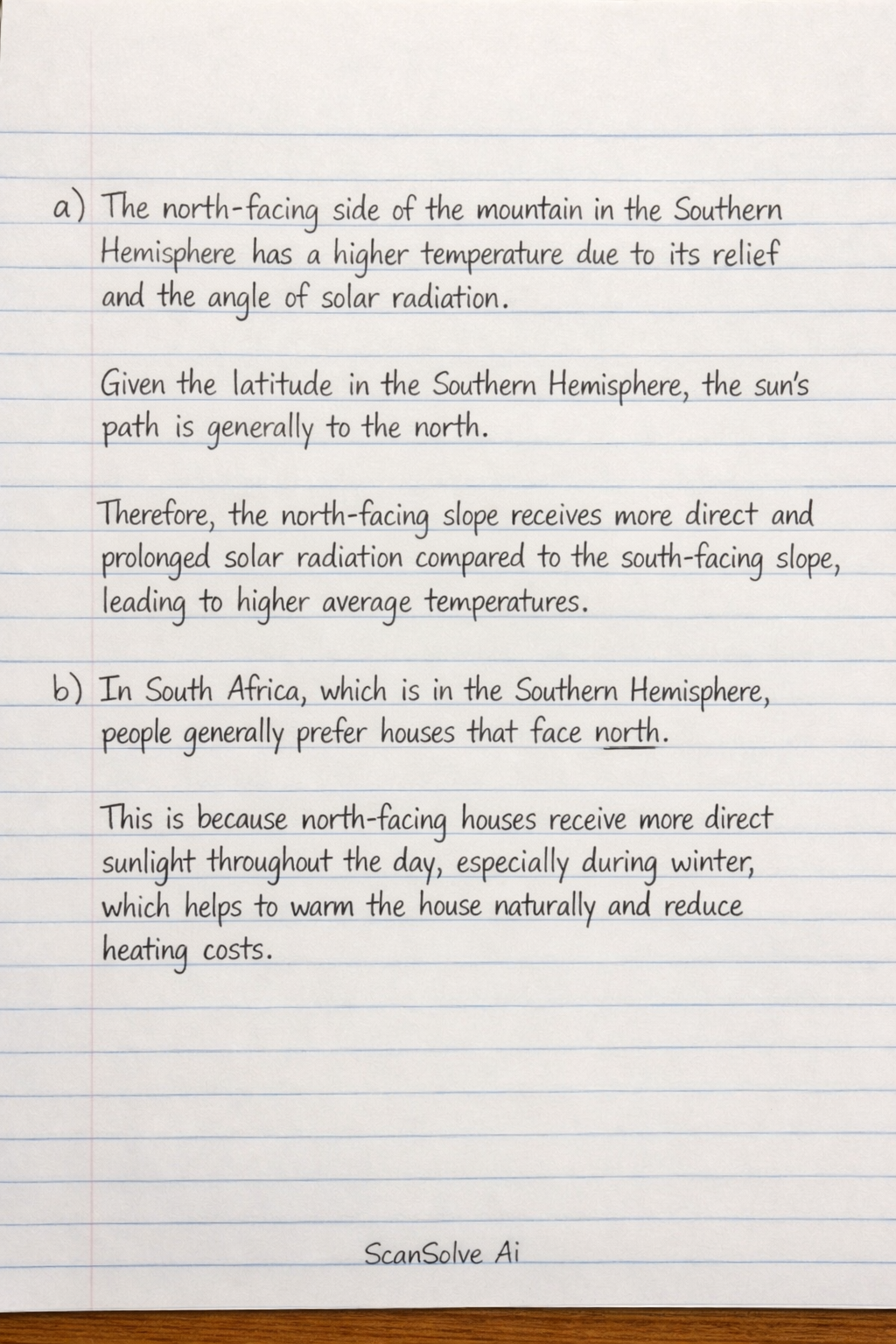
a) The north-facing side of the mountain in the Southern Hemisphere has a higher temperature due to its relief and the angle of solar radiation. Given the latitude in the Southern Hemisphere, the sun's path is generally to the north. Therefore, the north-facing slope receives more direct and prolonged solar radiation compared to the south-facing slope, leading to higher average temperatures.
b) In South Africa, which is in the Southern Hemisphere, people generally prefer houses that face north. This is because north-facing houses receive more direct sunlight throughout the day, especially during winter, which helps to warm the house naturally and reduce heating costs.
-
The shape of the land (relief) causes some places to receive more solar radiation than others because it dictates the angle at which the sun's rays strike the surface and the duration of exposure. Slopes that face the sun directly (e.g., north-facing in the Southern Hemisphere) receive more intense and longer periods of solar radiation. Conversely, slopes facing away from the sun or areas in deep valleys may be in shadow for extended periods, receiving less solar radiation.
-
a) Your drawing should illustrate a mountain range with air moving over it.
- On the windward side (the side facing the incoming moist air), you would show "moist air" rising, undergoing "cooling", and then "rain" falling. This side would be labeled with a higher rainfall amount, such as "500 mm".
- As the air passes over the mountain and descends on the leeward side, it would be labeled as "drier air". This side, known as the rain shadow area, would show significantly less rainfall, labeled with a lower amount like "200 mm".
b) Mountains significantly influence the amount of rainfall a place receives through a process called the orographic effect. As moist air is forced to rise over a mountain range, it cools and condenses, forming clouds and leading to heavy precipitation on the windward side. After passing over the peak, the now drier air descends on the opposite, leeward side. As this air descends, it warms and expands, reducing its relative humidity and preventing cloud formation. This creates a rain shadow area on the leeward side, which receives significantly less rainfall and is often characterized by arid conditions.
Still stuck on this one?
Ask a follow-up, and the answer starts from this question.
More Geography Questions
Handwritten Step-by-Step Solution
Get this as a handwritten image on WhatsApp — like a tutor wrote it for you.
Try on WhatsApp