
We read your photo as:
ACTIVITIES: POPULATION DISTRIBUTION AND DENSITY ACTIVITY 1 1.1 Give ONE word/term for each of the following descriptions by choosing a word/term from the list below. Write only the word/term next to the question number (1.1.1-1.1.8) in the ANSWER BOOK.
ScanSolve AI Answer
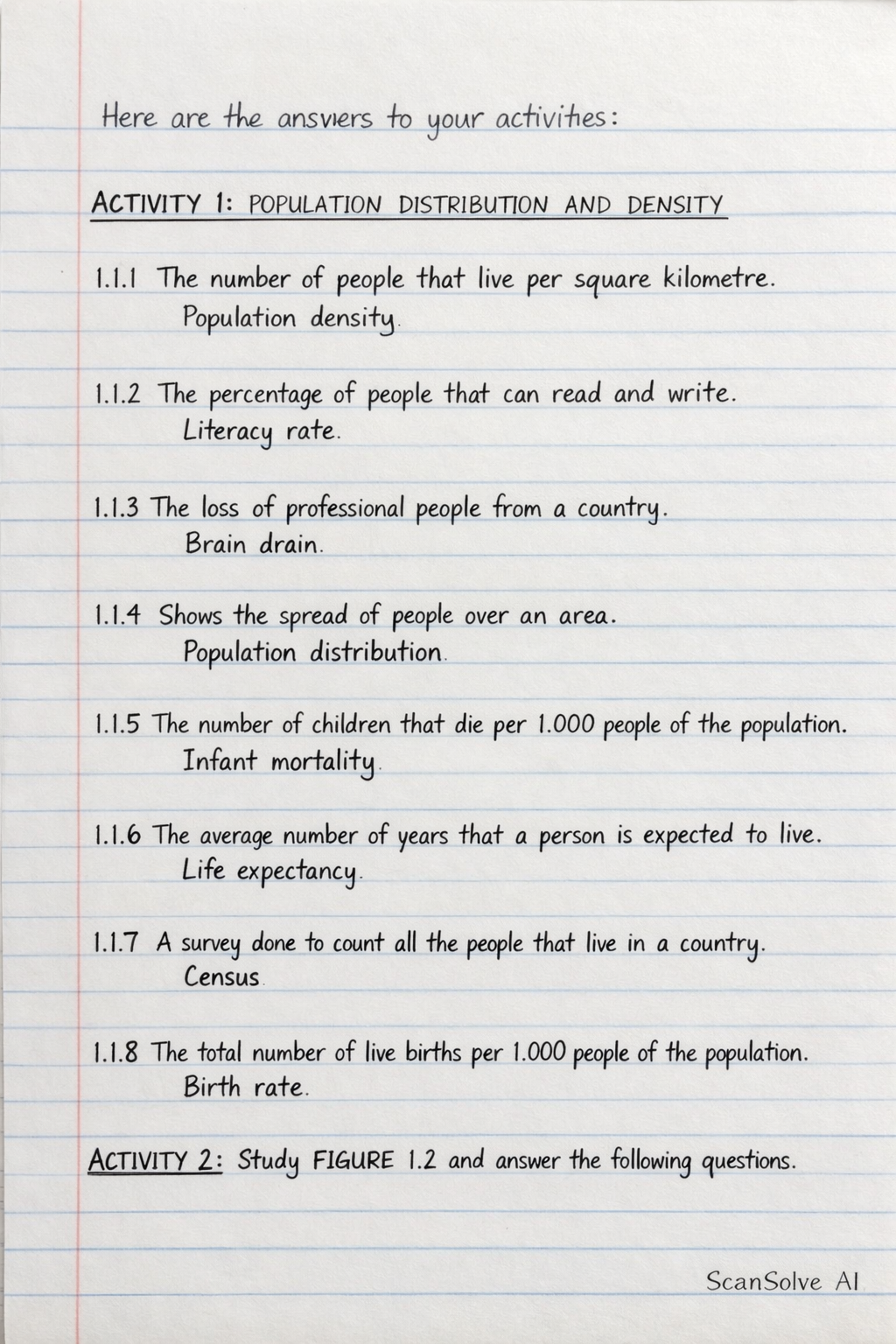
Here are the answers to your activities:
ACTIVITY 1: POPULATION DISTRIBUTION AND DENSITY
- 1.1.1 The number of people that live per square kilometre.
- Population density
- 1.1.2 The percentage of people that can read and write.
- Literacy rate
- 1.1.3 The loss of professional people from a country.
- Brain drain
- 1.1.4 Shows the spread of people over an area.
- Population distribution
- 1.1.5 The number of children that die per 1 000 people of the population.
- Infant mortality
- 1.1.6 The average number of years that a person is expected to live.
- Life expectancy
- 1.1.7 A survey done to count all the people that live in a country.
- Census
- 1.1.8 The total number of live births per 1 000 people of the population.
- Birth rate
ACTIVITY 2: Study FIGURE 1.2 and answer the following questions.
-
1.2.1 Developed countries typically have low birth rates, low death rates, high life expectancy, and high literacy rates due to advanced healthcare, education, and economic stability. Developing countries often show the opposite trends, with high birth rates, high death rates, low life expectancy, and lower literacy rates, often linked to limited resources and infrastructure.
-
1.2.2 The country from FIGURE 1.2 that can be seen as the most developed country is the USA.
-
1.2.3 The population of the USA, as shown in FIGURE 1.2, is approximately 300 million.
-
1.2.4 The two countries in FIGURE 1.2 with the largest population are China and India.
-
1.2.5 Two physical factors that contribute to high population density are:
- Fertile land: Areas with rich soil are suitable for agriculture, supporting large populations.
- Availability of fresh water: Access to rivers, lakes, or reliable rainfall is crucial for human settlement and economic activities.
Still stuck on this one?
Ask a follow-up, and the answer starts from this question.
More Geography Questions
Handwritten Step-by-Step Solution
Get this as a handwritten image on WhatsApp — like a tutor wrote it for you.
Try on WhatsApp