
We read your photo as:
An aeroplane flies from point P (30° N, 40° W) to point Q due east on the same latitude. The distance PQ is 4500 km. Find the longitude of Q.
ScanSolve AI Answer
Answer
Step-by-step solution
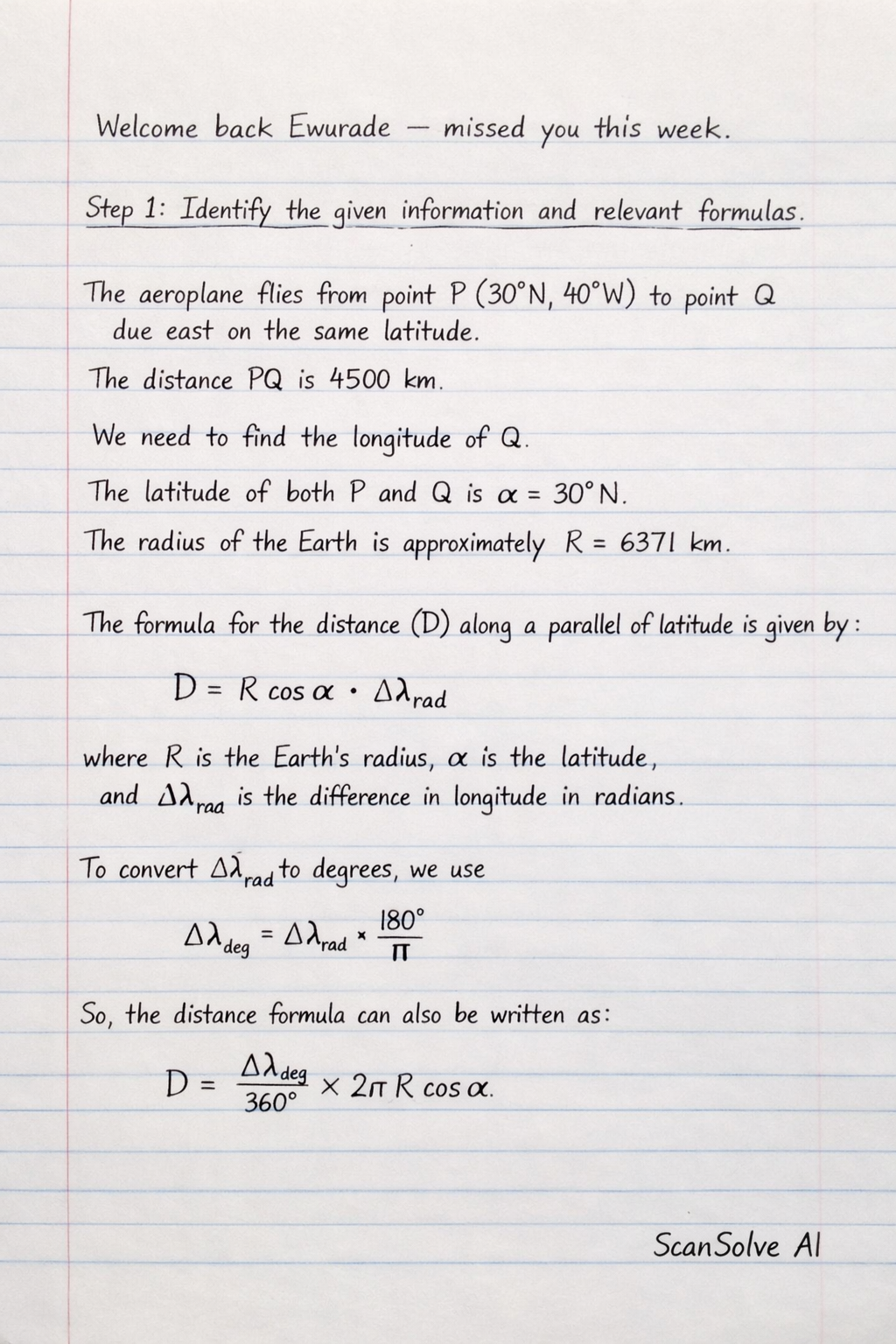
5 stepsIdentify the given information and relevant formulas.
The aeroplane flies from point P to point Q due east on the same latitude.
The distance PQ is .
We need to find the longitude of Q.
The latitude of both P and Q is .
The radius of the Earth is approximately .The formula for the distance () along a parallel of latitude is given by:
where is the Earth's radius, is the latitude, and is the difference in longitude in radians.
To convert to degrees, we use .
So, the distance formula can also be written as:Calculate the radius of the parallel of latitude ().
The radius of the parallel of latitude at is .
Calculate the difference in longitude ().
Using the distance formula :
Rearrange to solve for :
Determine the longitude of Q.
Point P is at . Since the aeroplane flies due east, the longitude increases (moves towards the east). We can represent west longitudes as negative values.
Longitude of Q = Longitude of P +
Longitude of Q =
Longitude of Q =Round the longitude of Q to the nearest degree.
Rounding to the nearest degree gives .
Try one yourself
A new problem that tests the same skill.
Still stuck on this one?
Ask a follow-up, and the answer starts from this question.
More Geography Questions
Handwritten Step-by-Step Solution
Get this as a handwritten image on WhatsApp — like a tutor wrote it for you.
Try on WhatsApp