
We read your photo as:
Analyze climate graphs to identify which station exhibits summer rain and a dry winter.
ScanSolve AI Answer
Answer
Step-by-step solution
5 stepsto determine which station has summer rain and a dry winter, we need to analyze each climate graph. "Summer" refers to the warmer months, and "winter" refers to the colder months, as indicated by the temperature curve. "Rain" refers to high precipitation, and "dry" refers to low precipitation.
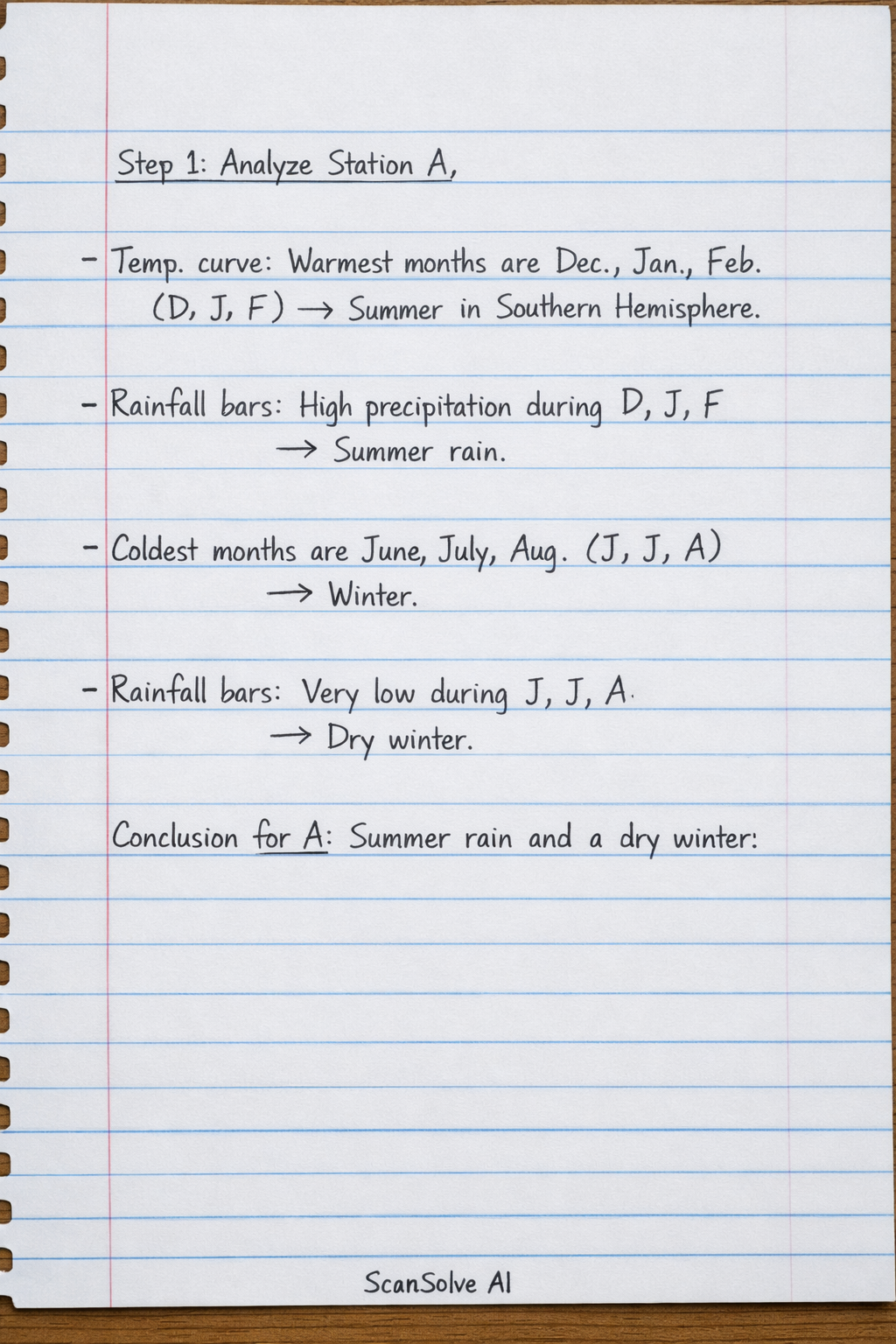
Analyze Station A.
- The temperature curve shows the warmest months are December, January, and February (D, J, F), indicating a Southern Hemisphere location. These are the summer months.
- The rainfall bars show high precipitation during these warm months (D, J, F), indicating summer rain.
- The coldest months are June, July, and August (J, J, A), indicating winter.
- The rainfall bars are very low during J, J, A, indicating a dry winter.
- Conclusion for A: Summer rain and a dry winter.
Analyze Station B.
- The temperature curve shows the warmest months are June, July, and August (J, J, A), indicating a Northern Hemisphere location. These are the summer months.
- The rainfall bars show high precipitation during these warm months (J, J, A), indicating summer rain.
- The coldest months are December, January, and February (D, J, F), indicating winter.
- The rainfall bars are low during D, J, F, indicating a dry winter.
- Conclusion for B: Summer rain and a dry winter.
Analyze Station C.
- The temperature curve shows the warmest months are June, July, and August (J, J, A), indicating a Northern Hemisphere location (summer).
- The rainfall bars are low during J, J, A (summer), indicating a dry summer.
- The rainfall bars are high during D, J, F (winter), indicating a wet winter.
- Conclusion for C: Dry summer and a wet winter (Mediterranean climate).
Analyze Station D.
- The temperature curve shows the warmest months are December, January, and February (D, J, F), indicating a Southern Hemisphere location (summer).
- The rainfall bars are low during D, J, F (summer), indicating a dry summer.
- The rainfall bars are high during J, J, A (winter), indicating a wet winter.
- Conclusion for D: Dry summer and a wet winter (Mediterranean climate).
Identify the best fit.
Both Station A and Station B fit the description of having summer rain and a dry winter. However, Station A shows a more pronounced dry winter with rainfall levels consistently near zero, and higher summer rainfall peaks compared to Station B. Therefore, Station A is the clearest example of this climate pattern.
The station that has summer rain and a dry winter is .
Try one yourself
A new problem that tests the same skill.
Still stuck on this one?
Ask a follow-up, and the answer starts from this question.
More Geography Questions
Handwritten Step-by-Step Solution
Get this as a handwritten image on WhatsApp — like a tutor wrote it for you.
Try on WhatsApp