
We read your photo as:
Answer questions 6a, 6b, 6c and 6d regarding wheat farming in Kenya and Canada.
ScanSolve AI Answer
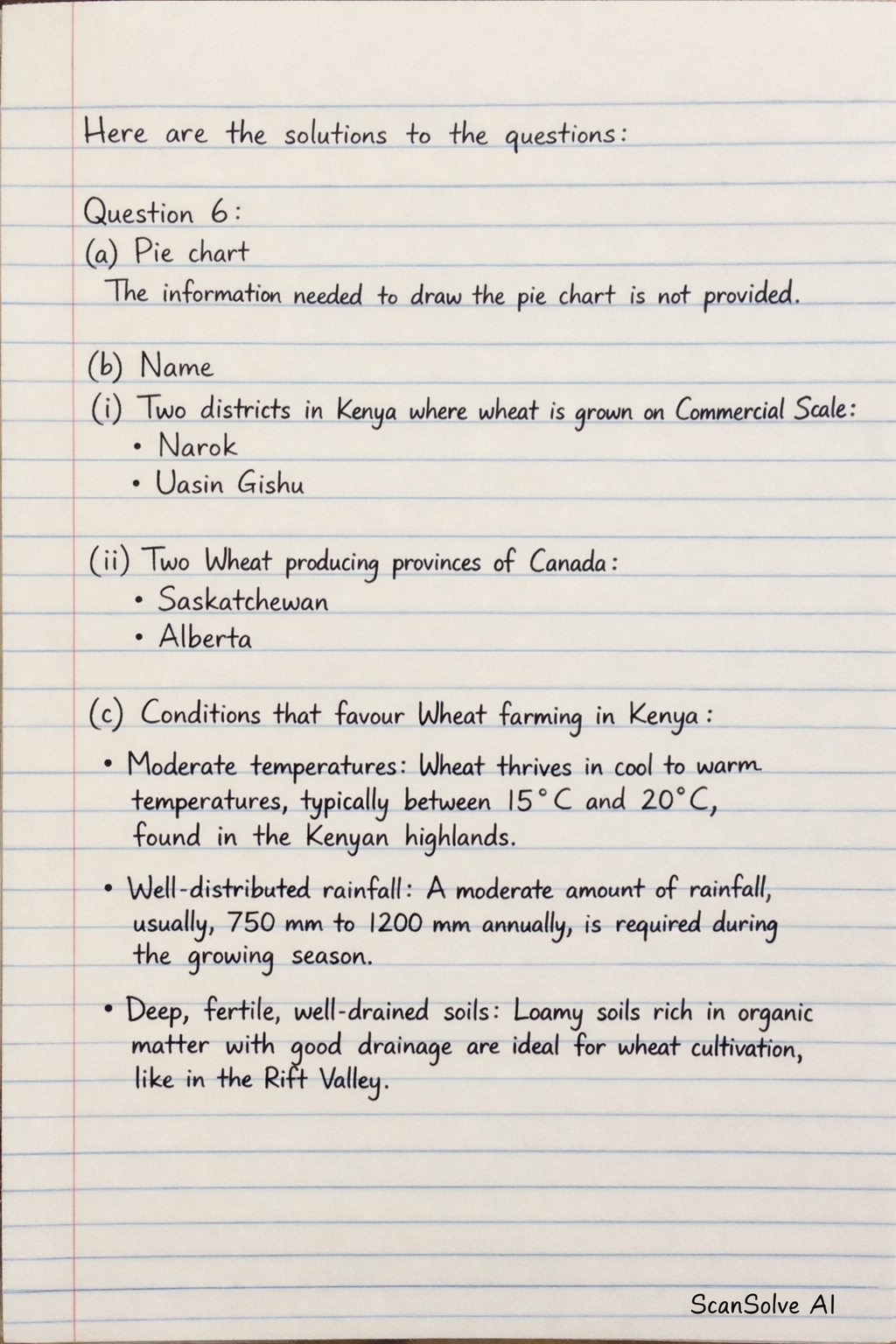
Here are the solutions to the questions:
Question 6:
a) Draw a Pie Chart to illustrate the information given above. (5mks)
The information required to draw the pie chart is not provided in the image.
b) Name
i) Two districts in Kenya where wheat is grown on Commercial Scale.
- Narok
- Uasin Gishu
ii) Two Wheat producing provinces of Canada.
- Saskatchewan
- Alberta
c) Explain three conditions that favour Wheat farming in Kenya.
- Moderate temperatures: Wheat thrives in cool to warm temperatures, typically between and , which are found in the Kenyan highlands.
- Well-distributed rainfall: A moderate amount of rainfall, usually to annually, is required during the growing season, which is characteristic of some highland areas.
- Deep, fertile, well-drained soils: Loamy soils rich in organic matter and with good drainage are ideal for wheat cultivation, found in areas like the Rift Valley.
d) Explain five factors which enable Canada to produce more Wheat than Kenya.
- Vast land area: Canada possesses extensive, flat plains (the Prairies) that allow for large-scale, highly mechanized wheat farming, unlike Kenya's more varied topography and smaller farm sizes.
- High level of mechanization: Canadian wheat farms utilize advanced machinery for planting, harvesting, and processing, leading to greater efficiency and output per farmer compared to Kenya.
- Advanced agricultural technology: Canada benefits from extensive research and development in improved wheat varieties, fertilizers, and pest control, resulting in higher yields per hectare.
- Favorable climate: The Canadian prairies experience long, sunny growing seasons with adequate moisture, which is highly conducive to wheat growth, despite cold winters.
- Developed infrastructure: Canada has well-established transportation networks (railways, roads) and storage facilities that efficiently move large quantities of wheat from farms to markets, reducing post-harvest losses.
Question 7:
a) i) Define the term deforestation.
Deforestation is the permanent removal of forests or tree cover from land, which is then converted to non-forest use such as agriculture, ranching, or urban development.
ii) State the causes of deforestation?
- Agricultural expansion
- Logging for timber and fuel wood
- Infrastructure development (roads, dams)
- Mining activities
b) Outline the stages involved in the extraction of timber from natural forests.
- Surveying and planning: Identifying suitable trees for felling, marking them, and planning access routes.
- Felling: Cutting down selected trees using chainsaws or mechanical felling machines.
- Delimbing and bucking: Removing branches from the felled trees and cutting the trunks into manageable log lengths.
- Skidding/Hauling: Transporting the logs from the felling site to a central loading area (landing) using tractors or cables.
- Loading and transportation: Loading the logs onto trucks or trains for transport to sawmills or processing plants.
c) Explain four characteristics of the tropical rain forest.
- High biodiversity: Tropical rainforests are home to an exceptionally large variety of plant and animal species, making them the most biodiverse terrestrial ecosystems.
- Dense, multi-layered canopy: The trees grow to varying heights, forming distinct layers that block most sunlight from reaching the forest floor, creating a dark and humid understory.
- High annual rainfall: These forests receive abundant rainfall, typically over annually, distributed throughout the year with no distinct dry season.
- High and constant temperatures: Temperatures remain consistently warm, usually between and , with little seasonal variation.
d) Describe the ecological uses of forests.
- Habitat for wildlife: Forests provide shelter, food, and breeding grounds for a vast array of plant and animal species, supporting biodiversity.
- Regulation of climate: Trees absorb carbon dioxide and release oxygen, playing a crucial role in regulating global climate and purifying the air.
- Soil conservation: Tree roots bind the soil, preventing erosion by wind and water, and maintaining soil fertility.
- Water cycle regulation: Forests influence rainfall patterns, reduce surface runoff, and facilitate groundwater recharge, contributing to water quality and availability.
- Air purification: Forests act as natural filters, trapping dust particles and absorbing pollutants from the atmosphere.
Question 8:
a) Name four ways in which minerals occur.
- In veins and lodes: Minerals are deposited in cracks, fissures, and faults within rocks.
- In beds and layers: Minerals are found as sedimentary deposits, often in horizontal strata.
- As alluvial deposits (placers): Minerals are concentrated by water action in riverbeds, beaches, or ancient stream channels.
- As disseminated deposits: Minerals are scattered throughout a large volume of rock rather than concentrated in veins.
- As residual deposits: Formed by the weathering and leaching of soluble components from parent rock, leaving behind insoluble mineral concentrations.
b) State the factors affecting exploitation of minerals.
- Size and quality of the deposit: The quantity and grade (concentration) of the mineral determine its economic viability.
- Accessibility: The ease with which the mineral deposit can be reached and extracted, considering terrain and infrastructure.
- Technology available: The existence of appropriate and cost-effective mining and processing technologies.
- Capital investment: The large financial resources required for exploration, extraction, processing, and infrastructure development.
- Market demand and price: The global demand for the mineral and its prevailing market price influence profitability.
- Government policies and regulations: Laws regarding mining rights, environmental protection, taxation, and labor.
- Environmental impact: The potential for ecological damage and the cost of mitigation measures.
c) i) Name one area where gold is mined in South Africa.
- Witwatersrand
ii) Describe methods of mining gold in South Africa.
- Deep-level underground mining: This is the predominant method due to the great depth of the gold-bearing reefs in the Witwatersrand basin. It involves sinking vertical shafts, then driving horizontal tunnels (drifts) to access the ore body. Blasting is used to break the rock, which is then hoisted to the surface for processing.
- Open-pit mining: For shallower gold deposits, large open pits are excavated. This method involves removing overburden (waste rock) to expose the ore, which is then extracted in benches.
d) i) What are the problems of mining in South Africa?
- Environmental degradation: Mining causes extensive land disturbance, habitat destruction, water pollution (e.g., acid mine drainage), and air pollution (dust and emissions).
- Health and safety risks: Miners face dangers from rockfalls, explosions, and exposure to dust, leading to respiratory diseases like silicosis and tuberculosis.
- Social issues: Mining can lead to displacement of communities, labor disputes, and the proliferation of illegal mining activities.
- Economic challenges: Fluctuations in global commodity prices, high operational costs, and increasing depth of mines can make operations less profitable, leading to job losses.
- Water scarcity: Mining operations are water-intensive in an already water-stressed country, leading to competition for resources.
ii) In what ways had gold contributed to the economic growth of South Africa?
- Foreign exchange earnings: Gold exports have historically been a major source of foreign currency, boosting the country's balance of payments.
- Employment creation: The gold mining industry has provided direct and indirect employment for millions of people, supporting livelihoods.
- Infrastructure development: Mining activities led to the development of extensive infrastructure, including roads, railways, power grids, and towns.
- Government revenue: Taxes and royalties from gold mining have provided significant revenue for government spending on public services and development projects.
- Industrial diversification: The gold industry stimulated the growth of related sectors such as engineering, manufacturing, and financial services.
Question 9:
a) i) Define the term Nomadic Pastoralism.
Nomadic pastoralism is a form of pastoralism where livestock are herded in search of fresh pastures and water, with the entire community or a significant part of it moving regularly from one place to another.
Still stuck on this one?
Ask a follow-up, and the answer starts from this question.
More Geography Questions
Handwritten Step-by-Step Solution
Get this as a handwritten image on WhatsApp — like a tutor wrote it for you.
Try on WhatsApp