
We read your photo as:
Answer the following geography questions: 23 (a) i, ii, iii; 24 (a), (b) i, ii; 25 (a).
ScanSolve AI Answer
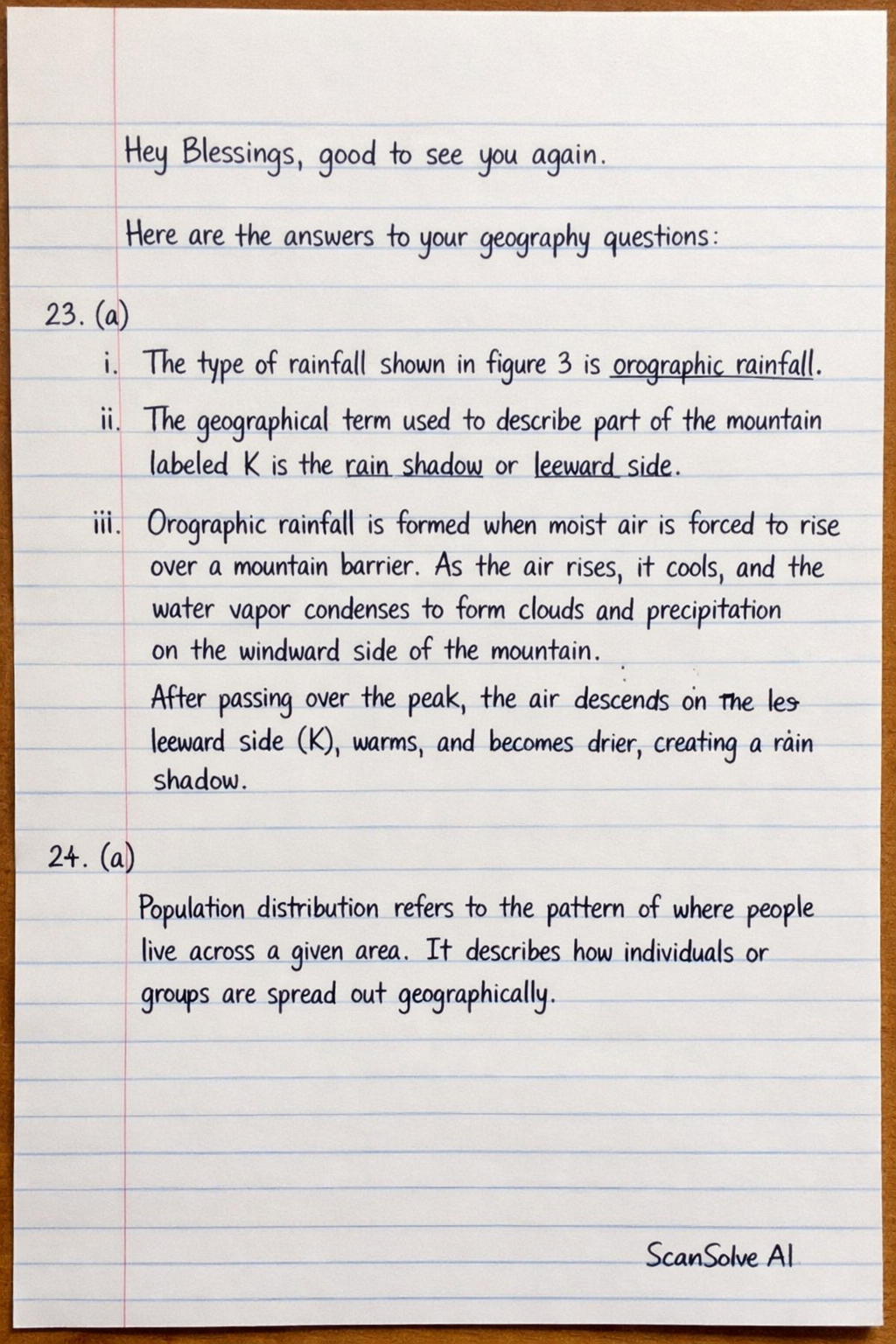
Here are the answers to your geography questions:
23. (a)
i. The type of rainfall shown in figure 3 is orographic rainfall.
ii. The geographical term used to describe part of the mountain labeled K is the rain shadow or leeward side.
iii. Orographic rainfall is formed when moist air is forced to rise over a mountain barrier. As the air rises, it cools, and the water vapor condenses to form clouds and precipitation on the windward side of the mountain. After passing over the peak, the air descends on the leeward side (K), warms, and becomes drier, creating a rain shadow.
24. (a)
Population distribution refers to the pattern of where people live across a given area. It describes how individuals or groups are spread out geographically.
24. (b)
i. Soil fertility: Areas with fertile soil are highly suitable for agriculture, which is a major economic activity in Malawi. This attracts a higher concentration of people to settle in these regions for farming, leading to a denser population distribution.
ii. Development of urban centres: Urban centers offer better employment opportunities, access to social services like education and healthcare, and improved infrastructure. This draws people from rural areas to cities, resulting in higher population densities in urban areas and a more dispersed population in rural regions.
25. (a)
Balance of trade is the difference between the total monetary value of a country's exports and its total monetary value of imports over a specific period.
25. (b)
Two factors that affect the balance of trade in Malawi are:
- Global commodity prices: Malawi's economy heavily relies on exporting agricultural commodities like tobacco and tea. Fluctuations in international prices for these goods directly impact the value of its exports. A drop in prices can lead to a trade deficit.
- Import demand: Malawi imports essential goods such as fuel, machinery, and manufactured products. High demand for these imports, coupled with their rising costs, can significantly increase the total value of imports, potentially leading to a trade deficit if export earnings do not keep pace.
25. (c)
Two countries which are Malawi's trade partners are:
- South Africa
- China
26.
Four factors that affect humidity are:
- Temperature: Warmer air has a greater capacity to hold water vapor than colder air. Therefore, higher temperatures generally lead to higher humidity levels if sufficient moisture is available for evaporation.
- Proximity to water bodies: Areas located near large bodies of water such as oceans, lakes, or rivers tend to have higher humidity because there is a constant source of water evaporating into the atmosphere.
- Vegetation: Dense vegetation, particularly forests, contributes significantly to atmospheric humidity through the process of transpiration, where plants release water vapor from their leaves into the air.
- Air masses: The origin and movement of air masses play a crucial role. Air masses that form over oceans or moist land regions will carry higher levels of humidity, while those originating over dry land or polar regions will typically have lower humidity.
Still stuck on this one?
Ask a follow-up, and the answer starts from this question.
More Geography Questions
Handwritten Step-by-Step Solution
Get this as a handwritten image on WhatsApp — like a tutor wrote it for you.
Try on WhatsApp